The load cell sensor is arguably the most important component in a force measurement or material testing system’s ability to provide accurate, precise and valid measurements. A sensor’s accuracy is often the primary characteristic that is used to specify a load cell sensor for a given application.
Mark-10 introduces their all-new G1105 Cork Extraction Fixture, designed for measuring the pull-out force of a cork stopper from a bottle. By measuring the extraction force, bottlers can ensure a satisfying customer experience, while maintaining the freshness of the contents.
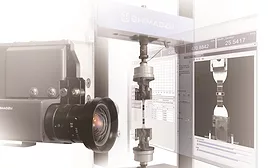
Tensile testing is arguably the most common test method used in both force measurement and material testing. Tensile testing is used primarily to determine the mechanical behavior of a component, part or material under static, axial loading.
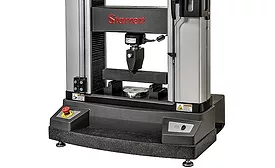
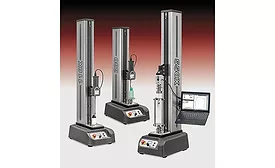
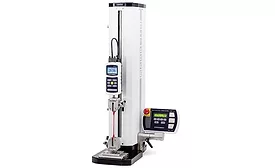
The L.S. Starrett Company has introduced a series of Motorized Digital Test Frames for performing a wide range of basic, high volume in-situ lean manufacturing force testing applications including tension, compression, flexural cyclic, shear and friction.
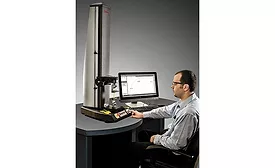
Computers and software play a major role in force measurement and quality control, but computers and application software come with a variety of on-going support requirements.
Regular tensile testing is important for checking rigid plastics through the entire manufacturing cycle, from the raw material to the forming process and ultimately the production part.
Force measurement, defined as the measurement of tensile or compressive loads acting upon an object, is an indispensable method of assessing and ensuring the quality of materials, components, and assemblies.