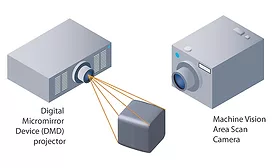
Real-world objects have depth, width and height, and automated systems such as robots need to “see” in these three dimensions if they are to operate successfully.
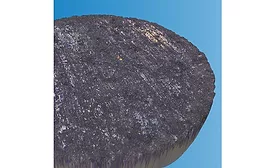
Combining benchtop mechanical testing of smaller brake material samples with rapid 3D surface metrology makes it possible to analyze results more quickly than ever before.
Researching how different materials influence brake pad performance and durability involves a vast amount of back-and-forth testing and metrology analysis.
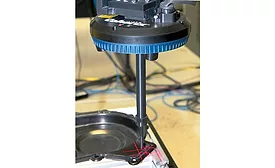
Bead dispensing is becoming a more and more common process for automotive manufacturing. In automotive body frame and chassis, aluminum is gaining popularity, as manufacturers seek to improve fuel efficiency without sacrificing vehicle integrity or performance.
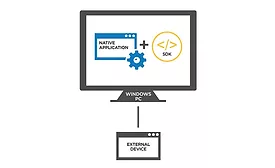
Many of today’s popular applications are designed to run natively on the Windows platform. Accessing and controlling external hardware devices with a Windows application is often achieved by using a driver provided by the hardware supplier and activating hardware functions using an SDK.
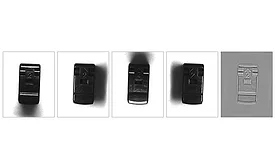
3D imaging brings more detailed analysis and insight to manufacturing and quality inspection processes where depth information can help verify proper assembly and detect surface defects.
AMETEK Creaform has introduced VXinspect, a 3-D inspection software that includes all the tools for first article inspection (FAI) and quality control.
AMETEK Creaform has introduced VXinspect, a powerful and intuitive 3-D inspection software that includes all of the tools for first article inspection (FAI) and quality control.
IN CONTRAST TO TRADITIONAL MACHINE VISION SYSTEMS THAT PROVIDE INFORMATION IN TWO DIMENSIONS, 3-D PROVIDES MORE INFORMATION ABOUT MANUFACTURING PROCESSES.
Manufacturing has made increasing use of traditional 2-D machine vision inspection, optical character recognition (OCR) and ID reading systems, which increase quality, improve throughput and reduce costs.
Offering a new 3-D Profiling capability to inspection measurement, Heidenhain’s versatile IK 5000 QUADRA-CHEK PC software system now gives operators the ability to quickly measure and determine parts profiles within desired tolerance zones.