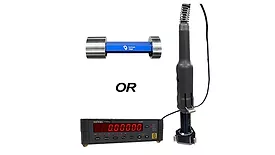
What should I be using to inspect an internal diameter (ID)? Should I use a Fixed Limit gage or some Variable gage? Is a Variable gage or a Fixed Limit gage more accurate? To answer these questions, we must begin with a few more clarifying questions.
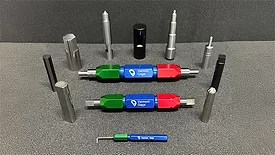
What is a custom gage? Is it a standard fixed limit gage made per ASME B47.1, or a modification of an existing design? Does the product require a new gage, a fixture, or a variable type gage? This article will explore modifications to existing plug gage designs and some special gage designs.
We are lucky in the metrology and gage manufacturing world to have access to standards maintained by ANSI, ASME, Mil, NIST, DIN, ISO, IEC and many more.
Understanding industry terminology is vital for success, especially for newcomers and seasoned professionals in new roles. This article explores how standards from organizations like ASME clarify key definitions in metrology and gage manufacturing, helping to prevent costly misunderstandings.
Generative AI Searches are transforming how professionals access technical data in fields like inspection and gages. While these tools deliver quick results, reliance on their outputs can lead to inaccuracies, as shown by discrepancies in thread specifications. Understanding the strengths and limitations of Generative AI is essential for ensuring the accuracy and relevance of information used in gage calibration and metrology.
Gage accuracy depends on product info. Thread form plating changes pitch diameter. Compensate for buildup to make correct pre-plate allowances. 60° UN threads change pitch diameter by 4x plating thickness.
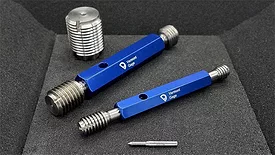
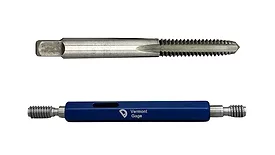
One of the more frequent questions we receive is: I am tapping a ¼-20 UNC 2B internal thread with an “H13” tap, what gage do I need to inspect the threaded holes in my parts after tapping?
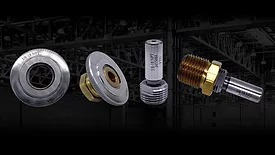
Taper Pipe Threads are one of the more challenging threads to produce and measure. The ASME B1.20.1-2013 Pipe Threads, General Purpose (Inch) is the current standard that covers both the part thread specifications and the gages for NPT, NPSC, NPTR, NPSM and NPSL threads.
Cylindrical ring gages have a number of inspection purposes. They are used as Go/No-Go gages to inspect the outside diameter of a shaft or rod. They are masters for dial bore gages, internal micrometers and coordinate measuring machines (CMMs).
Screw thread inserts (STI) require the threaded hole to be inspected prior to inserting the threaded insert or coil. The dimensions and tolerances for the gages used to inspect these threads have been a bit confusing over the past 30 years.
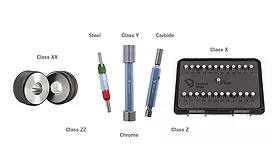
Selecting gages and other types of measuring tools can be challenging. It does not matter if you are an experienced or novice gage user, tool crib manager, lab manager or buyer.