Quality Magazine logo
search
cart
facebook twitter linkedin youtube
  • Sign In
  • Create Account
  • Sign Out
  • My Account
Quality Magazine logo
  • NEWS
  • PRODUCTS
    • FEATURED PRODUCTS
    • SUBMIT YOUR PRODUCT
  • CHANNELS
    • AUTOMATION
    • MANAGEMENT
    • MEASUREMENT
    • NDT
    • QUALITY 101
    • SOFTWARE
    • TEST & INSPECTION
    • VISION & SENSORS
  • MARKETS
    • AEROSPACE
    • AUTOMOTIVE
    • ENERGY
    • GREEN MANUFACTURING
    • MEDICAL
  • MEDIA
    • A WORD ON QUALITY PUZZLE
    • EBOOK
    • PODCASTS
    • VIDEOS
    • WEBINARS
  • EVENTS
    • EVENT CALENDAR
    • IMTS
  • DIRECTORIES
    • BUYERS GUIDE >
      • Supplier Insights
    • NDT SOURCEBOOK
    • VISION & SENSORS
    • TAKE A TOUR
  • INFOCENTERS
    • Digital Quality Management Systems
    • NEXT GENERATION SPC & QUALITY ANALYTICS
  • AWARDS
    • ROOKIE OF THE YEAR
    • PLANT OF THE YEAR
    • PROFESSIONAL OF THE YEAR
  • MORE
    • Expert Columns
    • NEWSLETTERS
    • QUALITY STORE
    • INDUSTRY LINKS
    • SPONSOR INSIGHTS
  • EMAG
    • eMAGAZINE
    • ARCHIVES
    • CONTACT
    • ADVERTISE
  • SIGN UP!
NDT

NDT | Neutron CT

Neutron Computed Tomography Offers Unique Inspection Capabilities

Unlike standard x-ray computed tomography, neutron CT offers unique capabilities for inspections that cannot be effectively performed using traditional methods.

By Gregory James Weaver
Vector illustration of Model of Abstract Atom Structure.

Image Source: Adisonpk / iStock / Getty Images Plus

May 16, 2024
✕
Image in modal.

Neutron computed tomography (nCT) is a nondestructive testing (NDT) method. The method involves penetrating an object with neutron radiation and capturing multiple cross-sectional images of the object from hundreds to thousands of angles as it is rotated a full 360 degrees. The images are then reconstructed using specialized software(s) to generate a three-dimensional representation of the internal structure of the object.

Many similarities exist between nCT and X-ray computed tomography (xCT). Both methods are used for imaging the internal structure of objects and both provide a 3D perspective of the entire part, however, they differ in the type of radiation used to penetrate the object. With nCT, instead of using X-rays, neutrons are employed as a type of penetrating radiation. Neutrons, like X-rays, pass through the object being examined and are absorbed to varying degrees based on the material properties of the object. The radiation that passes through the object is collected by a digital detector.

While nCT is beginning to gain commercial acceptance and increased usage, standard 2D neutron radiography (N-ray) has been around for nearly 100 years. It is used across many industries and is specified as required for many critical applications. Why use neutrons instead of X-rays? Both methods provide an image of the internals of a part, however, X-rays and neutrons interact quite differently within the atomic structure. This atomic interaction is straightforward, but a little refresher on an atom structure will help in understanding it.

An atom consists of a nucleus, composed of protons and neutrons, which are surrounded by a cloud of electrons. The electrons are distributed in energy levels or shells, and they orbit around the nucleus.

Figure 1 is an illustration of a diagram of an atom structure.
Figure 1 – Atom Structure. Image Source: Freepik

With this structure in mind, the main difference between neutrons and X-rays is that when X-rays are aimed at components, they interact with electrons. Neutrons on the other hand, interact with components’ nucleus. Figure 2 shows this quite well and this interaction makes for a dramatic difference in the absorption of energy. This is critical to the resulting images between standard X-ray radiography and neutron radiography, and of course the CT application of both methods as well.

Figure 2 is an illustration of X-ray and Neutron Interactions with the Atom
Figure 2 – X-ray and Neutron Interactions with the Atom. Image Source: Phoenix Imaging

These atomic level differences are the answer to the “why” question, but what does this mean for NDT? Again, for most applications the simple answer is absorption and/or penetration. Most materials will absorb X-rays and neutrons very differently. As an example, lead is used by nearly all X-ray system manufacturers as an X-ray absorber. They use lead to shield these systems for safety, because the correct amount of lead can effectively absorb all the X-rays the system can produce. Lead has a high atomic number and density, which means it has a large number of electrons and these items make it ideal for absorbing X-rays. On the other hand, when lead is imaged with neutrons, some smaller degree of the neutrons gets absorbed by the nucleus of the lead, but the vast majority pass through the material easily. As another example, many rubbers and plastics absorb few X-rays, but many of the elements in the materials absorb a good number of neutrons. As the examples suggest, different materials can be imaged with both X-rays and neutrons, and the results will be dramatically different.

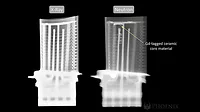
This difference in absorption also allows for another unique aspect of nCT, which is something called “tagging.” Tagging is a process where objects can be inundated under a vacuum in a liquid solution that contains a neutron absorbing element called Gadolinium (Gd). Gd absorbs a vast number of neutrons. If during the tagging process, the Gd is absorbed by a secondary material, then that material will have a dramatic contrast difference on the neutron radiograph or nCT data file. Figure 3 is an image of two turbine blades. Figure 3A has no residual ceramic core and Figure 3B has residual core that has absorbed the Gd and is easily identifiable.

Figures 3A and 3B – Gadolinium tagged turbine blades with and without residual core material
Figures 3A and 3B – Gadolinium tagged turbine blades with and without residual core material Image Source: Phoenix Imaging

Although there is similarity to xCT, the usage of each method is dramatically different. Unlike xCT, which has been active for over 50 years and has now become a common tool for quality control and inspection processes, nCT is a relatively newer method having been in existence for only about 20 years. Its adoption has been slower compared to xCT, primarily due to several factors including limited commercial availability, technological challenges, and higher costs associated with neutron sources.

Despite these challenges, nCT has been gaining traction in multiple industries. This is especially true in the research sector where it has been applied for many scientific studies and experiments. In addition, in the last few years, there has been a growing interest in transitioning nCT from research settings to production environments. This is driven by its unique potential for providing valuable insights into the internal structure of materials and components.

NDT

Related Articles

  • Revolutionizing Manufacturing: The Growing Trends of Industrial CT Scanning
  • From Lab to Line: Evolution of XRF in Manufacturing Quality Assurance and Control
  • Unlocking the Possibilities of NDE 4.0
  • Read More NDT ⮞

As commercial availability increases and technology advances, several trades are starting to explore the potential applications of nCT, particularly for inspecting lower volume and critical products where the detailed imaging capabilities of neutron radiation offer unique advantages.

Because of the unique sensitivity differences between nCT and xCT, there are many specific NDT applications for nCT being explored. The collected data sets are being used for various inspection needs. Although most of the applications are confidential, some of the inspection focus has been in areas such as disparate materials, large and dense materials, organics, and other difficult to X-ray items. The inspections detect issues like flaws, wall thickness variations, influx completeness, and other critical needs. Many diverse manufacturers are discovering a need for this testing method that is sensitive to issues that are blind in traditional X-ray. This is especially true where internal geometry and product integrity is critical.

In summary, neutron computed tomography (nCT) is a nondestructive testing (NDT) method that has emerged over the past two decades. It is gaining traction across various industries and applications. Unlike standard X-ray computed tomography (xCT), nCT offers unique capabilities for inspections that cannot be effectively performed using traditional methods. As a result, it is becoming increasingly valuable in manufacturing, research, and quality inspections. It is filling a previously unmet need in multiple fields. With its potential to provide detailed insights into the internal structure of materials and objects, nCT is poised to become an indispensable tool in a wide range of industries.

KEYWORDS: Computed Tomography (CT) Computed Tomography in Metrology CT technology manufacturing metrology neutron CT

Share This Story

Looking for a reprint of this article?
From high-res PDFs to custom plaques, order your copy today!

Greg Weaver is President at Weaver NDT and an ASNT LEVEL III RT #149144. For more information, call (505) 340-5680, email
[email protected] or visit WeaverNDT.com.

Recommended Content

JOIN TODAY
to unlock your recommendations.

Already have an account? Sign In

  • 2024 Quality Rookie of the Year Justin Wise 1440x750px banner with "Quality Rookie of the Year" logo inset

    Meet the 2024 Quality Rookie of the Year: Justin Wise

    Justin Wise is an exceptional individual who has been...
    Aerospace
    By: Michelle Bangert
  • Man with umbrella and coat stands outside while it rains at night looking at a building.

    Nondestructive Testing: Is there an ethics problem?

    I was a whistleblower who exposed fraudulent activities...
    NDT
    By: Dale Norwood
  • Unraveling Deflategate: Football stadium with closeup of football on field

    Unraveling the Tom Brady Deflategate

    The Deflategate scandal erupted following the 2014 AFC...
    Measurement
    By: Greg Cenker and Henry Zumbrun
Manage My Account
  • eMagazine Subscriptions
  • Newsletters
  • Online Registration
  • Subscription Customer Service
  • Manage My Preferences

More Videos

Sponsored Content

Sponsored Content is a special paid section where industry companies provide high quality, objective, non-commercial content around topics of interest to the Quality audience. All Sponsored Content is supplied by the advertising company and any opinions expressed in this article are those of the author and not necessarily reflect the views of Quality or its parent company, BNP Media. Interested in participating in our Sponsored Content section? Contact your local rep!

close
  • Key Takeaways for Quality Leaders
    Sponsored byComplianceQuest

    Key Takeaways for Quality Leaders from the 2026 Gartner Magic Quadrant™ for QMS

  • This image shows a person seated next to a Bobcat T66 compact track loader.
    Sponsored byPolyWorks by InnovMetric

    Supercharging Digital Gauging at Bobcat North America

  • Dorsey Calibration Lab photo by Tom LaBarbera Picture this Studios
    Sponsored byDorsey Metrology International

    Ensuring Product Quality in a Competitive Manufacturing Landscape

Popular Stories

a titanium diaphragm speaker driver

The One Thing Elon Gets Right Is Designed to Scare You

This image shows a person seated next to a Bobcat T66 compact track loader.

Supercharging Digital Gauging at Bobcat North America

Dorsey Calibration Lab photo by Tom LaBarbera Picture this Studios

Ensuring Product Quality in a Competitive Manufacturing Landscape

2026 Quality Professional of the Year!

Events

June 9, 2026

Future-Proof your Quality Processes with Advanced 3D Optical CMM Technology

Discover how to effortlessly capture complex data, leverage true multi-sensor automation, and ensure continuous operation without creating inspection delays.

June 22, 2026

Automate 2026

Automate is North America's largest robotics and automation event — and the best place to take your ideas from insight to impact.
 
Our show floor features the world’s leading automation solutions, from AI and robotics to motion control, vision systems, and more. Plus, our educational conference is second to none, led by the brightest minds in automation today.
 
Ready to transform the way you work? Take the next step at Automate.
View All Submit An Event

Products

Lean Manufacturing and Service Fundamentals, Applications, and Case Studies

Lean Manufacturing and Service Fundamentals, Applications, and Case Studies

See More Products
Quality Podcast Channel Custom Content

Related Articles

  • Gadolinium-tagged turbine blade shows highlighted ceramic core material in neutron image that is invisible to x-ray.

    Neutron Imaging Advances Aerospace Valve Inspection Capabilities

    See More
  • microfocus rotating target

    Computed Tomography for NDT

    See More
  • Various sample images from laboratory CT.

    Computed Tomography: From Laboratory to Shopfloor In-line Applications

    See More

Related Products

See More Products
  • Gaging and Inspection Tool Design DVD

  • The Disassembly Line: Balancing and Modeling

  • Reverse Engineering: 3D Data Capture DVD

See More Products
×

Stay in the know with Quality’s comprehensive coverage of
the manufacturing and metrology industries.

Newsletters | Website | eMagazine

JOIN TODAY!
  • RESOURCES
    • Advertise
    • Contact Us
    • Directories
    • Manufacturing Division
    • Store
    • Want More
  • SIGN UP TODAY
    • Create Account
    • eMagazine
    • Newsletters
    • Customer Service
    • Manage Preferences
  • SERVICES
    • Marketing Services
    • Market Research
    • Reprints
    • List Rental
    • Survey/Respondent Access
  • STAY CONNECTED
    • LinkedIn
    • Facebook
    • YouTube
    • X (Twitter)
  • PRIVACY
    • PRIVACY POLICY
    • TERMS & CONDITIONS
    • DO NOT SELL MY PERSONAL INFORMATION
    • PRIVACY REQUEST
    • ACCESSIBILITY

Copyright ©2026. All Rights Reserved BNP Media, Inc. and BNP Media II, LLC.

Design, CMS, Hosting & Web Development :: ePublishing