Measurement
Advancing Capabilities of Backlit Video Metrology
Even the best machined parts can benefit from 100% sorting.
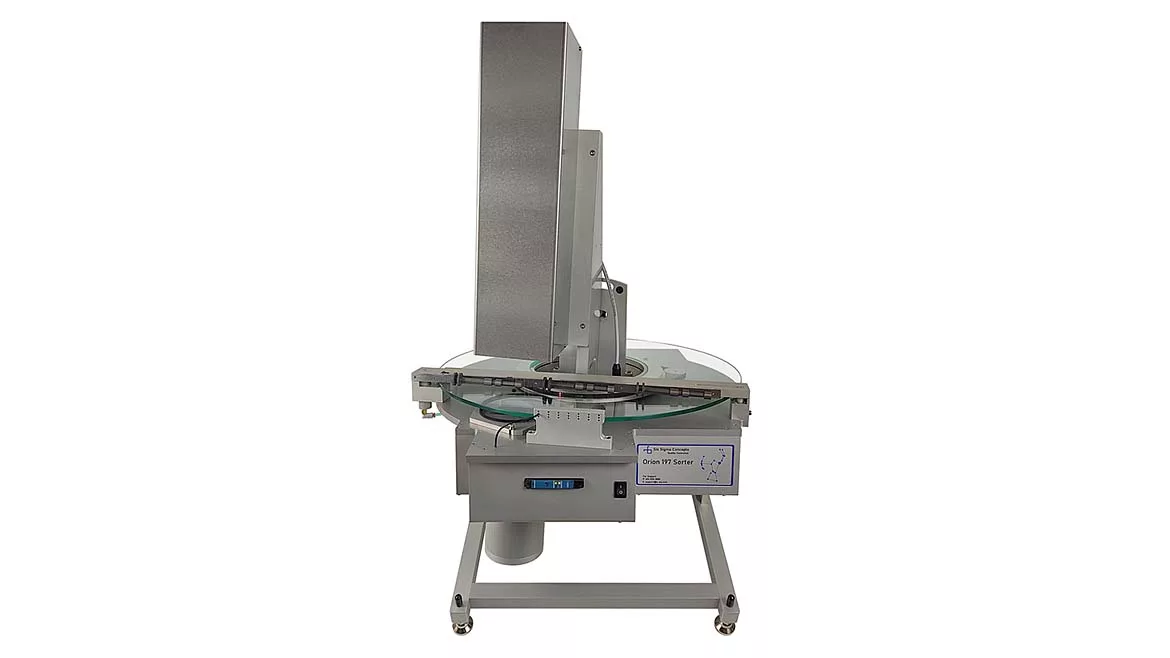
Backlit video metrology systems offer unmatched speed and precision for their price. They are the modern incarnation of shadowgraph technology, improving on nearly all inspection capabilities. Computer programs analyze digital image feeds of a part’s shadow using algorithms to determine the position and size of features. Advancements in computing power and algorithms allow for improvements in the precision, speed, type, and volume of detected and measured features. Integration with part positioning systems can stitch together part images, check rotating part profiles, and rapidly sort parts.

Subpixel interpolation is the driving force behind improved precision. It analyzes the white to black gradient of individual and small groups of pixels along the outer profile of the part’s shadow. Without interpolation, measurements would essentially be restricted to the image size of an individual pixel. With it, points can be determined to within 1/10th of a pixel’s size. So, if each pixel of an image represents a 0.001” square area, then interpolation can find an edge point’s position to within 0.0001”. Increasing sampling or using averaging can further improve precision to within 1/100th of a pixel’s size.
If an image were to perfectly match a part, then the accuracy of a measurement would be set to the limit of interpolation. In reality, optics distort an image to a significant degree. Thankfully these distortions remain relatively static, which means that they can be mapped and corrected. The accuracy of the system is then limited to how well the distortion is corrected and the stability of the distortion.

Algorithms, often called tools, take collections of interpolated points and determine fits to particular profiles, such as lines and arcs. Measurements are then able to be made of and between those found features. For example, the distance between two lines can measure a diameter or a height. Reference features can be found directly on the exterior profile or constructed from elements of the exterior profile. An axis can be found as the bisector between the edges of a diameter or taper. Bounding boxes or values tracked to referenced features can be used to determine if an individual feature is within its geometric dimensioning and tolerancing limits.
Specialized formulations can be made to find the dimensions of features that are not directly in the profile’s view. For example, when a screw is standing normal to the image, the helix will not show the top and bottom of the thread form at one point. Instead, you see one side of the thread as it retreats and the other side as it advances. This means that the pitch diameter measurement point cannot be imaged directly. Fortunately, since the individual sides of the thread form are imaged, a series of algorithms can be used to extract the correct pitch diameter. Threads where part of the form is fully obscured, such as multi-start threads, cannot be measured in such a manner.

Once an inspection program has been set up to analyze a particular part, it will do the same evaluation and automatically record the results each time. Essentially making inspections completely objective and eliminating the operator as a source of repeatability and reproducibility variance. Programs can be set such that the position and angle of a part is tracked. All of the evaluation tools along a part will shift position relative to a determinant feature of the part. Eliminating the need for fixturing or precision placement of self-standing or stably lying parts. This significantly simplifies part presentation to the metrology system for both operators and automated systems.

The efficiency of image analyzing software along with the computing power dedicated to it determine the volume of measurements that can be analyzed. Modern systems are capable of processing an image and analyzing scores of features in less than 100ms. To fully take advantage of this processing speed, camera frame rates should match or exceed the rates that their images are processed at. This means that the cameras for these systems are selected based on more than just resolution. Shutter, exposure, frame rate, and many other factors determine which cameras are appropriate for particular applications. Likewise, the stability and intensity of the backlight has to be maintained at these higher rates. An increase in image throughput can then be used to shorten the time to average multiple inspections, analyze parts as they rotate, and sort large volumes of parts.
Image stitching and similar methods allow for parts that do not fit within a single image to be measured as they or the imaging system is translated. Stages can be set to specific positions or encoded to track the change in part’s position between captures. Measurements that cross between images then add the translated distance as an offset to their values. An alternative to translating the part is to use multiple images to simultaneously analyze a part. A system with parallel cameras that are a known distance apart can find features on their respective images. Like with part translation, you can offset measurements that go across both cameras by the distance separating those images.

Rotating a part greatly expands the inspection capabilities of a backlit video metrology system. When images are processed rapidly a part can be inspected as it rotates in a continuous motion. This allows for a pseudo three-dimensional profile to be obtained. If the reference features are visible during rotation, then runout, concentricity, true position, and many other geometric dimensioning and tolerancing callouts can be checked. These measurements can be obtained at a much higher rate than physical probing, such as a CMM. If a backlit video metrology system inspects at ten frames per second, using a motor to rotate a part at 50° per second over a 180° range, it will perform 36 inspections at 5° intervals. When inspecting a ¼” long taper with a 0.001” square pixel size, the system obtains 500 inspection points per image and 18,000 over the three and a half seconds that the whole inspection takes place.

As tremendous as this capability is, there are inherent limitations when it comes to performing geometric dimensioning and tolerancing measurements. Backlit systems can only look at the outermost points of the profile. They cannot find reference features or defects that are obscured within the outer profile. This does not tend to be an issue when measuring runout between outside diameters, but unless the part is fixtured to an interior feature, measurements cannot reference that feature. Likewise, when measuring flatness, slope, convex, and other outward facing defects can be detected. But concave defects, like depressions, dents, and grooves are obscured by the surrounding material.
Tools tailored to continually rotating parts can be used to find features that are only present at set facings. This allows systems to measure cross holes and cross hole positions, as well as flat widths and cross corners on the fly. Additional functionality can be gained by setting conditions on when tools operate. With the proper conditions set, features that only appear at particular facings can be measured during continuous rotation. For example, a chamfer tool can be set to operate only when the corner profile of a hex is facing the camera.
Rapid image acquisition and high precision are key components to 100% inspection. There are a myriad of methods to automate part presentation to backlit video metrology systems, robots, belts, metal and glass rails, as well as metal and glass disks are the most predominant methods. Glass is often favored, as it allows images to be taken through it. High volume rates can generally only be achieved when parts continually move through a system from feed to inspection to sorting. Continual movement provides additional challenges, such as motion blur, consistent part facing, and critical operation timings. Overcoming these limitations allows for a single system to inspect and sort hundreds of thousands of parts within a single day.

Whether it is SPC or 100% sorting, backlit video metrology systems provide a rapid return on investment. Their fast, objective inspections allow operators to quickly get what they need with little chance error. Even the best machined parts can benefit from 100% sorting, as there are always anomalous parts, from stock ends to mixed parts or parts damaged in transport.
Looking for a reprint of this article?
From high-res PDFs to custom plaques, order your copy today!