Measurement
Determining Settling Time in Measurement Systems – An Analytical Approach
A balance has to be maintained between allowing too much or too little settling time.

Photo: anatoliycherkas/ iStock / Getty Images Plus
Transients are signals that vary over time. Often these transients vary less and less as time goes on. In measurement applications, this can present problems, as the metrologist or engineer must design the test in such a way that the measurement takes place only once the system has settled. This time period can be predetermined by testing. However, this determined period has to account for all scenarios and may have to be unnecessarily large in order to cover each case. In contrast, if the time is too short, it can cause error by letting some corner case tests through that haven’t settled sufficiently. A balance has to be maintained between allowing too much or too little settling time.
Often the settling transient behavior will take the form of an exponential decay curve. In these cases, the rate of decay may be utilized to determine when the system will settle enough to take a measurement. Such a method can be done on the fly and will greatly reduce unnecessarily long settling times while at the same time assuring sufficient settling to take a measurement. One method to do this in situ is discussed in the following text.
Theory
An exponential decay curve is something that is commonly found in naturally occurring physical phenomena. Some examples are a skydiver reaching terminal velocity, a resistor-capacitor (RC) time response, and a mass heating or cooling to a final state temperature. The basic phenomenon can be described by the following equation.

The decay time constant is the time for the phenomena to reach (1 - 1/e) or ~63% of its final value. We will also look at the first derivative (think slope) of the function in this discussion.
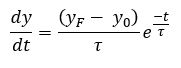
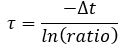
With some analysis, this phenomenon may be utilized to determine the time for a system to settle. First, an examination of successive slopes for the data in intervals of Δt is made. The ratio of these slopes is used to determine the time constant. This is done with the following equation which is derived from Equation (1).
 |
(3) |
|
where: ratio: ratio of current slope to previous slope (m2/m1) Δt: time difference between slope estimations |
|
With knowledge of the time constant (τ), the amount of time needed to settle within a given magnitude may be calculated as follows.
 |
(4) |
|
where: Δysettle: the desired magnitude of settling |
|
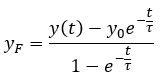
In the case of on-the-fly type calculations, yF may not be known. It may be determined by (5).
 |
(5) |
Examples
Consider an RC circuit with a 10 kΩ resistor and a 1 µF capacitor. This circuit has a time constant of 10 ms. A plot of this response is with y0 = 6 V and yF = 12 V is shown in Figure 1. A table of the values at various times is shown in Table 1.
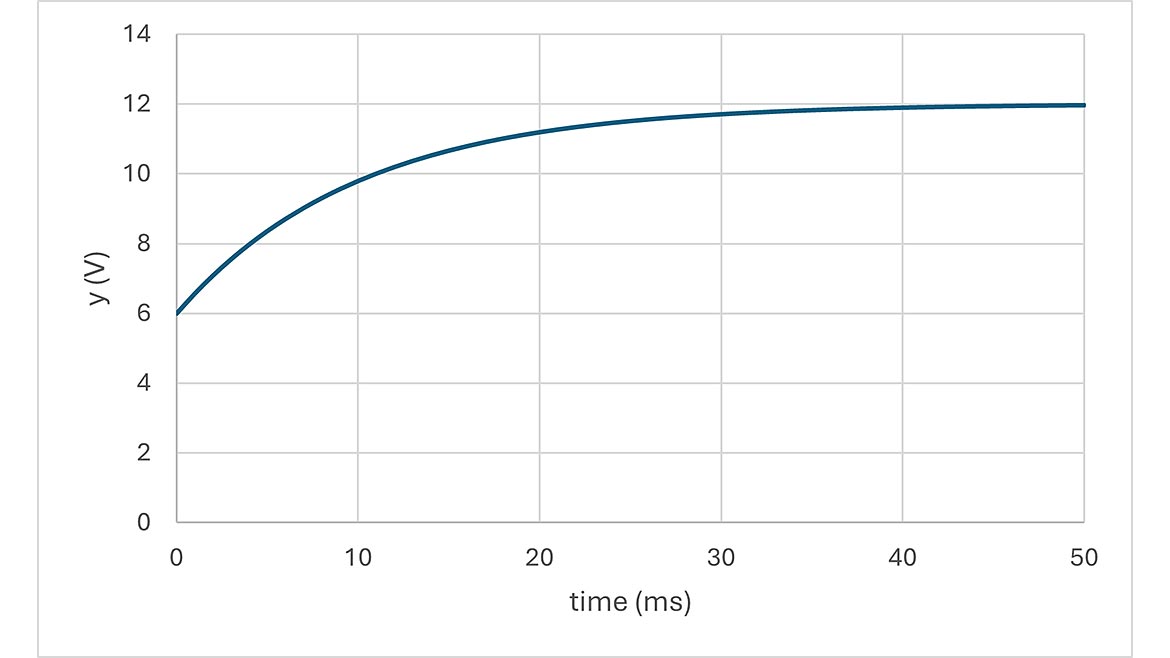
Figure 1: Response of an RC Circuit (Source: Fluke)
Table 1: Response at Various Times
t (ms) |
y (V) |
dy/dt (V/s) |
Ratio |
0 |
6.00 |
0.600 |
|
10 |
9.79 |
0.221 |
0.368 |
20 |
11.19 |
0.081 |
0.368 |
30 |
11.70 |
0.030 |
0.368 |
40 |
11.89 |
0.011 |
0.368 |
50 |
11.96 |
0.004 |
0.368 |
It can be seen in the table that the rate of change (slope) changes constantly. This is a characteristic of decay curves. This can be utilized in answering the question how long to wait. To get within 99% of the settled value, five time constants are necessary. For some measurement applications, more time is needed. The number of time constants to wait should be determined by the process’s need. The question that will be explored for the rest of this article is how to determine how much time to wait.
This method relies on the first derivative (slope) of the curve utilizing the central limit theorem. Using the example from Figure 1, these data were segmentized as shown in Figure 2. The estimated first derivative for each segment is represented by the slope of the segment. For this example, the estimation of the first derivative was always 3% greater than the actual value. A summary of the data from each segment is shown in Table 2. The segments were 10 ms in duration, so the middle value for each segment is shown.
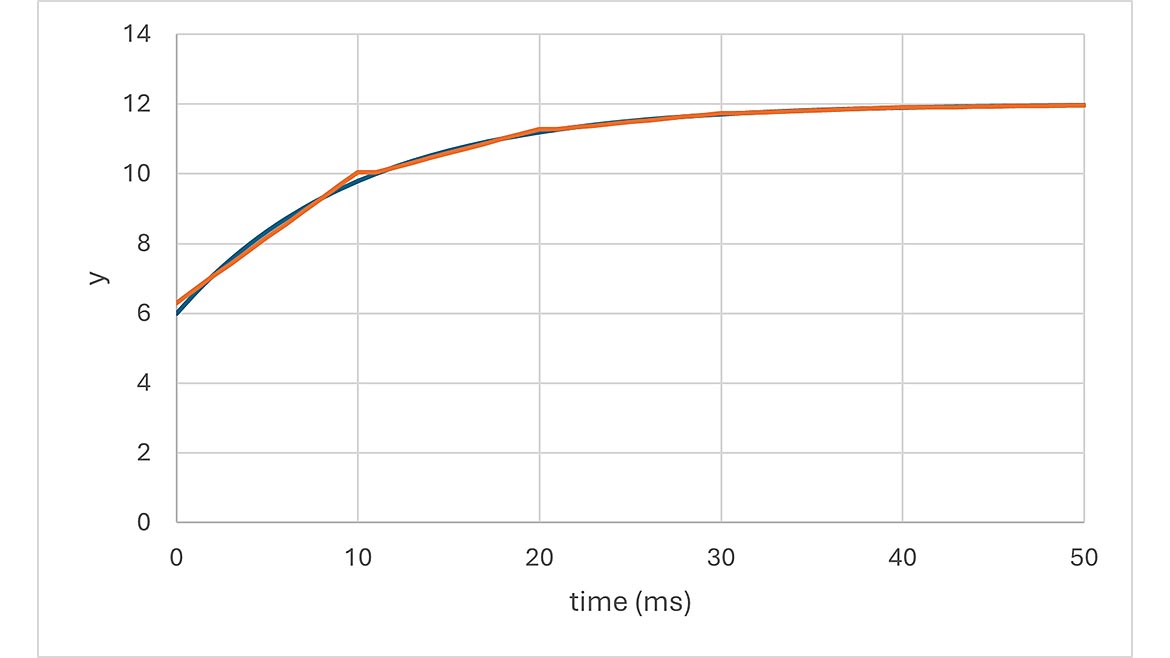
Figure 2: Segmentation of the Data (Source: Fluke)
Table 2: Summary of Each Segment
Segment |
t (ms) |
Slope |
ratio |
1 |
5 |
0.375 |
|
2 |
15 |
0.138 |
0.368 |
3 |
25 |
0.051 |
0.368 |
4 |
35 |
0.019 |
0.368 |
5 |
45 |
0.007 |
0.368 |
In the example in Table 2, Δt =10 ms and the ratio = 0.368. Using Equation (3), the time constant is
This previous example had no noise in the data. This is not the case in real world examples. The successive ratio values will vary and should be considered as an uncertainty in the time constant calculation.
As an example, data of a decaying temperature response with noise is shown in Figure 3. It is desired that the data settle to 0.1 K before taking recorded samples. The sample rate is 1 s, and the data are broken into segments of 10 s (10 samples). A summary of the slopes of the first five segments is shown in Table 3.
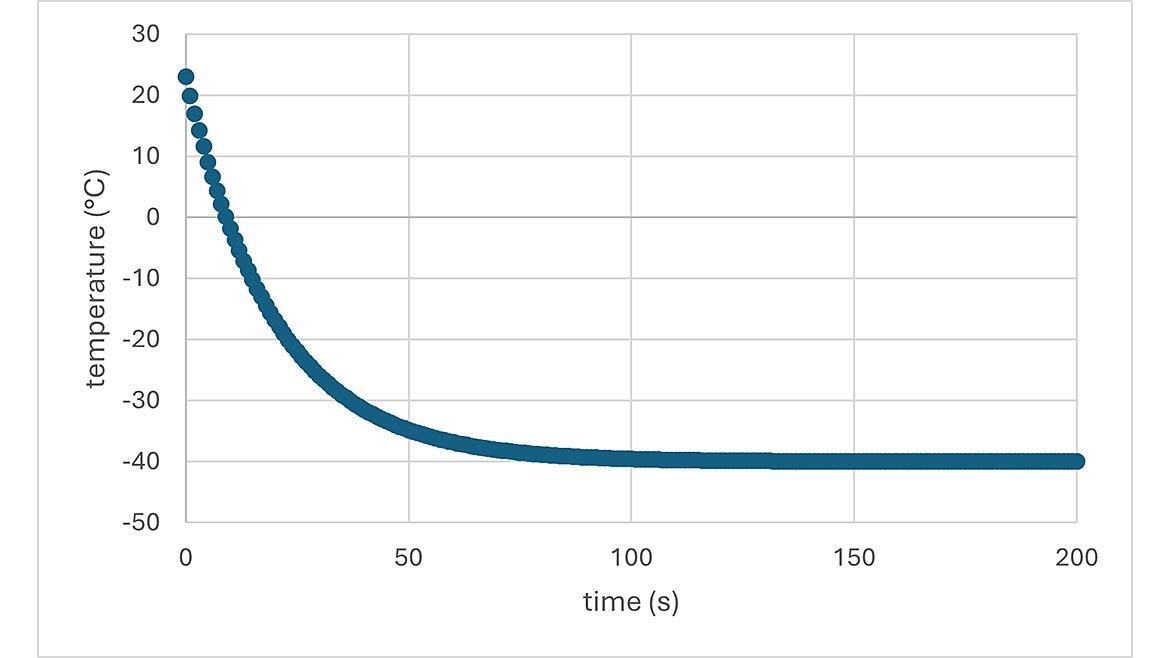
Figure 3: Temperature Decay Data (Source: Fluke)
Table 3: Summary of Segments
Segment |
t (s) |
slope |
ratio |
τ |
1 |
5 |
-2.480 |
|
|
2 |
15 |
-1.512 |
0.609 |
20.2 |
3 |
25 |
-0.908 |
0.601 |
19.6 |
4 |
35 |
-0.553 |
0.609 |
20.2 |
5 |
45 |
-0.345 |
0.625 |
21.3 |
The mean plus two standard deviations of the τ values is 21.7 s. The largest value is used, since it will provide the worst-case scenario with this method.
The next question is how long to wait before the data is considered settled. In this case y0 = 22.99 °C and at t = 50 s, y = -34.75 °C. Estimating for yF:
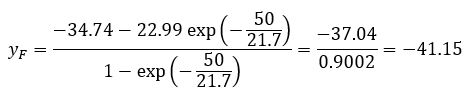
This value is slightly larger in magnitude than the true yF, since the estimate for τ includes some safety margin used for the worst case scenario mentioned above. The next step is to calculate tsettle.
tsettle=21.7[ln|22.99——41.15| —ln|0.1|]=21.7[4.16——2.30]=140.2 s
For these data, a look the first 10 seconds of data beyond t = 140 s is shown in Figure 4. These data show no slope beyond their noise floor.
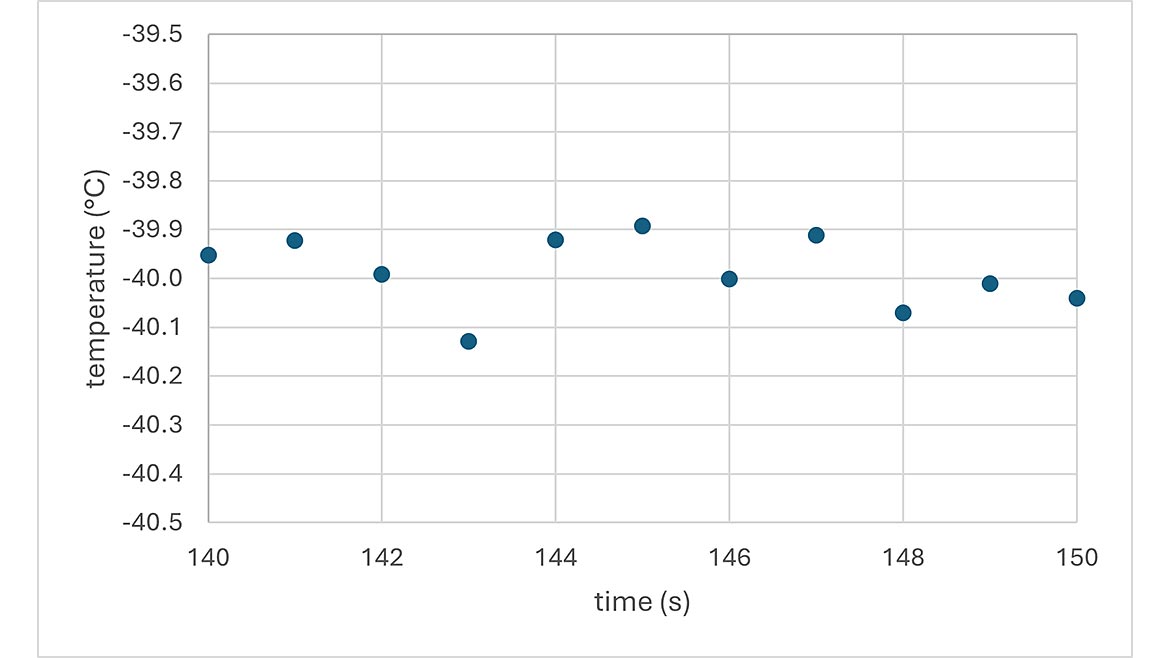
Figure 4: Settled Data (Source: Fluke)
Things to Look Out For
Noisy Data
In some cases, the data either may exhibit too much noise or may have too small of a sample size rendering this method useless. To demonstrate this, a set of data that was used to determine the transient response of a thermal radiation instrument shield is considered. The data taken is shown in Figure 5, and shows the reference measurement (REF), data taken inside the thermal radiation shield (SH), and data from an adjacent weather station (G3935). The consideration of the transient started at 20:16. The decay constant is calculated by subtracting SH – REF.
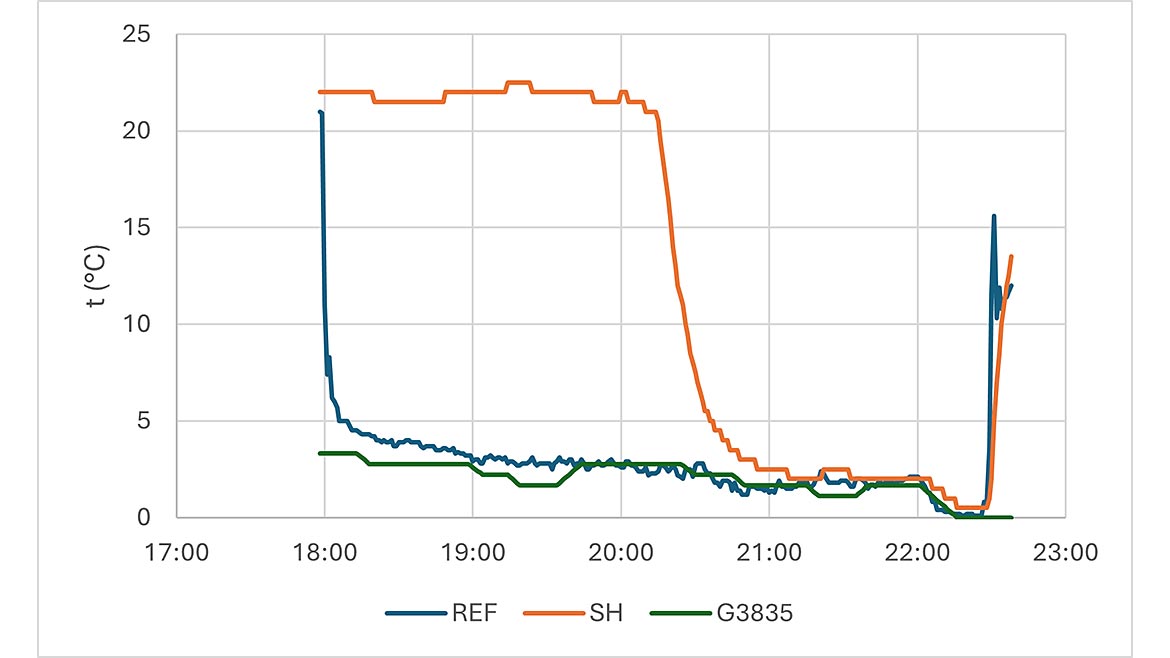
Figure 5: Raw Data from Radiation Shield Testing
The subtracted data is shown in Figure 6. When using this method, the calculated values for τ varied too much to be useful. This is due to noise in the data. The noise in the data is due to two factors. First is the fact that the data is subtracted from two sensors that may have a different transient response. Secondly, and more of a factor, is the display resolution of the shielded thermometer was 0.5 K, which introduces quite a bit of noise to the data. Using other methods, the τ value was determined to be 11.8 minutes.
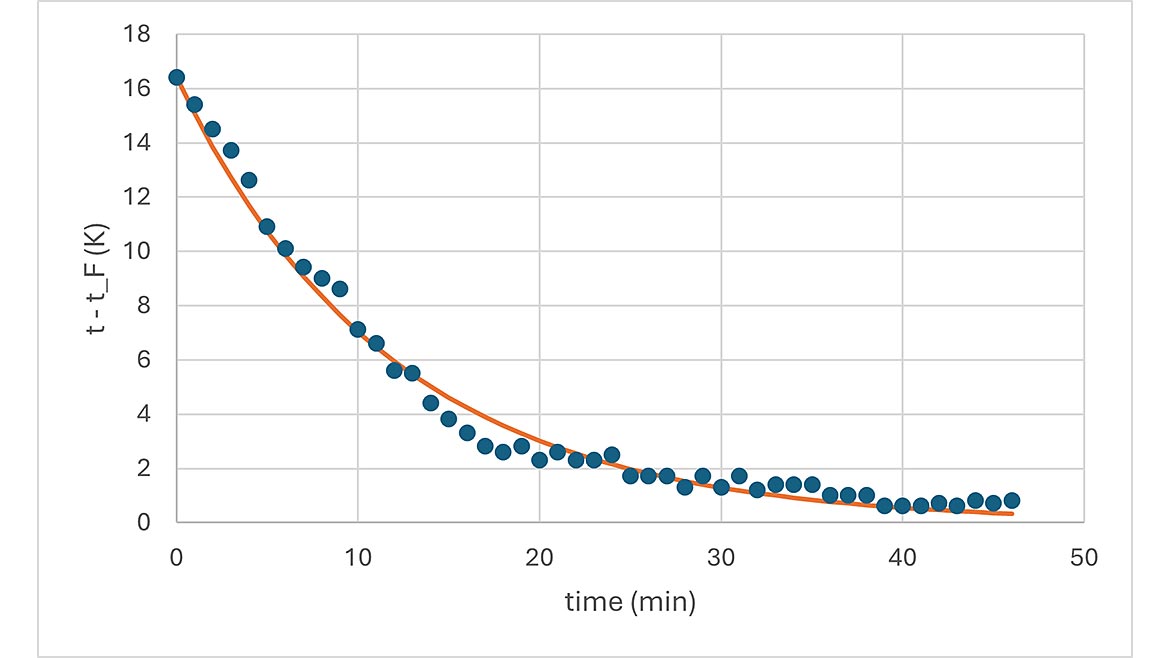
Figure 6: Transient Data from Solar Radiation Shield Testing (Source: Fluke)
Complex Transient Behavior
Care must be taken for systems with complex transient behavior. In this type of system, multiple transients have an effect on the signal. There may be an initial transient response, and a longer-term transient response. One such example is an RLC circuit such as the one shown in Figure 7.

Figure 7: RLC Circuit with Complex Transient Behavior
One possible response for such a circuit is shown in Figure 8. From these graphs, it is evident that the data has an initial rise and then rolls off into some sort of decay. While this is obvious on visual inspection, a poorly designed algorithm implementing the method described above may show error due to underestimation of the settling time. It may also be the case that if some error detection is used in the algorithm, the initial response may cause a reporting of unstable data.

Figure 8: Example of Complex Transient Behavior
Conclusion
The method shown here is one way to ensure that responses are allowed sufficient time to settle before measuring without waiting too long. As mentioned, this method is easily automated using simple algorithms. While the algorithms may be simple, great care must be taken to assure that the results lead to the measurement of stable settled data. This method may be used to take data sooner, while still allowing enough time for settling.
Looking for a reprint of this article?
From high-res PDFs to custom plaques, order your copy today!