Vision & Sensors | Machine Vision
The Perfect Long-Distance Relationship: CoaXPress over Fiber Optic Cables
It’s a rapidly evolving field with the latest advancements arriving in the form of CoaXPress over Fiber.

Since its introduction, the CoaXPress (“CXP”) high-speed digital interface standard has proven to be the optimal interface for demanding machine vision applications. It offers multiple advantages, the most important being speed. CXP provides deterministic, low-latency data transmission at up to 12.5 Gbps per channel from camera to host, which adds up to an incredible 50 Gbps when four channels are aggregated.
In addition to machine vision, CXP has shown itself to be an excellent upgrade option in legacy coax-based analog systems, such as those found in Intelligent Traffic Systems (ITS), medical imaging, or military and aerospace systems. Integrating a CXP frame grabber and CXP camera to a legacy system allows the already installed 75-ohm coaxial cable to be repurposed as a high-speed transmission medium.
If this wasn’t enough, an exciting new use case has emerged for the interface that holds tremendous potential: running the unaltered CXP protocol across fiber optic lines rather than coaxial cable. Fiber’s high bandwidth, EMI immunity, durability, safety, and compact size make it the perfect addition to CoaXPress. Targets up to 120 kilometers away from a host can be monitored with little or no latency and without signal degradation due to attenuation. Additionally, fiber resists tampering or harsh environments better than copper.
Let’s look at a few situations where a fiber and CXP combination would be a game-changer:
- Structural Monitoring: Inspecting the physical integrity of wind turbine blades, bridges, or other large infrastructures for stress, vibrations, and other damage.
- Industrial Plants: Observing assembly lines or large facilities that have multiple cameras mounted.
- Remote sites: Examining hard-to-reach areas, like within machinery, processing tanks, or aircraft components. This would be useful for destructive testing as well.
- Surveillance and Defense: Remotely monitor high-value targets, such as military installations, or apply the technology into reconnaissance activities.
- Pipelines: Inspecting pipeline interiors for leaks, corrosion, or cracks, particularly in isolated or “hazardous” areas that may contain explosive dust, fumes, or liquids.
- Underground: Examine sewer lines, cables, or tunnels.
- Astronomy: Connecting cameras in telescopes or remote viewing for astronomical observations.
- Aerospace: Scientific observation of satellite launches.
Limitations of GigE Vision
Long-distance imaging is not new, dating back to coaxial cables being used to transmit television images during the 1936 Summer Olympics. More recently, GigE Vision over fiber has been the “go to” choice to transmit control data and high-speed video via Gigabit Ethernet. GigE Vision cameras can use Ethernet hardware over fiber because the protocol is not dependent on the physical media.
GigE Vision over fiber setup is straightforward. In a basic system a GigE Vision camera and two copper-to-fiber media converters are connected by a fiber cable. The Ethernet signal is converted to fiber optics by the first converter near the camera and then back to copper by the second converter at the host PC. As an alternative, an industrial gigabit Ethernet switch with SFP or SFP+ fiber optic ports could be linked to a high-end GigE Vision camera that supports fiber optic connectivity via an SFP port or an adaptor. As long as the physical layer is compatible, the fiber connection should be transparent to the application because GigE Vision depends on common Ethernet protocols.
That sounds good, doesn’t it? The catch is this: Although GigE Vision can utilize the 100 Gbps capacity of Ethernet networks, the standard does not operate at that speed by default. Most GigE Vision cameras are running at 1 Gbps, which translates to a maximum data throughput of about 100–125 MB/s after overhead. When cameras use more bandwidth than is available, bottlenecks form.
That takes us to 10GigE Vision. Here, too, there are issues. It has become clear over time that CPUs cannot handle 10 Gbps traffic, which results in missing frames and intolerable latency. Unlike CXP or Camera Link systems leveraging modern frame grabbers, GigE Vision parses Ethernet packets and controls data streams using the host computer’s CPU. The primary advantage of GigE Vision over CXP—the elimination of a frame grabber—is negated, even though 10G frame grabbers with offloading capabilities or smart NICs can reduce CPU use. Older cable infrastructures must also be upgraded with CAT6 or CAT6a in order to handle 10GigE Vision, which drives up system costs even more.
The protocol’s frame lag, inability to deliver real-time triggers, high power consumption that causes overheating, and inability to link numerous cameras to a single PC are some of its other shortcomings. Applications for long-distance systems significantly exacerbate these problems.
GigE Vision remains a flexible and affordable choice for basic applications. Its drawbacks, however, render it less appropriate for long-distance travel, since its initially inexpensive cost of admission might rapidly increase.
New CXP Standards
CoaXPress 2.0 and 2.1 were released by the Japan Industrial Imaging Association (JIIA) standards committee in 2021. Their primary enhancements included the use of Micro-BNC connectors, the doubling of the uplink speed for triggering at frequencies higher than 500 kHz, the support for additional speeds (CXP-10 and CXP-12), and conformance with GenICam and GenDC.
In the flurry of news, the inclusion of CoaXPress over Fiber (CoF) in version 2.1 was largely overlooked. Yet CoF is truly revolutionary. It allows fiber optic cables to operate with the unaltered CXP protocol — that is, the data protocol remains CXP. Using standard Ethernet signaling, like 10GBASE-R for 10 Gbps, CXP data is encoded into the fiber to guarantee compatibility with existing fiber networks.
COF Takes Different Roads
Until recently, there were just two ways to send CXP over fiber. Both are functional, but they introduce more hardware, space needs, and potential points of failure to the system.
The first option is to use a specialized series of converter boxes with a fiber cable running between them. The first of these boxes converts the camera’s CXP output to fiber. At the host end, the signal is converted back into copper and linked to a CXP frame grabber. This configuration is possible, but it may prove costly.

The second option is requesting that the camera manufacturer redesign an existing non-CoF CXP camera to feature a fiber interface. The issue is that integrating a fiber output would need a simple CXP camera to be much larger and more powerful, especially a less expensive single or multiple link CXP unit with a small footprint. The camera manufacturer’s return on investment will likely be too low from a practical standpoint to proceed.

Third Option for CoF
Thanks to recent developments, a third CoF solution for long-distance imaging has surfaced. The focus is on the 1.1/2.0 compatible interface modules, which function with common single-link CXP cameras featuring Micro-BNC (HD-BNC) connectors. The design simplifies long-distance links and expedites commissioning.
Here is the setup: First, a coaxial cable is connected to the interface module’s input to the Micro-BNC output of the CXP camera. This first cable can be as long as forty meters to provide more deployment flexibility. It also supplies 13W of power to the camera after it is attached, eliminating the need for a separate power supply, plus it provides complete uplink channel functionality for camera configuration and control, firmware upgrades, and triggering.
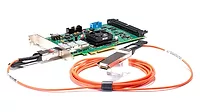
Next, an off-the-shelf single mode fiber optic cable with one QSFP+ transceiver on the input side and up to four transceivers on the other is connected to the QFi’s fiber output port. A CXP-12 frame grabber integrated inside an industrial PC (IPC) is connected to the fiber cable’s output end. No additional hardware or programming is necessary. To enable multi-camera installations, a single quad-link frame grabber can join the output of up to four of these interface modules. Additionally, several modules are compatible with multi-link cameras.
After five minutes or less of setup time, video data from the camera in CXP standard format will start streaming at a consistent 10 Gbps for up to 128 kilometers (75 miles) without signal loss. By removing several conversion steps, this third solution simplifies the procedure and gives system integrators a better long-distance option.
Conclusion
Long-distance vision systems consist of a host, fiber optic cables, specialized converters, and cameras optimized to transmit video data over extended ranges. It’s a rapidly evolving field with the latest advancements arriving in the form of CoaXPress over Fiber. While two options for CoF are now available, the interface module technique is a major step forward.
Looking for a reprint of this article?
From high-res PDFs to custom plaques, order your copy today!