Column | Raymond Holmes
Trends and Technological Developments in Modern Small to Medium-Scale Manufacturing
This year Marlin Steel incorporated several autonomous machines that enable technicians to multi-task instead of being tied to a particular machine for the duration of the operation.
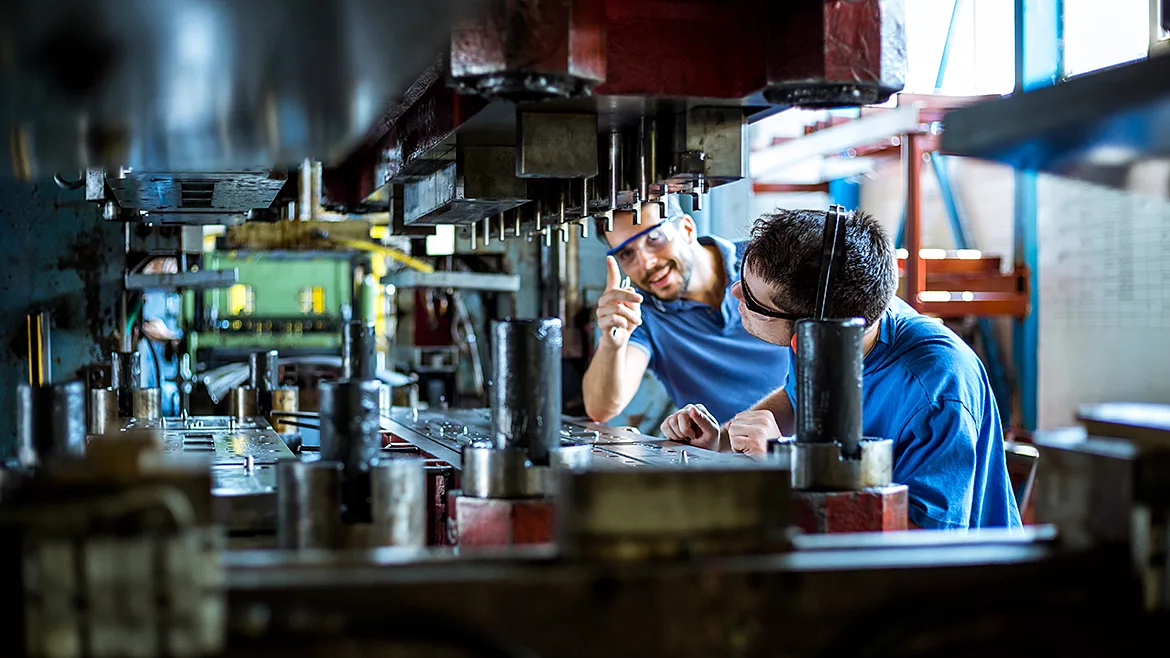
Small to medium-scale manufacturers such as Marlin Steel are at the forefront of a rapidly changing industrial landscape. While traditional large-scale manufacturing was once defined by economies of scale and centralized production, today’s modern companies thrive on precision, customization, and sustainability.
Automation and Robotics
Automation has transitioned from the domain of large corporations to become a powerful tool for small and medium manufacturers. This year Marlin Steel incorporated several autonomous machines that enable technicians to multi-task instead of being tied to a particular machine for the duration of the operation. Another development is the use of collaborative robots. Unlike traditional industrial robots, collaborative robots are designed to work safely alongside human operators, boosting productivity without eliminating jobs.
Automation reduces labor costs, minimizes production errors, and enables greater consistency in output. For smaller operations, this translates into the ability to scale up operations and gain new customers while maintaining high standards. Moreover, automation provides the flexibility to adapt to fluctuating demand without overextending resources, an advantage in today’s unpredictable economic environment.
Digitalization and Smart Manufacturing
The integration of digital technologies, or smart manufacturing, is revolutionizing how small to medium manufacturers manage operations.
For example, some of the wire forming machines we use here at Marlin Steel contain internet-enabled sensors embedded in machinery that track critical metrics like temperature, wire alignment and even have the ability to auto correct. This data allows operators to detect maintenance needs before a failure occurs, engineering to detect non-conformities occurring in real time thereby reducing unplanned downtime and ensuring product is manufactured correctly the first time benefiting on time delivery.
The need for precision in modern manufacturing has elevated measuring technology to a central role. This year, Marlin Steel has expanded its customer base to include medical device companies whose products require tighter tolerances that can’t be realized with the usual handheld measuring tools.
Laser measurement systems, for instance, provide highly accurate, noncontact methods for assessing component dimensions and surface quality. These tools are particularly valuable in industries like medical device manufacturing and aerospace.
Laser displacement sensors and scanners can identify deviations in form or alignment within seconds, allowing manufacturers to make quick corrections and avoid costly defects.
Optical metrology and machine vision systems also play a crucial role in quality control. High-resolution imaging tools inspect components for surface defects, measure geometries, and verify assembly accuracy in real time. These systems reduce the burden on manual inspection processes and increase throughput without compromising quality.
Coordinate measuring machines remain essential tools in precision manufacturing. Innovations in portability now allow CMMs to be used directly on the shop floor rather than in isolated labs.
Multi-sensor CMMs combine tactile probes, optical systems, and laser scanners in a single device, offering comprehensive inspection capabilities that support diverse production environments.
Marlin engineering utilizes CAD software to bring customer requirements to life which could then be used along with additive manufacturing to create sample parts for review. Manufacturers are leveraging this technology to manufacture complex, customized components with reduced lead times and minimal material waste.
Additive Manufacturing
Additive manufacturing also offers unparalleled design flexibility. Components can be digitally modeled, tested, and refined before production begins. This digital workflow streamlines the product development cycle, reduces tooling requirements, and enables manufacturers to quickly adapt designs.
Marlin Steel has also been a part of numerous demos previewing new 3D scanning technology which looks to be the future of CMM measuring. The rise of 3D scanning, which captures accurate digital representations of physical objects, is used for reverse engineering, quality verification, and digital twin technologies.
The successful integration of new manufacturing methods with precise measuring technologies enables manufacturers to compete on quality, responsiveness, and sustainability. Tools such as 3D scanning, portable CMMs, laser sensors, and Internet-based monitoring systems equip businesses with real-time feedback and control over their processes.
Localization and Reshoring Strategies
The vulnerabilities of global supply chains became evident during the pandemic and we at Marlin Steel encountered the same issues. Procuring materials produced by a range of vendors became challenging as supply chain times went from two to three weeks to two to three months. These issues almost brought manufacturing to halt, prompting a re-evaluation of overseas manufacturing. As a result, today’s manufacturing companies are increasingly pursuing localization and reshoring strategies.
Localized manufacturing reduces lead times, transportation emissions, and dependency on international logistics. It also strengthens local economies and supports better collaboration between manufacturers and suppliers. Moreover, having production nearby enhances the ability to rapidly adapt to customer needs.
The successful integration of new manufacturing methods with precise measuring technologies enables manufacturers to compete on quality, responsiveness, and sustainability. Tools such as 3D scanning, portable CMMs, laser sensors, and Internet-based monitoring systems equip businesses with real-time feedback and control over their processes.
Conclusion
Small to medium-scale manufacturing is undergoing a powerful transformation. From automation and digitalization to sustainable practices and localized production, manufacturers are embracing technologies that enhance flexibility, precision, and resilience. Measuring technologies, particularly those that emphasize accuracy, portability, and nondestructive testing, are central to maintaining high standards and supporting innovation.
As the manufacturing landscape continues to evolve, the ability to blend cutting-edge production tools with advanced measurement systems will define success. Manufacturing companies that invest in both innovation and precision are poised to lead in a future where customization, efficiency, and sustainability reign supreme.
Looking for a reprint of this article?
From high-res PDFs to custom plaques, order your copy today!