Machine Vision
Solving Processing Bottlenecks in High-Bandwidth Machine Vision Systems
As machine vision systems scale in complexity and performance, designers must adopt new strategies to manage processing bottlenecks.
As machine vision systems continue to evolve, they are increasingly tasked with supporting higher resolutions, faster frame rates, and multi-camera configurations. These demands are driven by applications in industrial automation, medical diagnostics, scientific research, and defense. While Ethernet-based standards such as GigE Vision have historically provided reliable bandwidth for video transmission, the primary challenge today is processing the vast amounts of data these systems generate.
The Shift from Bandwidth to Processing
For years, the focus in machine vision design was on increasing bandwidth to accommodate higher data volumes. GigE Vision, for example, scaled from 1 Gbps to 10 Gbps and beyond. However, as systems push toward 4K and 8K video, real-time streaming, and continuous operation, the bottleneck has shifted. Host systems—particularly CPUs—struggle to process incoming data efficiently, leading to latency, dropped frames, and reduced system responsiveness.
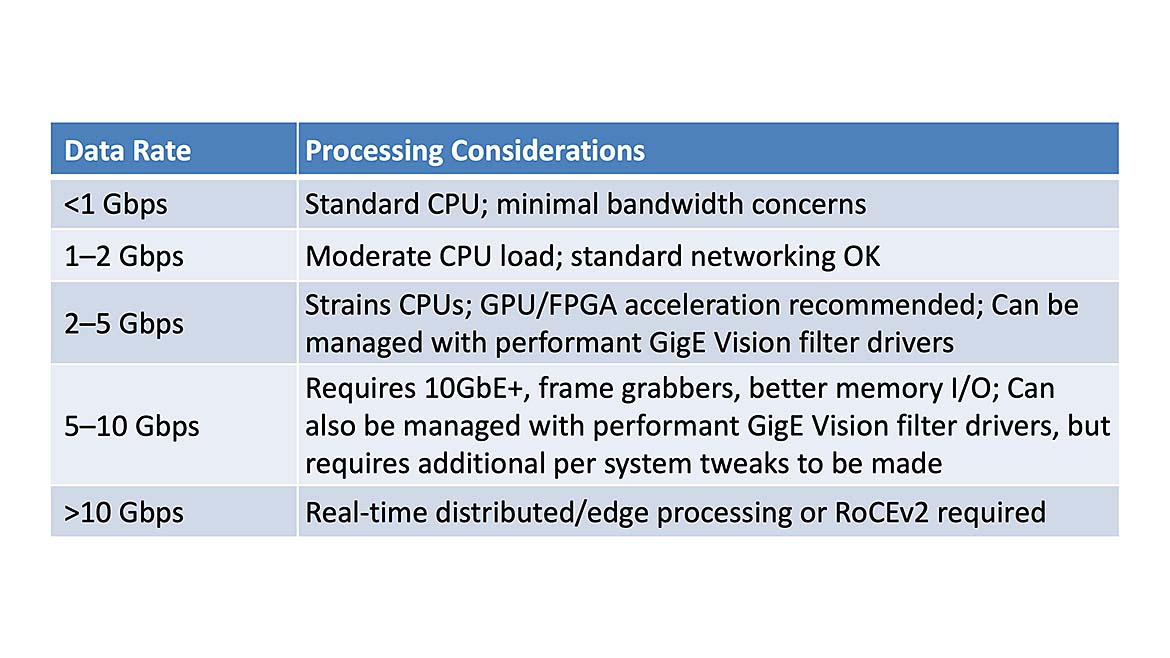
At data rates below 1 Gbps, standard CPUs can manage the workload comfortably. Between 2 and 5 Gbps, CPU strain becomes noticeable, prompting the use of GPUs or FPGAs for acceleration. In the 5 to 10 Gbps range, traditional PC architectures begin to falter, requiring frame grabbers, optimized memory I/O, and system-level tuning. Beyond 10 Gbps, host CPUs alone are insufficient, and designers must adopt advanced strategies such as edge processing and remote direct memory access (RDMA).
Balancing Performance, Reliability, and Cost
Designers of machine vision systems must balance performance with reliability and cost. The goal is not merely to move data faster but to ensure that every component—from the camera to the processor to the display—can handle increased throughput without compromising stability. Poor receive performance at high data rates is a common issue, often requiring hardware-based DMA engines to offload data transfer tasks from the CPU.
GPUs, FPGAs, and DPUs are increasingly used to handle image preprocessing workloads. Meanwhile, optimized Ethernet switches and network interface cards (NICs) help ensure deterministic, low-latency performance. These components must be carefully integrated to maintain synchronization and avoid packet loss.
Thunderbolt: A High-Bandwidth Alternative
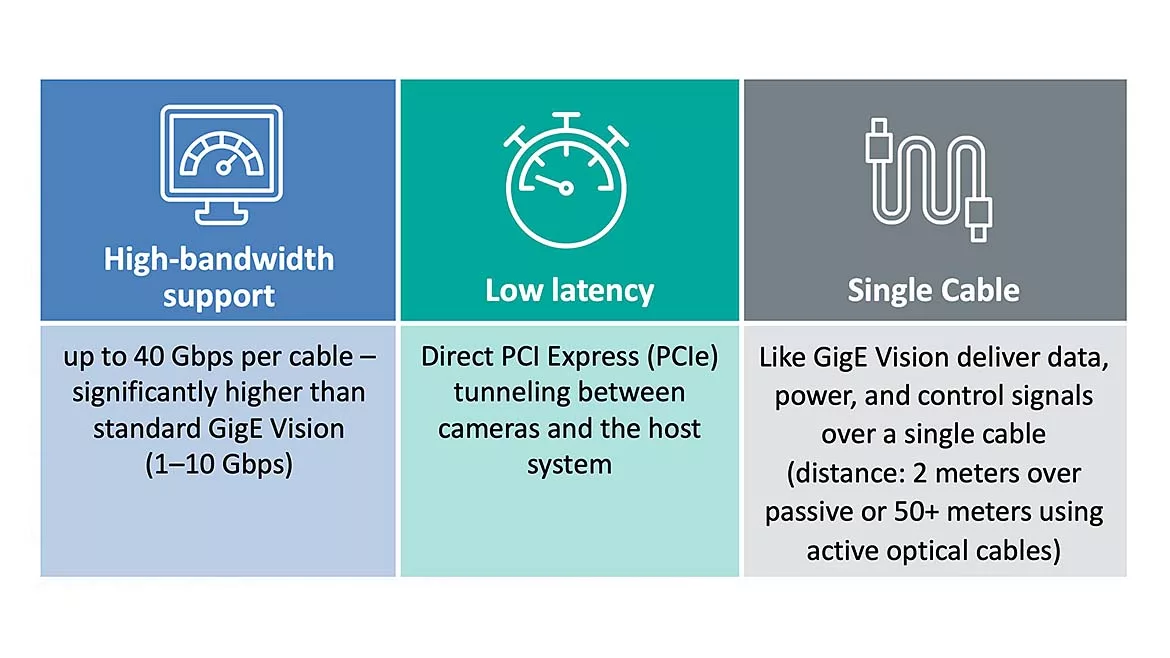
Thunderbolt technology has emerged as a compelling solution for machine vision applications operating in the 10 Gbps range and beyond. Thunderbolt 3 and 4 support up to 40 Gbps per cable, while Thunderbolt 5 is approaching 80 Gbps. This represents a significant leap over standard GigE Vision interfaces.
Thunderbolt enables direct PCIe tunneling, allowing data from the camera to be transferred directly to the host system’s memory with minimal overhead. This dramatically reduces latency, which is critical for real-time decision-making. Like GigE Vision, Thunderbolt can deliver data, power, and control signals over a single cable, simplifying system design and reducing clutter.
Thunderbolt Performance Benchmarks
Real-world implementations of Thunderbolt in machine vision systems have demonstrated:
- Thunderbolt 3: Up to 40 Gbps total bandwidth; PCIe data transfer typically ranges from 16–32 Gbps depending on system configuration.
- Thunderbolt 4: Maintains 40 Gbps bandwidth with guaranteed 32 Gbps PCIe throughput and support for dual 4K displays at 60 Hz.
- Thunderbolt 5: Doubles PCIe throughput to 64 Gbps and supports up to 120 Gbps for video with Bandwidth Boost, enabling triple 4K displays at 144 Hz or dual 8K displays.
In industrial setups using Jetson-based embedded systems, Thunderbolt uplinks have enabled seamless integration of high-end GPUs and measurement cards, achieving consistent throughput near the 40 Gbps ceiling with low latency and minimal CPU overhead.
RoCEv2: Enabling Zero-Copy Data Transfer
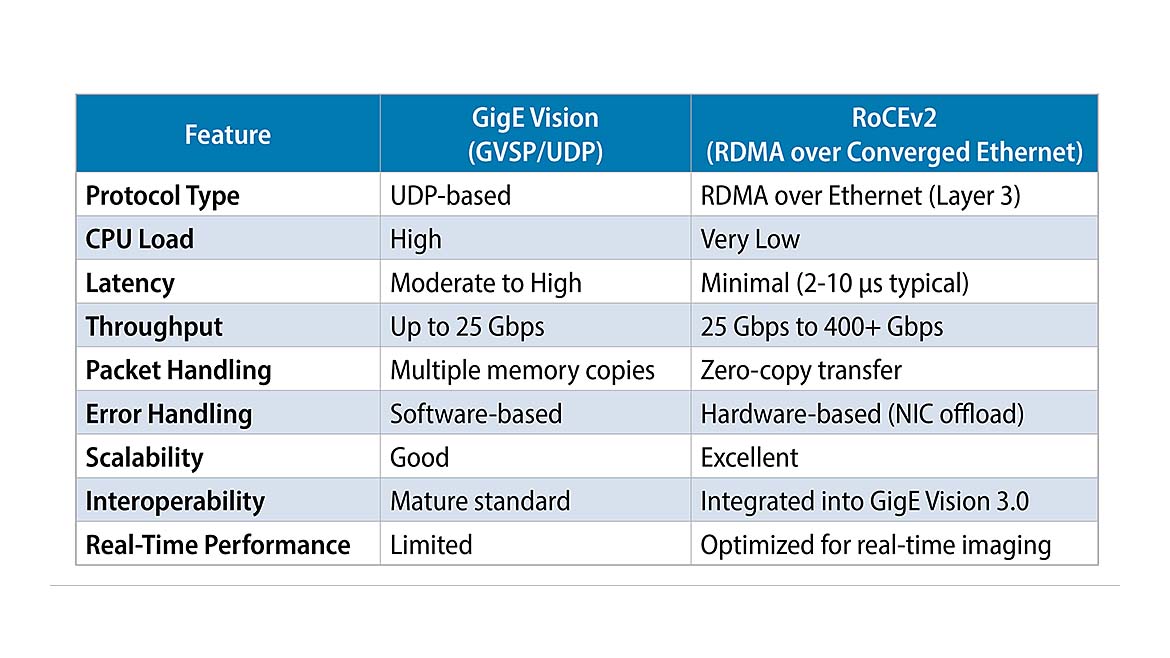
Remote Direct Memory Access over Converged Ethernet (RoCEv2) is a protocol derived from the InfiniBand specification that enables direct memory access over Ethernet. RoCEv2 allows imaging data to be transferred directly from the camera or sensor to the host processor’s memory without involving the CPU, operating system, or cache.
This zero-copy transfer significantly lowers latency and frees CPU resources for value-added tasks such as image analysis and AI inference. RoCEv2 operates over Layer 3 Ethernet, making it routable across IP networks and suitable for distributed systems. It supports high-throughput links of 25 Gbps and beyond, enabling multiple high-resolution, high-frame-rate streams with minimal CPU usage.
RoCEv2’s integration into GigE Vision 3.0 marks a significant evolution in machine vision standards, offering a future-proof path for high-performance, scalable imaging systems.
Real-World Applications
Medical Imaging
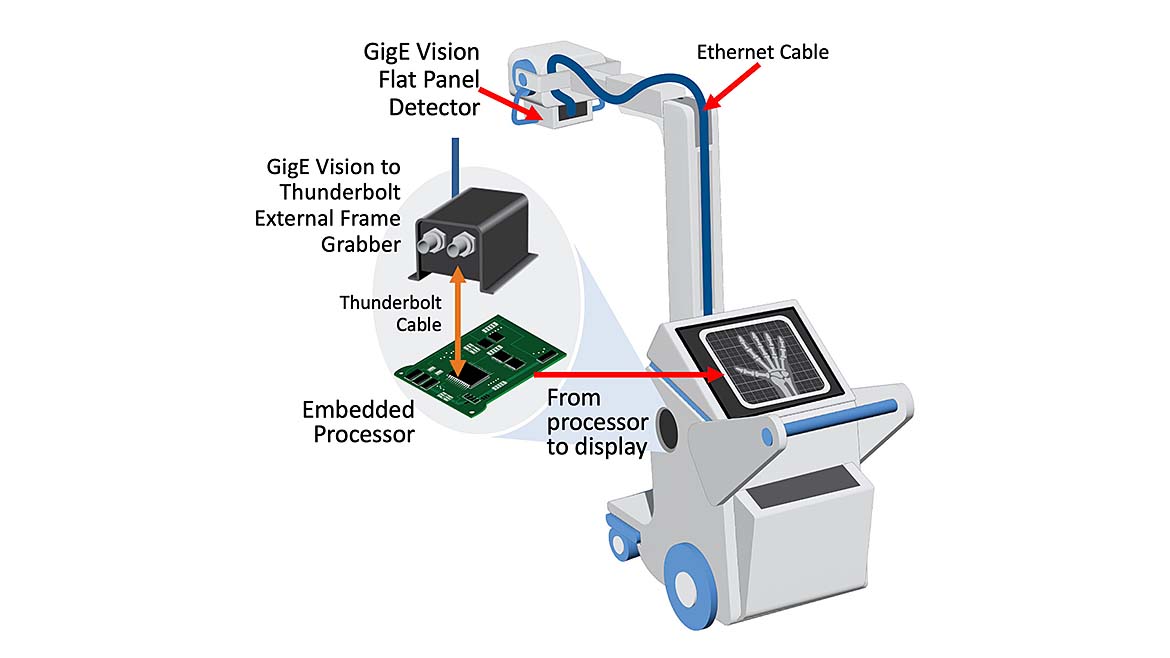
One of the fastest-growing markets for machine vision is point-of-care and mobile diagnostics. Bedside imaging systems in emergency rooms and ICUs, portable veterinary platforms, and mobile health units all benefit from high-speed data transfer and compact form factors. Thunderbolt and RoCEv2 enable real-time display and analysis while reducing hardware costs and improving mobility.
Microscopy and Life Sciences
In life sciences, ophthalmology, and quality control compact systems using high-bandwidth interfaces enable high-resolution imaging with laptop-based processing. These systems are ideal for mobile deployments and space-constrained environments, where traditional industrial PCs are impractical.
Industrial Inspection
Multi-camera setups in electronics and semiconductor inspection require synchronized, low-latency data transfer. RoCEv2 enables real-time defect detection and analysis by bypassing traditional bottlenecks and allowing parallel processing. This improves throughput and reduces false positives.
Defense and Surveillance
Wide-area monitoring systems benefit from RoCEv2’s scalability and low latency. Distributed architectures can support multiple sensors and displays, enhancing situational awareness and threat detection capabilities. These systems often operate in harsh environments, where reliability and performance are paramount.
Conclusion
As machine vision systems scale in complexity and performance, designers must adopt new strategies to manage processing bottlenecks. Technologies such as Thunderbolt, edge processing, and RoCEv2 offer powerful tools to reduce latency, optimize CPU usage, and enable real-time imaging across a wide range of applications.
By addressing the full processing pipeline—from image capture to analysis—these architectural innovations ensure that machine vision systems can meet the demands of modern industry without compromising reliability or cost-efficiency. The future of machine vision lies not just in faster data transmission, but in smarter, more efficient data handling across the entire system.
Looking for a reprint of this article?
From high-res PDFs to custom plaques, order your copy today!