PODCAST | Manufacturing’s Next Top Model
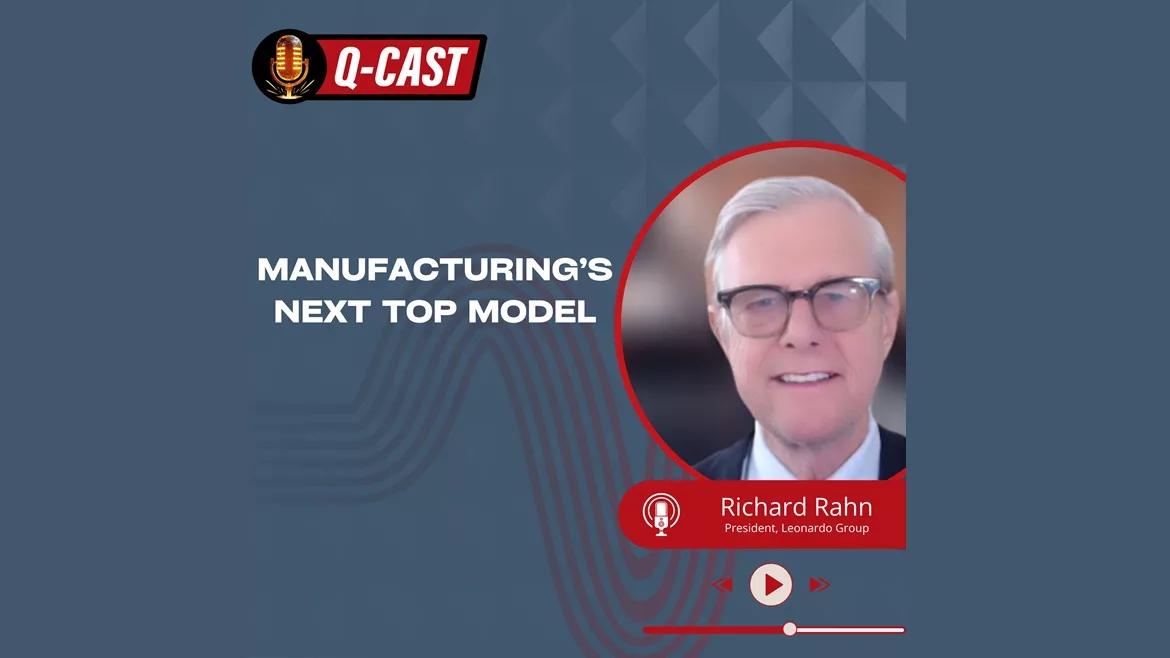
Richard Rahn is the president of the Leonardo Group, and he recently wrote an article for Quality related to digital twins.
Michelle: Could you tell us a little bit more about your experiences with digital twins?
Richard: Sure. Well, I'm going to date myself with these stories, but when I first went to business school, one of the projects I had to work on was doing a model of a ski area, and so this was back in the days, not quite the days where you had to walk to the data center with a shoebox of cards, but not too far off from that. So, in the very early days, I was exposed to modeling pretty early in my business career. But I didn't have a chance to actually use it until I had to actually go out on my own as a lean consultant.
This is in the early 90s now and a project for a major faucet manufacturer, a company that I don't want to mention by name, but you're very familiar with them. And our job was to redesign their assembly factory. And I was in charge for the first time working for a lean consulting company. And I wouldn't say it was a failure, exactly, but there were some questions that came up, some heated discussions with the client and with us.
And so, in reflecting on what we could have done differently, I realized that the reason that we went off track a little bit with that project, with that lean project, was that we didn't or weren't able to really understand the complexity of a mixed model environment, specifically.
We had different work content, different products, and in this particular case, a very short cycle time or takt time. And so, just to understand how this is going to work over a day or a week in your head is no matter how experienced you are, it's basically impossible. And it gets even more challenging if we have a more complex environment. This was the simplest, they gave me the simplest environment you can imagine. Just a few minutes of doing work to assemble a faucet. It's not exactly pushing the limits of complexity. But even so, when you're doing one every 20 seconds all day, a lot of things can go wrong. And really what happened was we were never able to achieve the volumes that we designed it to do.
And the question was always, well, why not? Why aren't we achieving this? And we didn't really know. So, some period later, I realized what we should have done is model it. Of course, we didn't have the software tools or if they existed, they weren't really available to us. We should have modeled that, and that would have pretty quickly showed us what the issue was. And the issue was that small delays add up over the day, so at the end of the day, you don't get the units that you expected.
So, that got me really convinced that modeling needed to be a part of our toolkit. So, any process improvement project, any rebalancing of the line, any new factory designs, should always include simulation modeling.
Listen to the Full Podcast Here:
Looking for a reprint of this article?
From high-res PDFs to custom plaques, order your copy today!