Machine Vision
AI-Powered Machine Vision Technologies Are Revolutionizing Industrial Applications
It’s not just quality assurance benefits.
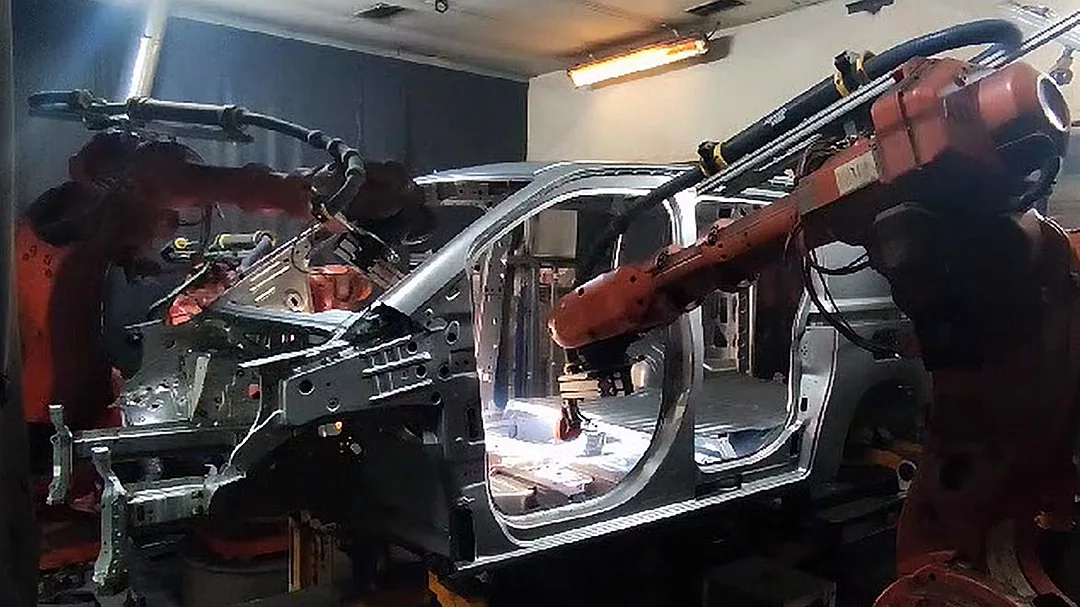
Machine vision application for inspecting weld seams on car bodies.
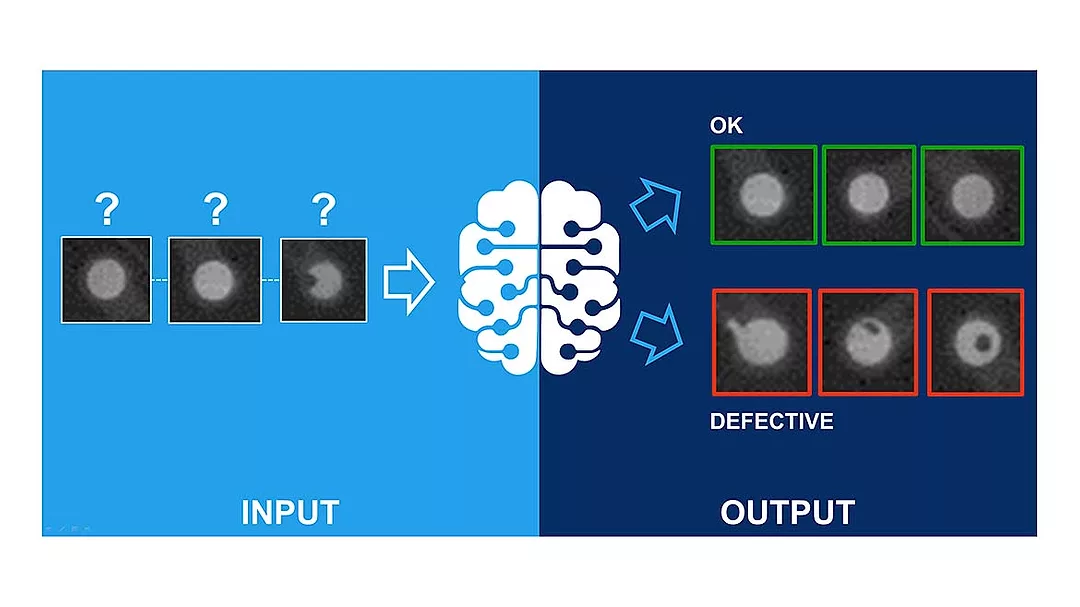
Deep learning-based algorithms learn automatically based on training image data.
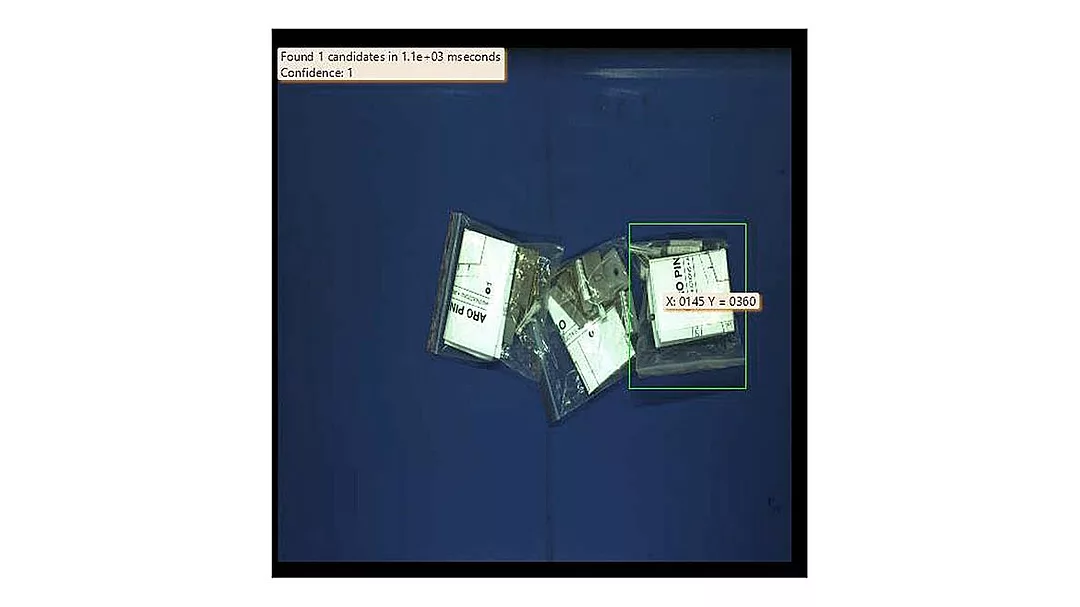
Robust Identification of translucent plastic bags overlapping of lying on top of each other with different contents.
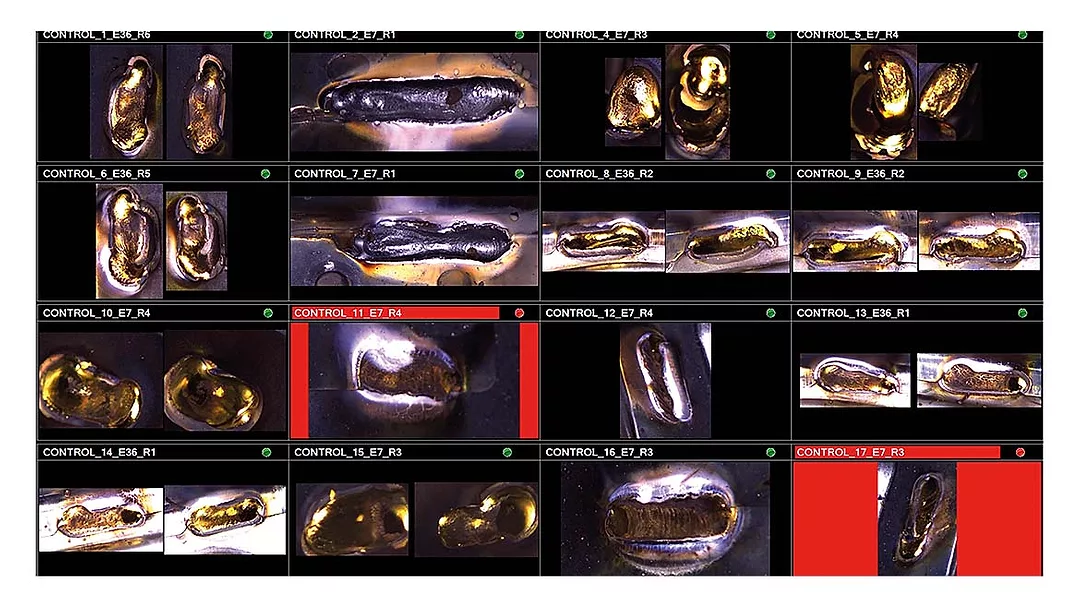
Deep learning technologies detect the difference between OK and NOK welds.
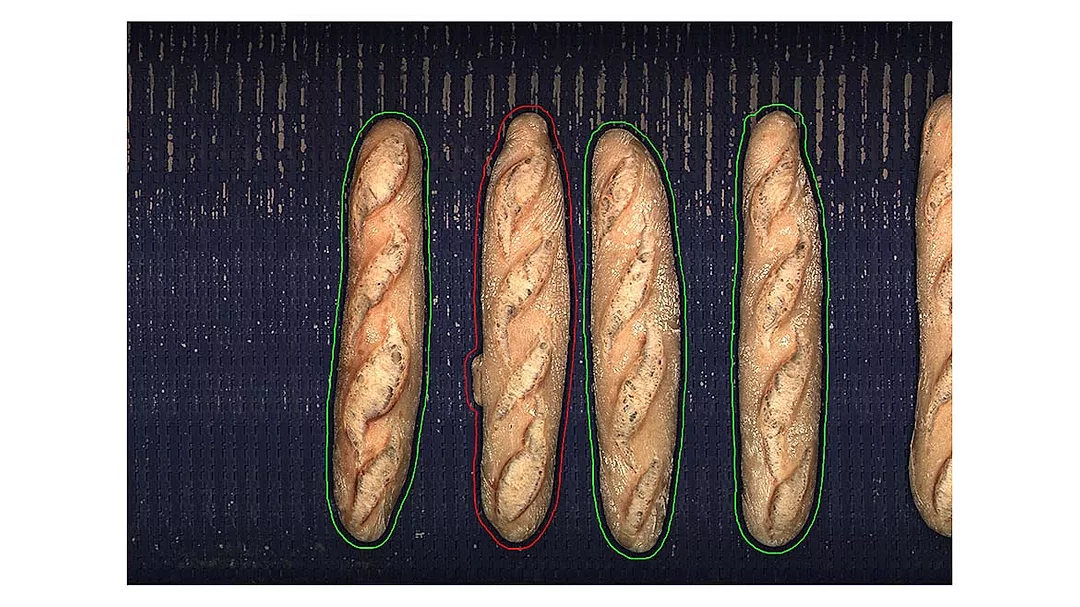
Defect detection on bakery goods.
No two eggs are identical, yet all are edible. This principle applies equally to industrial manufacturing: the diversity of produced parts and potential defects is virtually limitless. The added challenge for quality assurance and identification tasks? Just like with eggs, deviations are often acceptable – meaning not every variation constitutes a defect. This is where deep learning technologies come into play, enabling image processing applications that were previously unimaginable.
Comprehensive, automated defect inspection is indispensable across all manufacturing sectors. It ensures stringent quality standards, minimizes scrap rates, and ultimately reduces costs while boosting customer satisfaction and trust. Manual inspection processes, on the other hand, are significantly slower, prone to human error, and fail to leverage the advantages of digitalization.
Automating inspection workflows is therefore a strategic investment – delivering maximum precision and throughput while freeing human operators for more complex tasks. Machine vision has emerged as a key enabler for automated quality assurance, delivering faster, more reliable, and more robust results than the human eye in most industrial scenarios. Entire workflows are accelerated, achieving inspection cycle times of under 20 milliseconds per component.
Most long-standing machine vision systems operate on a rule-based approach. This means that for every conceivable application scenario, specific algorithms must be programmed to follow predefined rules. These methods can solve a wide variety of tasks quickly and efficiently, enabling companies to achieve significant gains in operational efficiency. That has been the reality of the machine vision world – until now.
The advancements introduced by artificial intelligence (AI) mark the beginning of a new era in machine vision. AI, and particularly its subset known as deep learning, breaks through the limitations inherent in rule-based methodologies.
Opening the door to next-generation machine vision applications
The most transformative advantage of deep learning lies in its reduced programming effort. Instead of hardcoding every defect type, systems undergo automated training using large sets of representative image data. This self-learning capability enables machine vision applications that were previously infeasible.
Take the food industry as an example: natural products exhibit high variability and even change over time – yet remain acceptable for consumption. Deep-learning-based solutions can reliably distinguish between OK and NOK products despite extreme variance, something rule-based algorithms cannot achieve. Techniques like Anomaly Detection ensure accurate classification without false negatives.
Another use case is weld seam inspection, where variability is equally high. Deep-learning-based classification now enables automated, reliable quality assessment – provided the underlying neural network is trained with image data of acceptable welds.
Software can streamline data handling, labeling, and training for such applications. Known defect classes (e.g., scratches, air inclusions, undersized welds) can be defined and trained for precise classification.
Beyond inspection: advanced automation scenarios
Deep learning also optimizes complex bin-picking and pick-and-place operations. For rigid CAD-based objects, deep 3D matching enables 3D bin picking using only 2D image data. For deformable or translucent items – such as plastic bags containing assembly parts – methods like object detection and gripping point detection allow robots to grasp objects reliably, even when stacked or randomly oriented. Robust performance is achieved through extensive image-based training, accommodating virtually infinite shape and position variations.
Another domain enhanced by deep learning is optical character recognition (OCR). Traditional OCR struggles with reflections, surface irregularities, and inconsistent lighting. Deep OCR maintains high recognition rates under these conditions, accurately localizing characters regardless of orientation, font, or polarity. It also groups characters into words and eliminates misinterpretations of visually similar symbols, significantly improving accuracy – even for hard-to-read text – thanks to pre-trained deep neural networks.
Proven in real-world use cases
These technologies are integral to our standard machine vision software, delivering measurable benefits across diverse industries. One more notable real-world example comes from the automotive sector: a global manufacturer of premium car batteries leveraged the manufacturer’s vision software to automate the entire cell assembly process, including visual inspection and packaging. The result: defective products were prevented from leaving the plant, and false-negative classifications dropped by 57.3%, driving both quality and efficiency gains.
Bridging deep-learning- and rule-based machine vision to enable new applications
Machine vision, and in particular deep learning, demonstrates through its broad range of methods and use cases that it is indispensable for modern quality assurance across all manufacturing sectors. Its precision and high-speed performance help reduce costs, optimize resource utilization, and maintain customer satisfaction through consistent product quality.
Having said that, both rule-based algorithms and deep learning approaches have their place in industrial automation. The most groundbreaking machine vision applications leverage the strengths of both paradigms. By combining these technologies, manufacturers can achieve maximum robustness and throughput in automated inspection and handling tasks.
With advanced machine vision platforms, users can seamlessly access and integrate rule- and deep-learning-based methods within a single workflow. This hybrid approach enables new applications to be automated with maximum speed and exceptional robustness. And in the end, it ensures that every component, just like every egg, finds its proper place in its packaging box.
Looking for a reprint of this article?
From high-res PDFs to custom plaques, order your copy today!