Robotics
What Should Quality Professionals Know About the Updated U.S. Robot Safety Standard?
The Association for Advancing Automation recently released ANSI/A3 R15.06-2025, the first major revision of the U.S. safety standard for industrial robots since 2012.
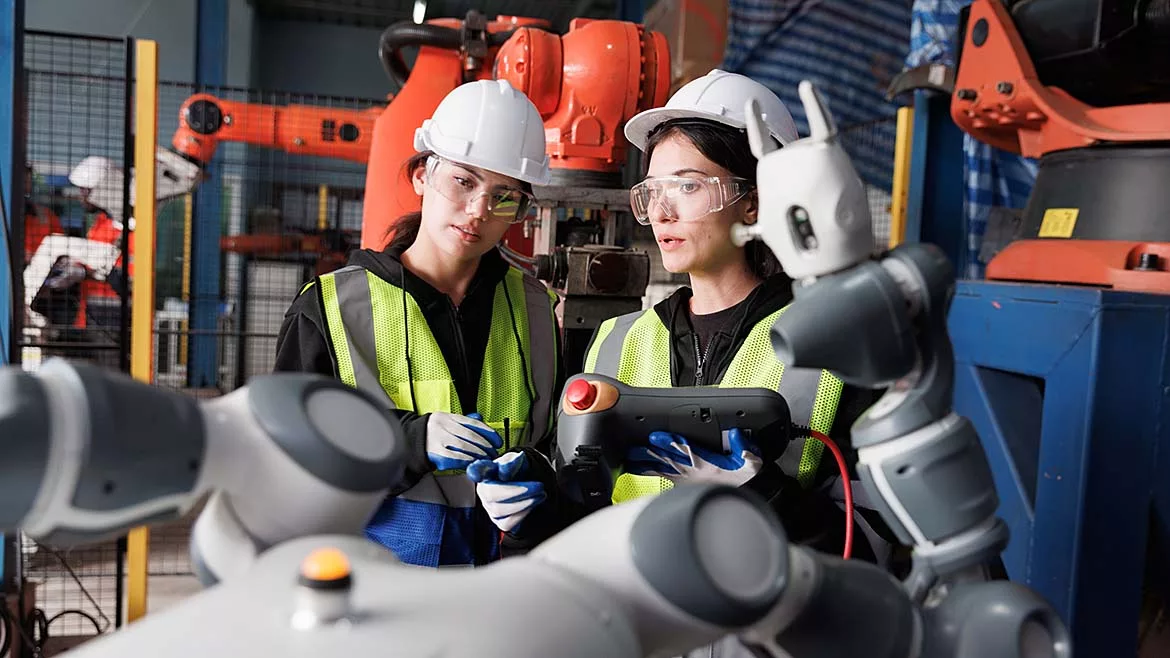
Robots are no longer confined to fenced cells performing repetitive tasks on the factory floor. Today, they operate alongside people, integrate with advanced technologies and help support increasingly flexible production environments. As robotics adoption continues to expand, it brings both new opportunities for efficiency and new challenges for safety and system design.
Modern robotic systems interact with broader manufacturing ecosystems, meaning they needed a major update to their safety framework. To address this need, the Association for Advancing Automation recently released ANSI/A3 R15.06-2025, the first major revision of the U.S. safety standard for industrial robots since 2012.
The new standard is not just a safety milestone, it’s a call to action for industrial companies around the world. There is a direct impact to millions of people working in these industry environments, especially quality teams.
Why is the new standard needed?
This was the first update to the flagship safety standard in over 13 years, and the world of robotics has fundamentally changed in that timeframe. In 2012, most industrial robots operated in fixed, highly controlled environments and were usually physically separated from workers by guarding systems.
Since then, automation technology and how manufacturers deploy it within their operations has changed significantly. Modern factories involve daily human-robot collaboration, and robots are not necessarily separated from workers or dynamic production cells. Here are the major shifts in technology that prompted this new standard:
- The rapid growth of collaborative robot applications
- Increasing deployment of robots outside traditional cages
- Greater integration with machine vision and artificial intelligence
- The expansion of robotics adoption beyond automotive manufacturing
- The rise of flexible production cells and reconfigurable automation
Safety now must be evaluated across the entire robotic ecosystem, not just the individual robots themselves. This means teams must consider interactions between robots, tools, sensors, software, human operators and surrounding equipment. The updated standard supports this system-wide safety approach by delivering clearer guidance, better classifications and a safety roadmap for the intelligent automation era.
What should your quality teams know about the standard?
Robot safety might often be under the purview of engineering or environmental health and safety teams, but this updated standard has important implications for quality professionals responsible for system validation, documentation and compliance.
As robotics adoption expands and systems grow more complex, quality teams have an important role in safe, reliable and compliant operations. New validation procedures and traceability for compliance and audit purposes are needed more than ever before.
The updated standard also provides clarity on the growing collaboration between humans and robots.
The terms “collaborative robot” and “collaborative application” have, in the past, been used interchangeably—but the term “collaborative robot” is no longer used.
A collaborative application refers to the overall system in a shared workspace between humans and multiple robots.
The updated standard emphasizes evaluating the entire application, not just the robot itself. Even those robots designed with safety functions, such as power and force limiting and speed and separation monitoring, that allow them to collaborate with humans, require careful risk assessment when deployed in real-world production environments. Now, quality professionals must verify how safety controls operate within the complete system, including end-of-arm tooling, rather than assuming inherent equipment safety of an individual robot.
Documentation and traceability in robotic applications
Documentation has always been a core function of quality management systems, but advances in technology introduce new considerations for quality teams. Today’s robotic applications often involve multiple vendors, integrators and software components. In automated environments with reprogrammable systems, accurate documentation becomes critical.
The updated standard encourages organizations to maintain clear documentation describing how robotic systems are designed, validated and maintained. This documentation may include:
- Risk assessment records
- Safety validation procedures
- System configuration details
- Change management documentation
- Maintenance and inspection records
From a quality perspective, these records support both internal process control and external audits.
They also provide critical context in the event of incident investigations or regulatory reviews. And because robotic systems can evolve over time through software updates or process modifications, traceability becomes a key component of maintaining safe operations.
The expansion of robotics in the “Year of Complexity”
2026 has been dubbed “The Year of Complexity” by industry professionals, and it’s already living up to its name. Manufacturers have been facing competing pressures such as labor shortages, supply chain volatility and rising compliance expectations. At the same time, these companies are being asked for more product variation and customization with greater efficiency—all while managing budget constraints.
Automation—particularly robotics—has become one of the primary tools manufacturers are using to thrive amid this complexity. In 2025, North American companies ordered 36,766 robots valued at $2.25 billion, representing a 6.6% increase from 2024 and a 10.1% increase in revenue.
This market expansion has been driven in part by advances that allow robotic systems to operate more flexibly within dynamic production environments. Robots can now perform tasks such as handling parts and inspecting products using vision-guided systems. They are also now able to better operate within mixed human-robot workspaces. Robotics aren’t being used to replace all workers, but to support them by handling repetitive or high-precision tasks. This enables human employees to focus on higher-
value activities.
To put it simply, today’s manufacturing environment is much more complex. Robotic systems often involve multiple integrated technologies, including vision systems, safety scanners, programmable logic controllers and networked industrial software. Production cells may need to be reconfigured frequently to accommodate new products, shorter production runs or evolving customer demands.
This is one of the key reasons the updated ANSI/A3 R15.06-2025 Robot Safety Standard places greater emphasis on evaluating safety at the system level rather than focusing solely on the individual robot itself.
A practical checklist for quality teams
As organizations work to implement the updated safety framework, quality professionals can take several practical steps to support safe and effective robotic deployments.
- Review the updated standard. Understanding how these new safety standards apply to robotic systems can help quality teams in cross-functional discussions.
- Strengthen documentation and safety validation in existing quality management processes. This may include updating validation protocols, strengthening change management procedures and confirming that automated systems are included in proactive audit planning.
- Collaborate with engineering and safety teams. Robot safety is multidisciplinary, so it’s important to involve mechanical design, controls engineering and safety teams.
- Stay informed on evolving safety standards. As automation technologies continue to advance, standards and best practices continue to evolve. Staying informed helps quality teams anticipate compliance requirements and maintain safe production environments.
As robotics adoption continues to grow, the intersection of automation, safety and quality will become an increasingly important consideration for manufacturers navigating the complex production environments of today’s factory floor.
If you are interested in learning more, industry experts will discuss the implications of the updated standard at Automate 2026. At the show, automation and safety professionals will explore evolving best practices for robotic system design, risk assessment and safety in automation and manufacturing.
Looking for a reprint of this article?
From high-res PDFs to custom plaques, order your copy today!