Software
Driving Quality in a World That Won’t Slow Down
Let’s look at several steps in a typical seamless production process and how they ultimately ensure that quality products are produced and delivered on time.

Today, quality is an economic engine in its own right—driving productivity, customer loyalty, and profitability. Yet, as manufacturers face greater demands to ensure quality, they must also keep pace with a global market that is accelerating under economic pressure on one side and environmental constraints on the other.
Quality assurance as a process has evolved from discrete steps to an integral, real-time part of the manufacturing operation. Quality today involves not only inspections during and after production, but also the continuous monitoring of the entire production lifecycle. This includes the validation of raw materials; the certification of production workers; the proper calibration of tooling and production equipment; and even the labeling, packaging, and shipment of goods.
The seamless delivery of goods at every step in the supply chain has become an integral part of today’s competitive commercial equation. Whether it is a contracted manufacturing step in a complex finished good or the final assembly of a product for delivery to the end user, market expectations are for a perfect product delivered within a very short timeframe at a competitive price. Availability, product performance, and pricing information have never been more visible to both commercial and consumer customers, making anything less than excellence a competitive disadvantage.
Integrated Technologies Fill Quality Gaps
Fortunately, as market demand for end-to-end quality performance has grown, so have the manufacturing technologies available to deliver a seamless flow of product. For example, material requirements planning (MRP) software tracks raw material inventory. A manufacturing execution system (MES) monitors production status. A quality management system (QMS) records inspection data. And a warehouse management system (WMS) tracks the location of finished goods.
In the past, these legacy systems often operated as islands of information, creating the need for discrete steps in manufacturing that could lead to errors and costly delays. However, modern versions of these technologies are highly integrated and connected to the same data sources. For mid-size companies, there are even some solutions that provide an entire portfolio of manufacturing modules within a single product residing on a single database.
Taken as a whole, these integrated technologies are often referred to as manufacturing enterprise resource planning (ERP), and they enable the continuous flow required to adapt and respond quickly to changing conditions.
When manufacturing ERP is in place, the production lifecycle of a product is traced through the genealogy of production runs, including lot and serial numbers. These unique identifiers are assigned at the time a production work order is created and provide the means to document and track compliance and processes from the earliest stages of production through final shipment, effectively creating a seamless production process.
Let’s look at several steps in a typical seamless production process and how they ultimately ensure that quality products are produced and delivered on time.
Linking Sales to Achievable Commitments
At the onset of a sale, a process typically known as capable to promise (CTP) is run within the manufacturing ERP system. CTP evaluates the resources necessary to produce a product, including materials, labor, and equipment. It identifies any resource gaps between the desired delivery date and available capacity, suggesting ways to close those gaps or recommending a more realistic delivery date. In this way, CTP acts as an agent to ensure accurate and achievable delivery commitments to customers.
Setting Up for Success
Once an achievable delivery date is agreed upon and a sales order is created, the production work order is generated, and the material requirements planning process is initiated. MRP software orders or reserves all necessary materials and allocates the required labor, tools, and production equipment. This step effectively provisions and schedules the job. It also creates the lot and serial numbers that serve as the unique identifiers of the product throughout its lifecycle.
At the initiation of production, the necessary resources are brought together and validated. Raw materials are certified as correct through required QMS steps, tooling and equipment are validated through the maintenance, repair, and operations (MRO) process, and operator training and certification are confirmed through human capital management (HCM) records.
While this may sound like a series of discrete steps, these activities are part of a prescribed manufacturing ERP workflow that must be followed and acknowledged before a job is allowed to start. The signoffs and records are automatically captured in the ERP system. Failure to complete and acknowledge a required step results in an alert being issued to management, which must be resolved before the job can proceed.
Monitoring Production Performance
Once the job is in production, three real-time quality monitoring processes are at work: production monitoring, in-line quality inspections, and process monitoring.
Production Monitoring tracks the progress of production—for instance, how many cycles a machine has run or how many parts have been assembled. It is one of the clearest examples of the value of end-to-end integration across manufacturing ERP functions.
Production monitoring measures progress against the planned schedule, informs inventory and financial systems of raw material consumption, and updates the MRO module with runtime data on tools and equipment. In this way, production monitoring acts as the real-time “eyes and ears” of production operations, backflushing actual production results throughout the organization.
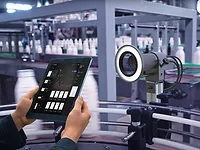
In-line quality inspections take place directly on the production line and may include manual checks, such as dimensional measurements or cosmetic assessments, as well as automated inspections performed by cameras and digital instrumentation. In all cases, the key characteristics are real-time measurement and recording within the QMS features of the manufacturing ERP system.
If persistent problems are detected, supervisor alerts are issued and processes may be halted. Additionally, out-of-specification products are diverted to scrap queues and recorded as defective quantities. This provides multiple benefits: defects are removed early, samples are retained for statistical process control (SPC) analysis, and accurate counts of good parts are maintained.
Process monitoring, rather than tracking output, focuses on the operating parameters of production equipment. These include variables, such as temperature, pressure, and amperage. Such parameters are strong indicators of whether a process is operating correctly or trending out of specification.
As with production monitoring and in-line inspections, process data is recorded by time, serial number, and lot number, in histogram formats. This data is monitored in real time and can trigger alerts for supervisor intervention or even automatically halt production if necessary.
Histograms and other historian data are not only valuable for real-time intervention but also serve as invaluable resources for root-cause analysis. Today, historian data is often shared with customers as proof of proper production controls and inspection—a clear value-added service provided by the manufacturer.
Ensuring Accurate Labeling
In today’s fast-moving, digital supply chains, mislabeled products can significantly damage a manufacturer’s reputation. Accurate, machine-readable labels are essential for both commercial and consumer customers. For this reason, most manufacturing operations automatically generate and apply digital labels at the point of production.
Leveraging the manufacturing ERP system, these labels contain not only descriptive product information but also machine-readable data that supports material handling systems and ensures traceability through lot and serial numbers, including recall capability if necessary.
Bringing It Together With Fulfillment
Final fulfillment to customers is another area where quality assurance directly impacts customer satisfaction and competitive advantage. It’s also a culmination of the multiple processes coming together.
For example, the combination of production monitoring, in-process inspection, process monitoring, and lot-level tracking provides inventory control with accurate visibility into when, where, and how much finished goods product is available for shipment. Meanwhile, accurate, machine-readable labeling ensures that finished goods are stored in the correct warehouse locations. Likewise, directed, scanner-based pick, pack, and ship functionality within a WMS ensures shipping accuracy.
This is yet another example of how integrated workflows not only drive quality on the shop floor, but extend that value chain all the way to the shipping dock, and ultimately, to the customer.
Conclusion
Quality today is not just a department or a lab with gages and computerized measuring equipment. It is an integral part of every step in the manufacturing process. At the same time, the world shows no signs of slowing down, and the pace of information flow is approaching real-time in almost every aspect of business.
Keeping up means configuring manufacturing operations with integrated end-to-end information technology that supports the ability to run without disruption, meet compressed deadlines, and deliver quality-assured products. Equally important, it lays the foundation for building a resilient, competitive business that delivers value to customers and minimizes waste and lost profits.
Looking for a reprint of this article?
From high-res PDFs to custom plaques, order your copy today!