Automotive
Closing the Quality Gap Between Computer-Aided Engineering and Real-World Automotive Manufacturing
There is a persistent gap between what computer simulation predicts and what the production floor delivers. Research now shows exactly how to close it.

Every vehicle begins as a simulation. Before a single tool is built or a single part is pressed, engineers model how materials will behave, how components will form, and how structures will perform under load. Computer-aided engineering — CAE — has become one of the automotive industry's most powerful tools, and its adoption is accelerating. The global CAE market was valued at nearly $11 billion in 2024 and is projected to reach $25 billion by 2032.
And yet the industry is in the middle of a warranty and quality crisis unlike anything in recent memory. Ford spent $4.8 billion in a single year fixing vehicles it had already sold — four percent of its automotive revenue, three times the industry average. Global warranty reserves hit a record $64.8 billion in 2023, up 17 percent in a single year. Vehicle recalls in the United States have risen 42 percent over the past decade. Scrap and rework costs the average manufacturer up to 2.2 percent of annual revenue — every year, with no end in sight.
These costs do not come from careless engineering. They come from a gap — a persistent, costly, and largely invisible gap between what the digital model assumed and what the physical production line actually delivers. Closing that gap is one of the defining challenges of automotive manufacturing quality today. And the industry is beginning to find real answers.
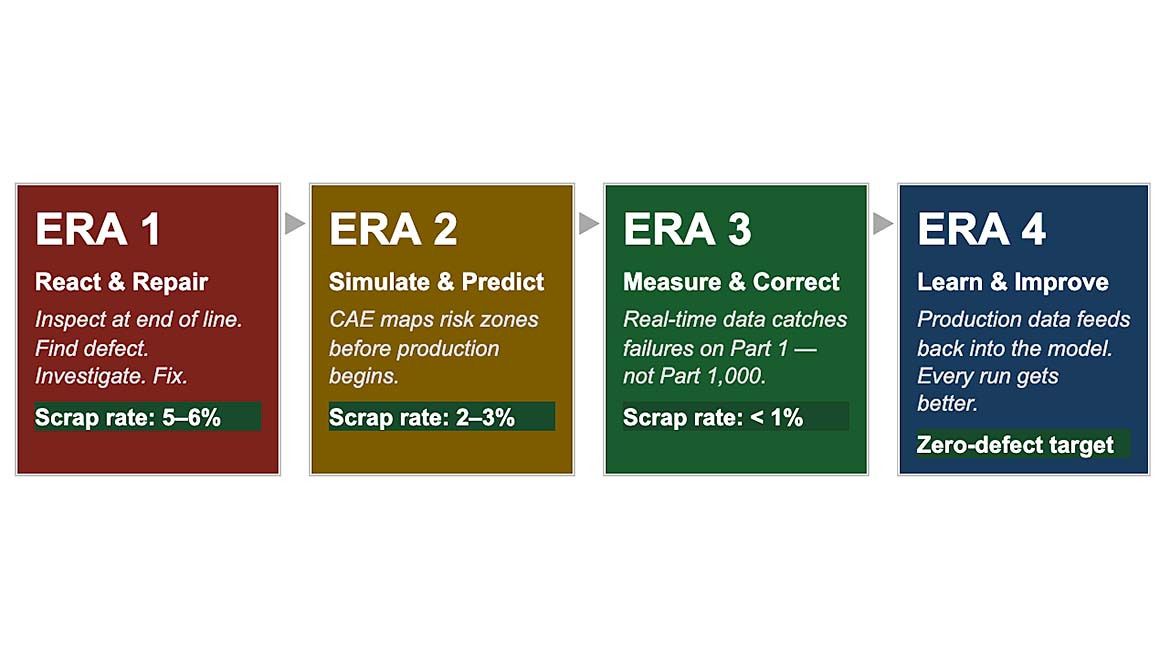
The Quality Maturity Journey — Four Eras of Automotive Manufacturing
Automotive manufacturing quality has evolved through distinct stages. Understanding where an organization sits on this journey — and what the next stage looks like — is the starting point for closing the gap between simulation and production.
Why the Gap Exists — and Why It Persists
Computer-aided engineering works by modelling reality. It simulates how steel will deform under forming loads, how tooling will interact with material, how process parameters will affect output quality. When the model is accurate and its assumptions hold, it is extraordinarily effective — AI-assisted simulation has already cut die validation timelines by 31 percent in leading automotive operations.
The problem is that production lines do not behave like models. Material properties vary from batch to batch. Tooling wears gradually and unevenly. Lubrication is applied by humans under time pressure. Temperature and humidity affect how metal behaves under forming loads. These variables mean that even a well-validated simulation can diverge from production reality — not dramatically, but by enough to turn a process that looked safe on screen into one that produces defects on the floor.
In advanced high-strength steel stamping — the materials that now form the structural core of modern vehicle safety systems — the margin for that divergence is almost nonexistent. These steels are engineered to be extraordinarily strong but stretch less before they crack, which compresses the forming window and leaves no buffer for process variation. Traditional end-of-line inspection, which catches only 65 to 80 percent of defects even under ideal conditions, is structurally unsuited to managing this challenge.
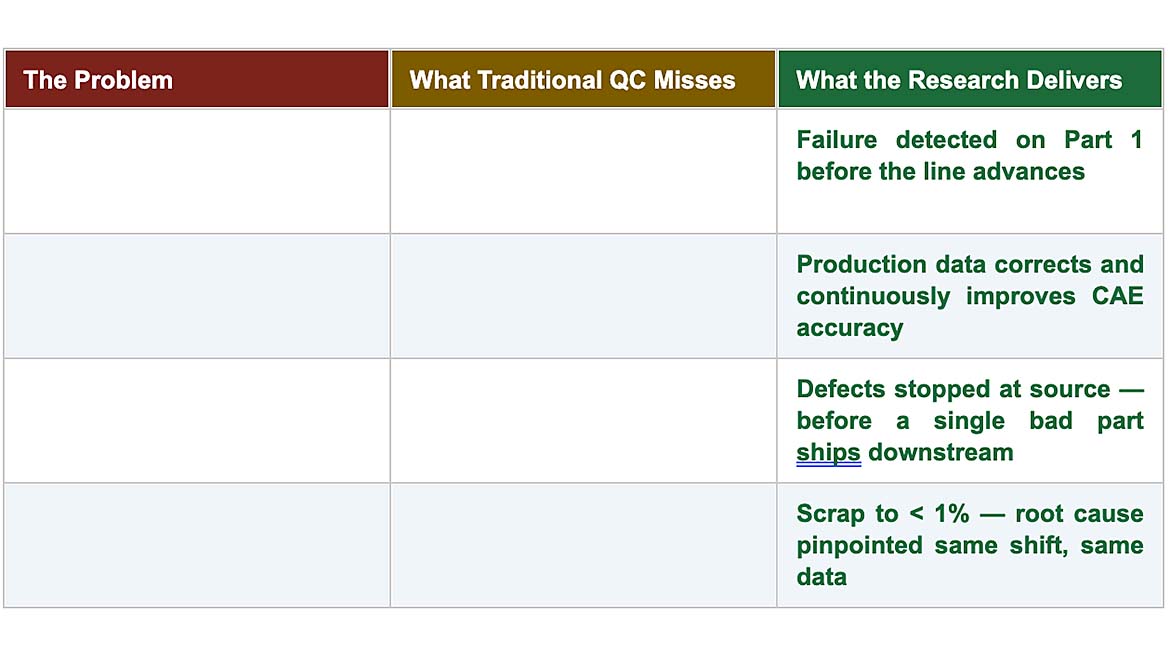
The Quality Gap — Problem, Persistence, and Resolution
Four of the most consequential quality problems in automotive stamping — what they are, why conventional approaches cannot solve them, and what research demonstrates when the gap is actively closed.
What Closing the Loop Actually Looks Like
The solution to the CAE-to-production gap is not to replace simulation. It is to connect simulation continuously to what is actually happening on the production floor — creating a closed loop in which each informs and improves the other.
In practice, this means deploying real-time measurement systems — optical, sensor-based, or vision-driven — that can capture forming quality data on production parts within minutes of manufacture. That data is compared against what the CAE model predicted. Where they align, production confidence increases. Where they diverge, engineers have immediate, precise information about what is different and where to act — before the problem multiplies across a full production run.
In a documented production case, this approach was applied to a structural automotive body panel formed from one of the most demanding advanced steels in common production use. The CAE simulation predicted the process was within safe limits. The first production part, measured in real time using optical forming analysis within minutes of pressing, revealed the simulation was wrong — the steel was being formed beyond its safe threshold in a critical zone. A forming failure had already begun, hidden beneath the part geometry and invisible to conventional inspection.
The measurement data identified the location and root cause precisely. A targeted correction was made to the tooling and process. The next part was measured immediately — the problem was gone. In the two thousand parts produced after that correction, not a single forming failure occurred. Scrap rate went from a projected five percent to effectively zero. And when the production measurement data was fed back into the CAE model, the simulation became more accurate — better calibrated to the actual production conditions, and more reliable as a guide for future programs.
Chart 1: Quality KPI Tile Grid — Before vs. After Closing the CAE-to-Production Gap
Across seven key quality metrics, the performance data from the production case study — an automotive advanced steel stamping line producing 108,000 panels per year — shows the magnitude of change when real-time measurement and CAE simulation operate as an integrated closed-loop system.
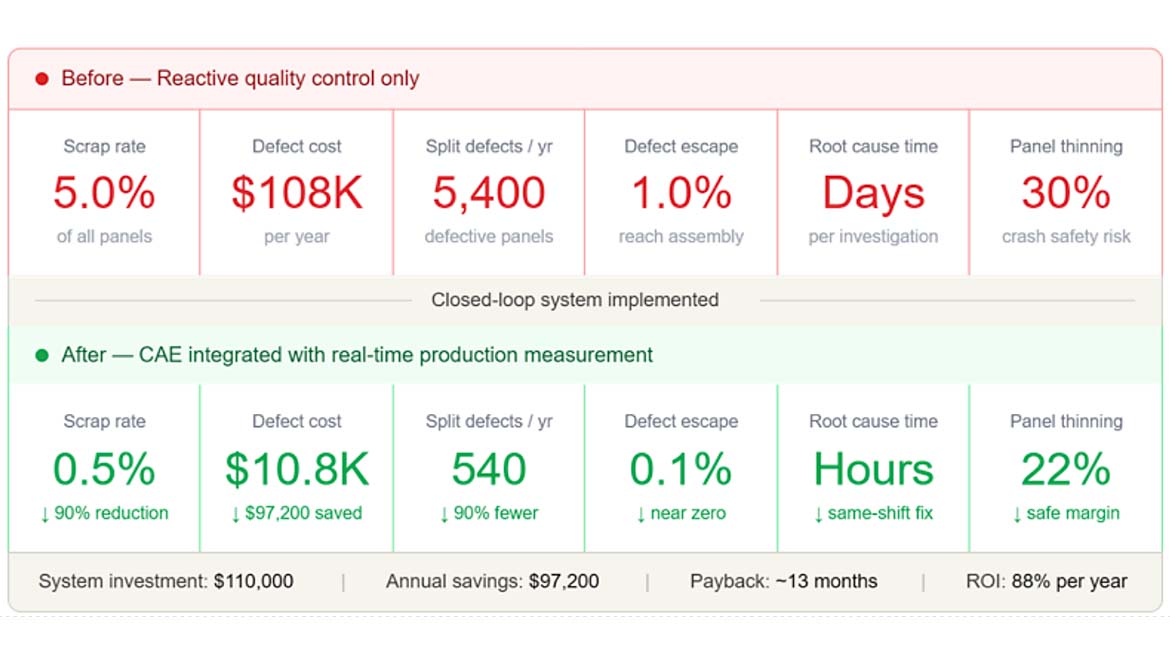
Data source: All quantitative values in this chart are drawn directlyfrom peer-reviewed research: Patel, K. (2024). Enhancing Stamped Part Quality: Real-Time Split Detection to Eliminate PanelWaste. International Journal of Scientific Research and Management (IJSRM), Vol. 12, Issue04, pp. 1165–1179. DOI: doi.org/10.18535/ijsrm/v12i04.ec07
The Technologies Making This Possible — and Who Is Already Using Them
The automotive industry's leading manufacturers are not waiting. BMW's GenAI4Q program adapts quality checks dynamically to each individual vehicle configuration, eliminating the one-size-fits-all inspection model. Volkswagen has embedded more than 1,200 AI applications across its factories, many targeting defect detection and process stability in real time. Toyota uses digital twins of its European manufacturing plants to simulate production changes without disrupting live operations. General Motors applies predictive maintenance platforms that monitor production equipment and anticipate failures before they affect output. Volvo's augmented reality inspection system has cut inspection time by 90 percent and training time by 60 percent.
AI-enabled predictive maintenance, industry data shows, can reduce unscheduled downtime by 35 to 50 percent. Computer vision quality systems are catching defects with accuracy that matches — and frequently exceeds — human inspectors. AI-assisted simulation has already compressed die validation from ten weeks to six. And as NVIDIA announced in 2025, CAE simulation performance is accelerating up to 50 times faster on next-generation hardware, making real-time comparison of simulation prediction and production measurement increasingly practical as a standard production tool.
But technology adoption alone does not close the gap. What the research demonstrates is that the most powerful lever is the connection between tools, not any individual tool. When CAE simulation and real-time production measurements operate as a single integrated system — each informing and improving the other — the gap between digital prediction and physical production narrows continuously. Every production run teaches the model something new. Every new vehicle launches benefits from everything the system has already learned.
The manufacturers who build this capability now will find that the gap between simulation and reality becomes smaller with every part they make — and every warranty reserve, every recall, and every scrap pile becomes smaller with it. The cost of leaving the gap open is $64.8 billion and climbing. The cost of closing it is a system that gets better every time it runs.
References
- Patel, K. (2024). Enhancing Stamped Part Quality: Real-Time Split Detection to Eliminate Panel Waste. International Journal of Scientific Research and Management (IJSRM), 12(04), 1165–1179. https://di.org/10.18535/ijsrm/v12i04.ec07
- Warranty Week (2024). Worldwide Auto Warranty Report. warrantyweek.com
- NHTSA / AutoInsurance.com (2025). Car Recall Facts and Statistics 2025.
Looking for a reprint of this article?
From high-res PDFs to custom plaques, order your copy today!