Measurement
Closing the Gap Between Lab and Line
Bridging R&D and production with standardized color, appearance and physical property testing.
I. Introduction
One of the most persistent challenges in manufacturing is translating laboratory success into production reliability. Laboratory testing establishes product performance under controlled conditions, but scaling those results to the production line introduces new variables that can alter both visual and physical properties of the product. The laboratory’s role is to simulate real production environments while achieving the desired performance targets; however, discrepancies often arise when lab expectations diverge from the realities of production.
This article examines the critical attributes of a product’s specification and explores how controlling production variables, supported by standardized testing methods and digital communication, can ensure that the performance of the coating in the lab performs equally well on the line.
II. Understanding the Lab-to-Line Gap
Bridging the gap between research and manufacturing begins with understanding the differences between laboratory development and full-scale production. In the lab, target specifications are established for surface qualities, including color, appearance, and texture, as well as physical properties such as abrasion resistance, adhesion, film thickness, hardness, and viscosity. These qualitative characteristics are translated into measurable, quantitative values that can be tracked and verified in production.
The challenge lies in maintaining those values across vastly different environments: the controlled precision of the lab versus the variable conditions of the production floor.
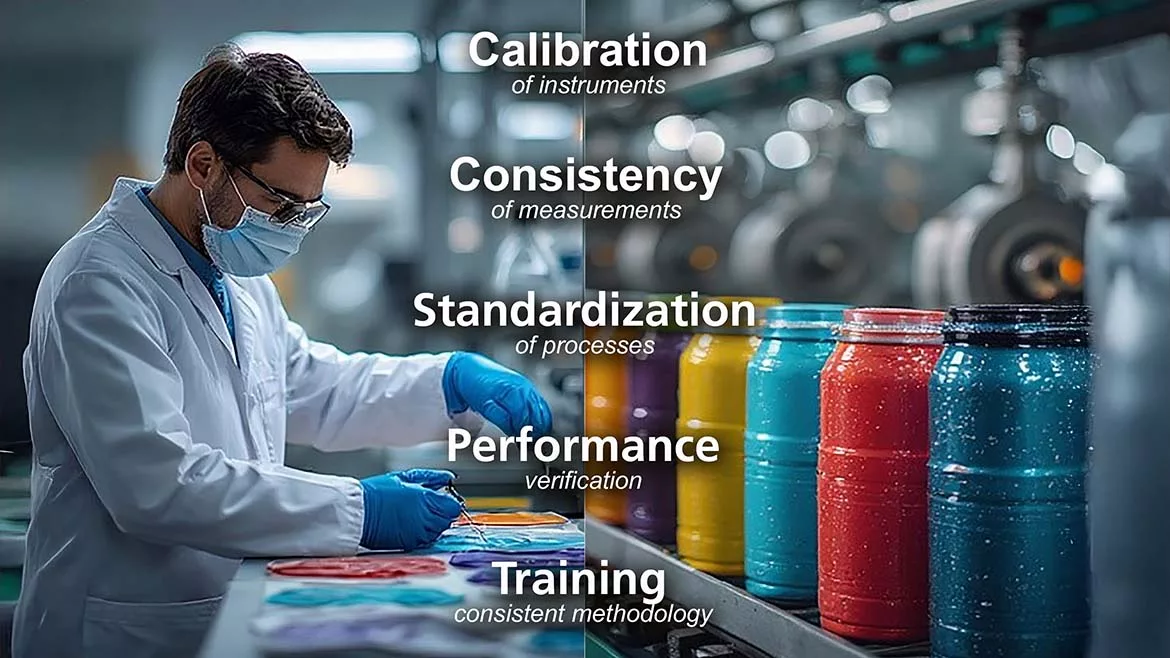
Consistency depends on controlling key factors, including:
- Calibration and recertification of instruments
- Illuminant and color equation alignment
- Inter-instrument agreement
- Instrument geometry consistency
- Operator training and procedural standardization
- Measurement of both visual and physical property performance
Managing these variables ensures measurement integrity and reproducibility, fundamental to achieving true lab-to-line correlation.
III. Defining and Measuring Performance Parameters
The most effective way to avoid unexpected production outcomes is to maintain the same measurable parameters established in the lab throughout the manufacturing process. This begins by assigning quantitative values to performance criteria during the design phase.
For example, accurate color assessment requires defining instrument geometry, illumination, observer angle, and the color difference equation. Incorporating digital color standards further strengthens this process by ensuring color data can be shared seamlessly between lab and production systems. These digital references eliminate subjectivity in visual evaluations, accelerate approval cycles, and ensure that every batch aligns with the approved target standard.
Implementing robust testing procedures establishes clear parameters to monitor and control production variables, ensuring adherence to quality standards and consistent customer satisfaction.
Critical Attributes/Properties to Align Lab and Production
| Property | Measurement Tool | Purpose / Notes |
|---|---|---|
| Viscosity / Flow | Stormer, Zahn, Ford, or Rotational Viscometers | Production release criterion |
| Color / Appearance | Spectrophotometer, Gloss Meter, Visual Light Booth (D65) | ΔE, color tolerance, gloss, haze |
| Density / Weight per Gallon | Digital Density Meter, Density Cup | Batch consistency |
| Solids by Weight / Volume | Oven, Infrared Dryer, or Density Calculations | Coating formulation accuracy |
| pH / Conductivity | pH Meter | Stability indicator (water-based systems) |
| Film Thickness (Wet/Dry) | Wet Film Gauge, Magnetic Dry Film Gauge | Confirm target coating build |
| Dry Time / Tack-Free | Drying Time Recorder, Stopwatch Method | Verify cure schedule |
| Adhesion | Crosshatch Cutter (ASTM D3359), Pull-Off Tester | Substrate bonding strength |
| Hardness | Pencil Hardness Tester, König or Persoz Pendulum | Surface durability |
| Impact Resistance | Impact Testers | Flexibility and toughness |
| Flexibility / Mandrel Bend | Conical or Cylindrical Mandrel Tester | Crack resistance on deformation |
| Gloss / DOI | Gloss Meter, DOI Meter, Orange Peel | Surface appearance quality |
| Opacity / Hiding Power | Spectrophotometer, Drawdown Cards | Coverage efficiency |
| Surface Profile / Roughness | Profilometer, Gloss Meter | Important for adhesion and appearance |
| Chemical Resistance | MEK Rub Test, Spot Tests, Immersion Testing | Resistance to solvents, acids, or alkalis |
| Corrosion Resistance | Salt Spray (ASTM B117), Humidity & Weathering Tests | Protective coating & UV performance |
IV. The Role of Reliable Testing Equipment
Reliable testing equipment serves as the critical link between laboratory validation and production performance. In the lab, precise instruments verify material properties, confirm product formulations, and define process parameters under controlled conditions. On the production floor, the same level of accuracy ensures these validated parameters translate into consistent, real-world results. This covers everything from physical characteristics like coating adhesion, hardness, and resistance to visual qualities like color and appearance.
Understanding inter-instrument agreement helps set realistic expectations for reproducibility between environments. When instruments provide accurate, repeatable data across both lab and line, they create a unified feedback loop that enables early deviation detection, maintains quality standards, and minimizes costly rework or downtime. Dependable testing tools ultimately allow manufacturers to scale production with confidence, ensuring consistency in every batch.
V. Calibration and Recertification of Instruments
Instrument calibration is essential to maintaining data integrity and confidence in measurement results. Each instrument should be calibrated according to manufacturer recommendations and recertified annually, ideally traceable to NIST or equivalent standards.
Regular maintenance and recertification not only extend equipment life but also minimize downtime and prevent measurement errors. Inconsistent or unstable instrumentation can undermine even the most rigorous quality systems, introducing uncertainty into the data used for decision-making. Standardizing instruments, calibration routines, and data reporting across R&D and production ensures faster scale-up, higher first-pass yield, and greater overall reliability.
VI. Monitoring and Controlling Production Variables
To prevent costly production errors, testing instruments should be utilized at every stage of manufacturing from evaluating incoming raw materials to conducting in-process checks and final inspections. Incoming material testing focuses on variations in viscosity, density, color, and appearance, ensuring consistency before production begins.
The use of digital standards and integrated software platforms strengthens this process by creating a seamless communication link between the lab and production. Digital standards provide quantifiable reference data for color, gloss, film build, and appearance that is verified and shared electronically. Integrated software enables real-time data collection, automatic comparison to target tolerances, and immediate feedback to operators when deviations occur.
During in-process testing, critical production variables including oven temperature, fluid flow, film build, and line speed are closely monitored alongside material properties such as viscosity, dry time, adhesion, hardness, flexibility, and chemical or corrosion resistance. These tests typically follow ASTM or ISO standards, depending on product type and industry requirements.
Once optimal performance ranges and digital specifications are established in the lab, they are communicated to production teams to ensure shared understanding of product expectations. Even minor deviations in any of these aspects can impact visual or physical performance. By combining precise testing, digital standardization, and integrated data management, manufacturers can maintain process control, reduce variability, and consistently produce products that meet customer and regulatory specifications.
VII. Training and Personnel Development
Training plays a vital role in supporting lab-to-line consistency. Even with standardized procedures and calibrated instruments, differences in technique or interpretation can introduce variation. Regular, hands-on training ensures all personnel follow consistent methods for calibration, testing, and data review. This is critical for onboarding new team members more efficiently and in alignment with established procedures.
Training also encourages collaboration between R&D and production, helping teams align on expectations, share insights, and resolve issues efficiently. When staff are confident in their procedures and united in their understanding, results become more consistent, and products move from lab to line with fewer adjustments or delays.
Conclusion
The ultimate goal of closing the lab-to-line gap is to ensure every product produced meets the same color, appearance and physical standards defined during development. Accurate color and appearance measurement, using the correct instrument geometry and digital communication ensures visual acceptance and alignment with approved targets. Physical property testing validates that the coating performs as designed in real-world conditions.
By uniting standardized measurement practices, digital data integration, and vigilant process control, manufacturers can bridge the divide between R&D and production delivering coatings that meet every decorative, functional, and performance expectation with confidence.
BYK-Gardner USA. For more information, call (301) 483-6500 or (800) 343-7721, email [email protected], or visit https://www.byk-instruments.com/.
(20) BYK-Gardner Instruments: Posts | LinkedIn
Looking for a reprint of this article?
From high-res PDFs to custom plaques, order your copy today!