Vision
Dual-Use Vision Technologies: Transforming Modern Defense Systems
Vision technologies are particularly well suited to meet modern defense requirements because they mirror many of the core operational challenges already solved in commercial quality control and automation markets.
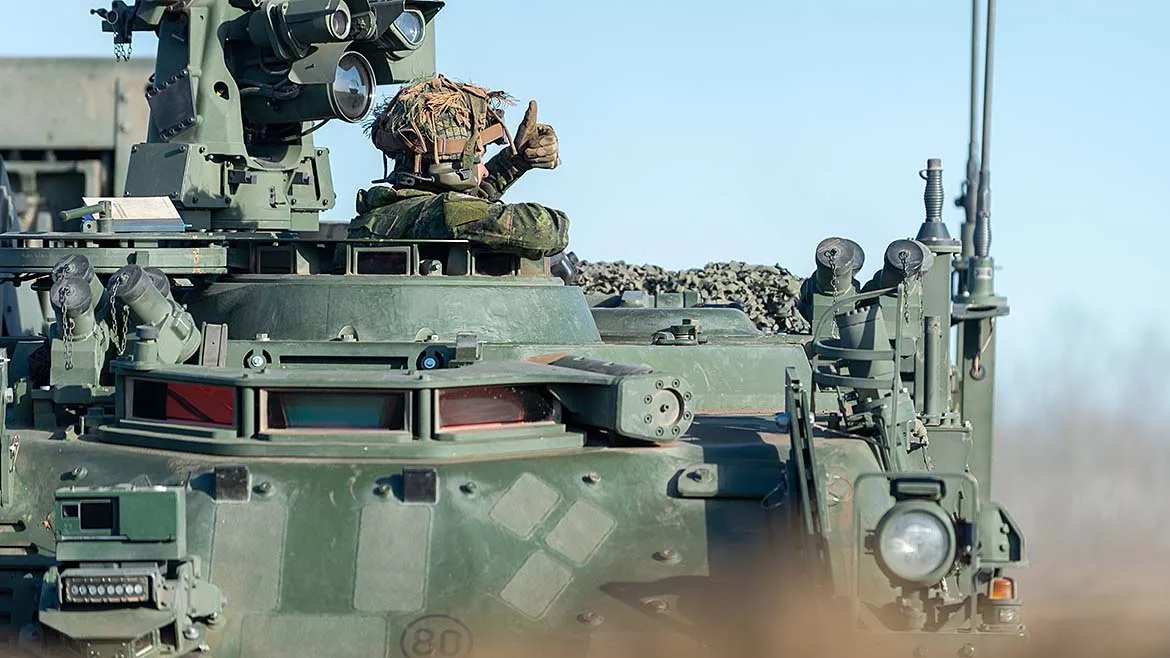
Defense is shifting from slow, proprietary systems to fast, modular architectures powered by dualuse vision technologies and commercial innovation developing for industrial automation.
The defense sector is undergoing a structural shift. For decades, military capability development relied on highly customized systems, proprietary technologies, and long procurement cycles. Today, that model is giving way to a new paradigm defined by speed, modularity, and adaptability. At the center of this transition is the rise of dual-use vision technologies: commercially developed imaging, sensing, and processing solutions originally designed for industrial uses are now playing a critical role in defense applications.
This convergence between commercial innovation and defense needs is not incidental. It is driven by a fundamental alignment between what modern military operations require and what the vision technology ecosystem has already spent decades perfecting for industrial automation and quality control: real-time data capture, low-latency transport, scalable processing, and interoperable system design.
The Shift Toward Dual-Use in Defense
Modern defense organizations face a dynamic and rapidly evolving threat environment. In response, they are increasingly prioritizing technologies that can be deployed quickly, upgraded continuously, and integrated across multi-domain operations. Traditional defense development cycles, often spanning five to ten years, are no longer compatible with the pace of change in both threats and technology.
Dual-use technologies address this gap directly. Commercial off-the-shelf (COTS) vision components, including cameras, sensors, networking interfaces, and processing platforms, are now mature, cost-effective, and widely available. Originally developed for industries such as manufacturing and robotics, these technologies bring proven performance and reliability into defense environments.
Equally important, dual-use systems allow for modular design approaches. Instead of building monolithic platforms, system integrators can assemble solutions from interoperable components, enabling faster prototyping, incremental upgrades, and reduced integration risk. This shift away from proprietary architectures also avoids vendor lock-in, creating more flexible and resilient supply chains.
Why Vision Technology Is Uniquely Positioned
Vision technologies are particularly well suited to meet modern defense requirements because they mirror many of the core operational challenges already solved in commercial quality control and automation markets.
For more than two decades, industrial vision systems have operated in mission-critical environments where precision, reliability, and real-time performance are essential. These same characteristics translate directly into defense use cases, from surveillance and reconnaissance to target detection and autonomous navigation.
Another key advantage is the maturity of standards. Vision technologies have widely adopted open, standardized protocols for data transport and synchronization. These standards, such as GigE Vision, align closely with defense requirements for interoperability, allowing sensors, processors, and displays from multiple vendors to function as a unified system. This is critical in multi-domain operations where data must move seamlessly across air, land, sea, and space platforms.
Finally, vision technology benefits from rapid innovation cycles. Commercial imaging systems evolve on a timeline measured in months rather than years. As a result, defense programs that adopt dual-use vision solutions gain access to continuous performance improvements in resolution, sensitivity, processing power, and efficiency—without needing to redesign entire platforms.
The Sensor-to-Decision Pipeline
At the core of modern defense applications is a data pipeline that transforms raw sensor inputs into actionable intelligence. Vision technologies enable each stage of this pipeline:
- Sensors capture environmental data across multiple modalities, including visible light, infrared (IR), near-infrared (NIR), and short-wave infrared (SWIR). Each modality contributes unique capabilities, such as low-light visibility, thermal contrast, or spectral analysis.
- Transport layers move high-bandwidth sensor data with low latency and deterministic timing. Standards-based networking ensures reliable and synchronized data delivery across distributed systems.
- Processing layers, increasingly located at the edge, perform image analysis, sensor fusion, and AI inference. Processing data closer to the source reduces latency and reliance on potentially contested communication links.
- Decision layers present actionable insights to operators or autonomous systems, enabling faster and more informed responses.
This pipeline underscores a key trend: the growing importance of edge computing. By processing data locally, defense systems can maintain situational awareness and operational effectiveness even in environments where communications are degraded or denied.
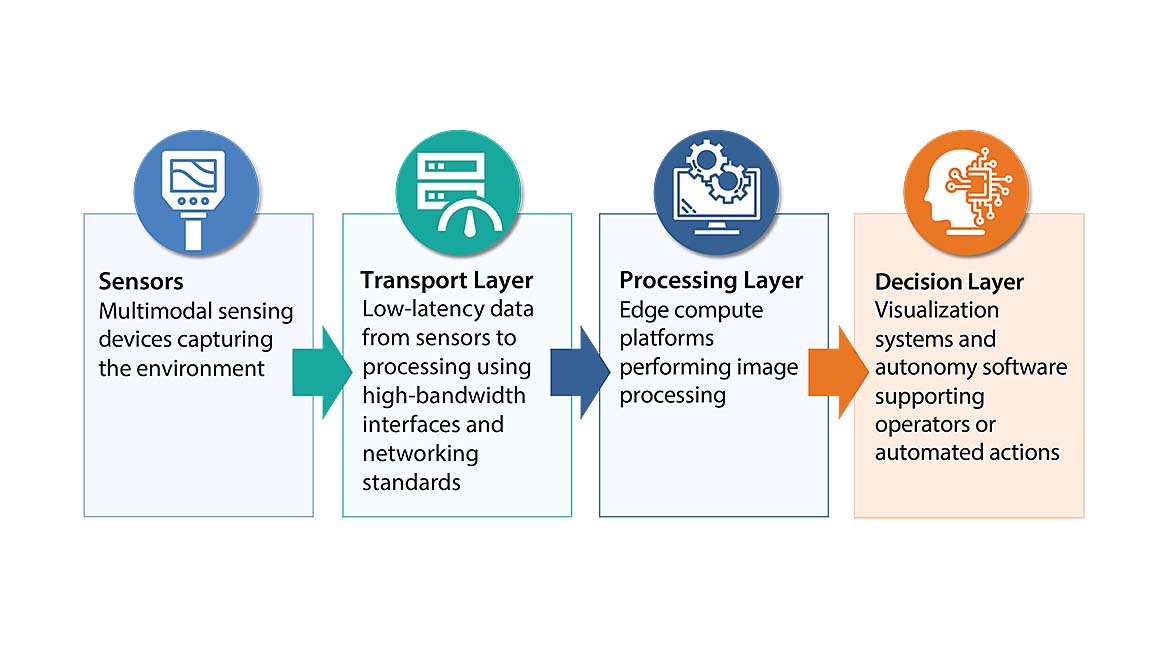
Sensor-to-decision pipeline: multimodal sensing, low-latency transport, edge processing, and AI-driven insights enabling faster, informed autonomous and semi-autonomous actions. Source: Pleora
Core Technology Trends Driving Adoption
Several interrelated trends are accelerating the adoption of dual-use vision technologies in defense.
Edge Computing
Edge computing has become a foundational capability. Instead of transmitting all sensor data to centralized servers, systems increasingly perform analysis directly on the platform, whether a vehicle, drone, or fixed installation. This enables real-time decision-making and reduces bandwidth requirements, a critical advantage in contested environments.
Multi-Sensor Fusion
No single sensor can provide a complete picture of complex operational environments. Modern systems combine inputs from multiple sources, such as cameras, thermal imagers, LiDAR, radar, and acoustic sensors, into a unified, time-synchronized view. This fusion improves detection accuracy, reduces false alarms, and enhances overall situational awareness.
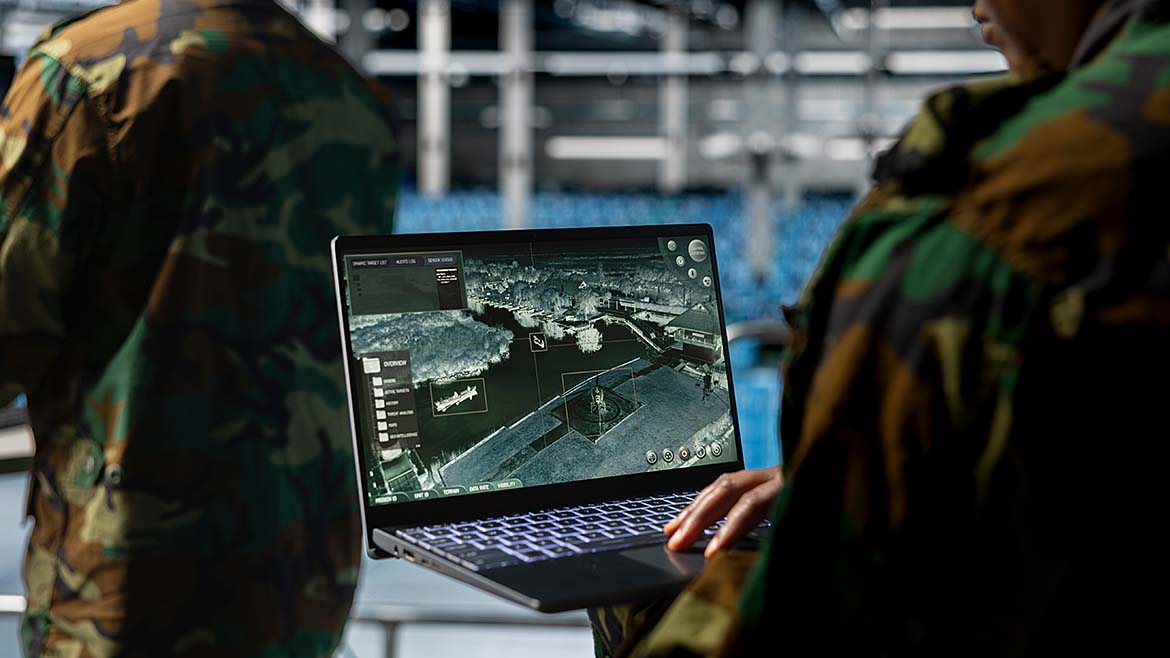
Combining diverse sensing modalities into a synchronized view improves situational awareness and lowers design and infrastructure costs. Source: Pleora
Advanced Imaging Modalities
Technologies such as IR, NIR, and SWIR imaging extend operational capabilities into low-light and obscured conditions. These modalities are particularly valuable for long-range detection, perimeter security, and counter-unmanned aerial systems (C-UAS) applications.
Size, Weight, and Power (SWaP) Optimization
Smaller, lighter, and more power-efficient sensors and processing units enable deployment across a wider range of platforms, including drones, soldier-borne systems, and distributed sensor networks. Lower SWaP also simplifies upgrades and allows for greater sensor density, which enhances coverage and redundancy.
Key trends driving adoption: edge computing, multi-sensor fusion, advanced imaging, and SWaP optimization enable real-time insight, enhanced awareness, and flexible deployment. Source: Pleora
Key Application Areas
The impact of dual-use vision technologies is evident across a broad spectrum of defense applications.
Autonomous Systems
Unmanned ground vehicles (UGVs) and unmanned aerial vehicles (UAVs) rely heavily on vision for navigation, obstacle avoidance, and target identification. Real-time image processing and sensor fusion enable these systems to operate with increasing levels of autonomy, even in complex and dynamic environments.
Persistent Surveillance
Distributed networks of vision sensors provide continuous monitoring across large areas. By incorporating edge-based analytics, these systems can automatically detect and classify events, reducing the burden on human operators while maintaining high levels of situational awareness.
Counter-UAS and Threat Detection
Detecting and tracking small, low-signature threats—such as drones—requires high-speed imaging combined with sophisticated processing. Dual-use vision systems offer the performance and flexibility needed to support detect-classify-track workflows in real time.
Vehicle Situational Awareness
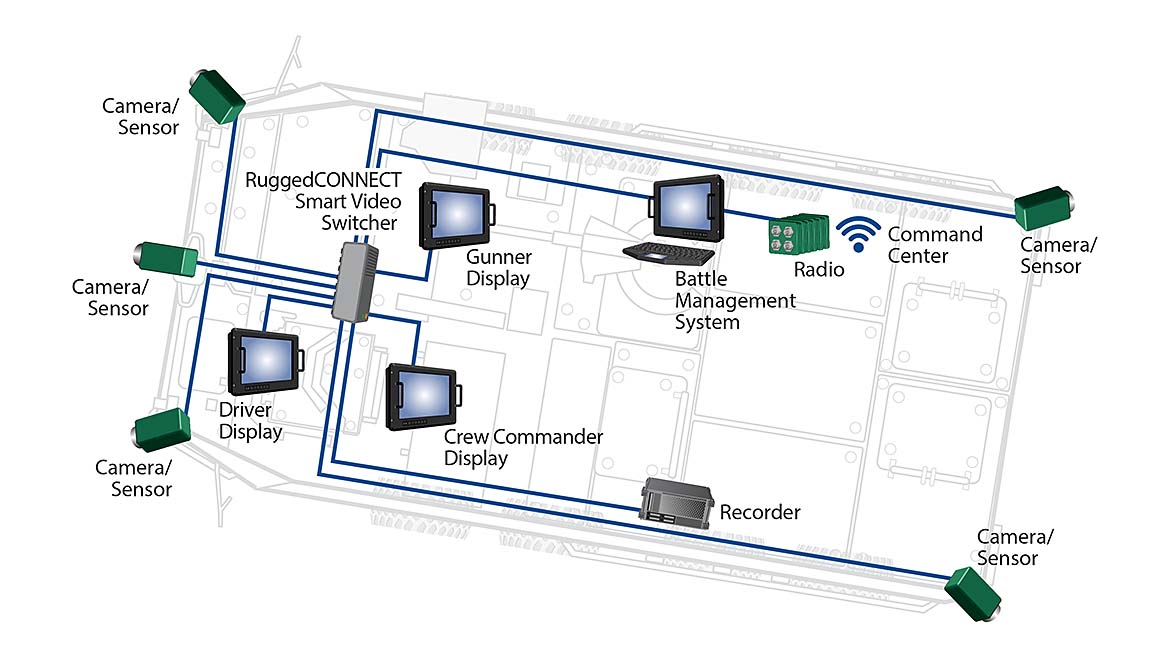
Modern military vehicles are increasingly equipped with 360-degree camera systems that provide drivers and crew with a comprehensive view of their surroundings. These systems improve safety, enhance operational effectiveness, and serve as a foundation for future autonomy.
Response
Multicamera vehicle architecture: sensors feed a rugged video switcher to deliver synchronized situational awareness to crew displays, onboard systems, and command networks.
Multi-Sensor Fusion Platforms
At the highest level of complexity, integrated platforms combine vision and non-vision data into a single, synchronized data stream. AI-driven analytics transform this data into actionable intelligence, supporting both human decision-makers and autonomous systems.
Enabling Modernization Without Replacement
One of the most compelling advantages of dual-use vision technologies is their ability to extend the life of existing platforms. Rather than replacing entire systems—an approach that is costly and time-consuming—defense organizations can modernize by upgrading sensors, networking, and processing components.
Standards-based interfaces allow legacy systems to be digitized and integrated into modern architectures. Once data is available in a unified digital format, it becomes possible to add advanced capabilities such as sensor fusion and AI-driven analytics with minimal disruption.
This modular approach not only reduces cost and risk but also creates a scalable path for continuous improvement. As new technologies emerge, they can be integrated incrementally, ensuring that systems remain relevant over extended operational lifecycles.
Challenges and the Path Forward
Despite the clear advantages, adopting dual-use technologies is not without challenges. Bridging the gap between commercial innovation and deployable military capability requires alignment across procurement processes, operational requirements, and system integration.
Organizations must balance the speed and flexibility of commercial solutions with the rigorous standards and certification requirements of defense environments. Additionally, ensuring interoperability across diverse systems and vendors remains a complex task.
However, the direction is clear. Defense is increasingly embracing open standards, modular architectures, and commercial innovation as a means of accelerating capability development.
Conclusion
Dual-use vision technologies are reshaping the defense landscape by enabling faster deployment, greater flexibility, and enhanced operational effectiveness. By leveraging decades of commercial innovation, defense organizations can build systems that are not only more capable but also more adaptable to evolving mission requirements.
From edge computing and multi-sensor fusion to advanced imaging and modular system design, vision technologies are central to the transformation of modern defense systems. As the boundary between commercial and military technology continues to blur, the ability to move seamlessly from sensor to decision will define the next generation of defense capability.
Ultimately, the goal remains unchanged: improve awareness, enable faster decisions, and reduce risk. Dual-use vision technologies are proving to be one of the most effective paths to achieving that objective.
Looking for a reprint of this article?
From high-res PDFs to custom plaques, order your copy today!