Quality Magazine logo
search
cart
facebook twitter linkedin youtube
  • Sign In
  • Create Account
  • Sign Out
  • My Account
Quality Magazine logo
  • NEWS
  • PRODUCTS
    • FEATURED PRODUCTS
    • SUBMIT YOUR PRODUCT
  • CHANNELS
    • AUTOMATION
    • MANAGEMENT
    • MEASUREMENT
    • NDT
    • QUALITY 101
    • SOFTWARE
    • TEST & INSPECTION
    • VISION & SENSORS
  • MARKETS
    • AEROSPACE
    • AUTOMOTIVE
    • ENERGY
    • GREEN MANUFACTURING
    • MEDICAL
  • MEDIA
    • A WORD ON QUALITY PUZZLE
    • EBOOKS
    • PODCASTS
    • VIDEOS
    • WEBINARS
  • EVENTS
    • EVENT CALENDAR
    • THE QUALITY SHOW
    • IMTS
  • DIRECTORIES
    • BUYERS GUIDE >
      • Supplier Insights
    • NDT SOURCEBOOK
    • VISION & SENSORS
    • TAKE A TOUR
  • INFOCENTERS
    • Digital Quality Management Systems
    • NEXT GENERATION SPC & QUALITY ANALYTICS
  • AWARDS
    • ROOKIE OF THE YEAR
    • PLANT OF THE YEAR
    • PROFESSIONAL OF THE YEAR
  • MORE
    • Expert Columns
    • NEWSLETTERS
    • QUALITY STORE
    • INDUSTRY LINKS
    • SPONSOR INSIGHTS
  • EMAG
    • eMAGAZINE
    • ARCHIVES
    • CONTACT
    • ADVERTISE
  • SIGN UP!
Management

Additive

From Document Control to Process Evidence: Why AM Quality Needs A New “System”

In a world where production is data-rich and regulated customers demand speed, consistency, and proof, quality management can’t stop at documents.

By Tim Wischeropp
Metal additively manufactured component on a reflective surface.
Image credit: Marina_Skoropadskaya / iStock / Getty Images Plus (Creative #1144311514)
July 16, 2026

If “QMS” makes you think binders, approvals, and document control, you’re not wrong. In most factories, QMS is where procedures go to live a long, well-governed life. However, in production additive manufacturing, a document-centric QMS can be perfectly compliant and still leave you dangerously exposed. Because in AM, the question that matters is not only “Do you have a procedure?” It’s also “Can you prove what actually happened to this part, quickly, consistently, and at scale?”

And that is the moment many AM operations discover they don’t have a quality system. They have a quality library.

The part doesn’t care about your procedures

A conventional QMS excels at governance (approvals, training records, CAPA workflows, audit trails around documentation). It’s designed to ensure an organization behaves consistently. But AM has a habit of turning “consistency” into a data problem. Because AM quality evidence is not a single document. It’s a chain of linked facts such as powder state, build parameters, machine events, post-processing route, inspection outcomes, and (crucially) what changed since the last accepted build.

If that chain lives in spreadsheets and shared drives, you can still ship parts. You can even pass audits. But you do it the hard way, by reconstructing reality under pressure. That’s not quality management. That’s quality theater.

Auditors don’t want a presentation

If you’ve ever sat in a serious audit, you know the feeling. The auditor isn’t asking for your “best” slide deck. They’re asking for the one thing a document-centric system can’t reliably produce on demand, namely a coherent, part-level story that survives cross-examination.

In production AM, the questions that matter rarely live inside one document. They cross the entire chain. Which powder batch and reuse state was used? Which parameter set was active? What post-processing route was followed? Which inspection results apply to this exact serialized part? What changed since the last accepted run?

If answering these questions requires manual hunting, you don’t have an audit trail, you have an investigation.

From paper evidence to process evidence

This is why AM is forcing a quiet reinvention of quality management. Not because quality suddenly matters more (aerospace and medical have always cared). But because AM changes what “quality evidence” is. In powder-bed AM, evidence is more granular, more interconnected, and more sensitive to drift over time. So the center of gravity moves from document control to process evidence.

Process evidence is not a folder. It is structured, queryable, and connected at part level. It makes it possible to answer hard questions quickly and consistently because the relationships between powder, build, post-processing, and inspection are enforced, not implied.

This doesn’t replace your QMS. It complements it. The answer isn’t “throw out your QMS”, it’s stop forcing your QMS (or your MES) to become something it was never designed to be.
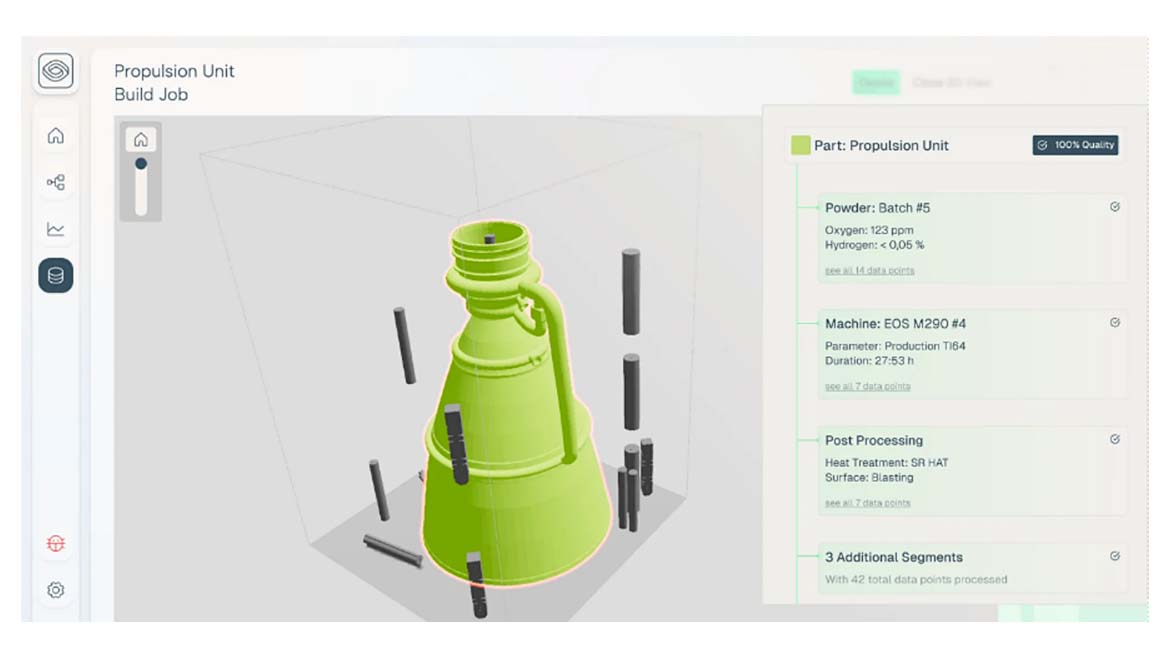
All process evidence, from powder to final part, is linked on part-level. Source: amsight

Stop bolting “quality” onto MES and calling it solved

I’ll say it plainly, because it will save CTOs and operations leaders a lot of pain. MES is not a quality system for AM. It’s an execution system. It schedules, routes, timestamps, and records sign-offs. It is the heartbeat of workflow, not the brain of AM evidence.

What happens in many organizations is predictable, they try to “solve AM quality” by adding custom fields, attachments, and bespoke workflows into MES. Then they wonder why their reporting still ends up in Excel. It’s because they’re trying to make a workflow tool do the job of an evidence tool.

The missing layer is not another platform

For CTOs and integration partners, it helps to stop thinking in product names and start thinking in types of truth. The production stack contains different truths that should not be pushed together:

  • ERP holds commercial truth (orders, finance, inventory).
  • MES holds execution truth (workflow, routing, status).
  • A document-centric QMS holds governance truth (procedures, approvals, compliance framework).
  • And a production-level AM quality layer holds process-evidence truth: powder → build → post-processing → inspection, linked at part level.

That last one is the gap most organizations feel but struggle to name. They have “systems,” yet when a customer asks a pointed question about a part, the answer still lives in spreadsheets.

Why AM-specific modelling matters

AM fleets are heterogeneous. Different OEMs, different generations, different log formats, different inspection flows. Traditional systems can store attachments and notes, but they rarely normalize AM data into a consistent model that supports cross-machine comparison, drift detection, or repeatable reporting. And that modelling is not a “nice to have.” It changes what you can do operationally:

You can move beyond “prove it passed” to “prove it’s stable.” You can build repeatable reporting templates instead of rebuilding evidence packs per customer. You can run SPC and trend analysis without starting every month by cleaning spreadsheets.

That’s not just compliance improvement. That’s cost reduction. That’s fewer scrapped builds. That’s fewer weeks lost to non-conformity investigations that begin with “where is the data?”

Qualification is the moment the truth arrives

If you want to know whether your AM quality approach is built for production, don’t look at your best prototype. Look at your qualification package. IQ/OQ/PQ-style thinking forces a process-level view. You’re not only proving the part, you’re proving the process can produce the part repeatedly.

This is why “Process & Machine Qualification” naturally sits next to “Prove Part Conformity” in production AM. One is evidence for this part, the other is evidence that the process is stable enough to trust the next hundred.

If your qualification evidence lives in spreadsheets and PowerPoints, you can still qualify. But sustaining and scaling that qualification becomes painful. Regulated customers don’t just want a one-time dossier, they want confidence that stability holds over time.

The simplest test for leaders

If you want to know whether you’re document-heavy but evidence-light, try this exercise. Pick one shipped part. Now ask whether you can retrieve (within minutes) a coherent chain of evidence such as powder history, build job, post-processing route, inspection results, and a clear record of what changed since the last accepted run.

If the answer involves multiple files, multiple people, and manual collation, you haven’t failed. You’ve simply found the gap. And that gap is exactly what we want to address, making AM process evidence usable at scale, so “audit-ready proof” becomes the default output of production rather than an emergency project the night before an audit.

Conclusion

AM isn’t killing the QMS, it’s evolving it. In a world where production is data-rich and regulated customers demand speed, consistency, and proof, quality management can’t stop at documents. It must include process evidence that behaves like a system.

If that sounds like “more software,” I’d argue the opposite. It’s less chaos. It’s fewer spreadsheets. Fewer bespoke workarounds. Fewer heroic individuals keeping the quality story alive. And in production AM, that is what maturity looks like, not more paperwork, but better evidence.

LEARN MORE

  • Traceability Isn’t Control: Why Metal AM Needs SPC to Stop Scrapping Parts
  • The Missing Infrastructure for Production Additive Manufacturing: Why Quality Data Needs a Digital Backbone
  • Common Challenges and Keys to Success for Fatigue Testing of Additively Manufactured Metals
KEYWORDS: additive manufacturing (AM) CAPA manufacturing metrology quality management system (QMS)

Share This Story

Looking for a reprint of this article?
From high-res PDFs to custom plaques, order your copy today!

Tim Wischeropp, CEO, amsight 

Recommended Content

JOIN TODAY
to unlock your recommendations.

Already have an account? Sign In

  • 2024 Quality Rookie of the Year Justin Wise 1440x750px banner with "Quality Rookie of the Year" logo inset

    Meet the 2024 Quality Rookie of the Year: Justin Wise

    Justin Wise is an exceptional individual who has been...
    Aerospace
    By: Michelle Bangert
  • Man with umbrella and coat stands outside while it rains at night looking at a building.

    Nondestructive Testing: Is there an ethics problem?

    I was a whistleblower who exposed fraudulent activities...
    NDT
    By: Dale Norwood
  • Unraveling Deflategate: Football stadium with closeup of football on field

    Unraveling the Tom Brady Deflategate

    The Deflategate scandal erupted following the 2014 AFC...
    Measurement
    By: Greg Cenker and Henry Zumbrun
Manage My Account
  • eMagazine Subscriptions
  • Newsletters
  • Online Registration
  • Subscription Customer Service
  • Manage My Preferences

More Videos

Sponsored Content

Sponsored Content is a special paid section where industry companies provide high quality, objective, non-commercial content around topics of interest to the Quality audience. All Sponsored Content is supplied by the advertising company and any opinions expressed in this article are those of the author and not necessarily reflect the views of Quality or its parent company, BNP Media. Interested in participating in our Sponsored Content section? Contact your local rep!

close
  • Key Takeaways for Quality Leaders
    Sponsored byComplianceQuest

    Key Takeaways for Quality Leaders from the 2026 Gartner Magic Quadrant™ for QMS

  • This image shows a person seated next to a Bobcat T66 compact track loader.
    Sponsored byPolyWorks by InnovMetric

    Supercharging Digital Gauging at Bobcat North America

  • Dorsey Calibration Lab photo by Tom LaBarbera Picture this Studios
    Sponsored byDorsey Metrology International

    Ensuring Product Quality in a Competitive Manufacturing Landscape

Popular Stories

Infographic explaining the ISO 9001:2015 quality management system, highlighting the Plan-Do-Check-Act cycle, continuous improvement, customer focus, and quality management principles.

What ISO 9001:2015 Really Means to an Organization

CNC operator monitoring a machining center control panel.

Where Is ISO9001:2026 Taking Us?

Collage of manufacturing professionals wearing hard hats in an industrial facility, representing plant management, engineering, and production workforce roles.

ASQ Quality in Education Think Tank

2026 Quality Professional of the Year!

Events

August 12, 2026

Eliminate Manual FAI Processes and Reduce Inspection Time by Up to 90%

Discover how advanced FAI software automates First Article Inspection workflows by generating inspection plans, validating results in real time, integrating 2D/3D data, and reducing quality escapes to improve efficiency and compliance.

October 25, 2026

AAPS 2026 PharmSci 360

We look forward to seeing you at the 2026 PharmSci 360 held on October 25-28, 2026 in New Orleans! 

AAPS is the convener of the pharmaceutical science community, bringing together thousands of scientists from across the world and the drug development process. For them, PharmSci 360 combines all the energy of a large scientific conference with the intimacy of a small niche meeting because of its unique programming structure.

PharmSci 360 is built on five tracks that cover the pharmaceutical development process. Scientists attending the meeting report that they build their schedule to solve their problems, and may attend programming in only one track or all of them!

View All Submit An Event

Products

Lean Manufacturing and Service Fundamentals, Applications, and Case Studies

Lean Manufacturing and Service Fundamentals, Applications, and Case Studies

See More Products
Rookie of the Year Custom Content

Related Articles

  • The image features a Microsoft Surface Book running software to enhance data-driven processes for additive manufacturing (AM).

    The Missing Infrastructure for Production Additive Manufacturing: Why Quality Data Needs a Digital Backbone

    See More
  • This image illustrates the use of Statistical Process Control (SPC) to transition a manufacturing workflow from an unstable state to a stable one

    Traceability Isn’t Control: Why Metal AM Needs SPC to Stop Scrapping Parts

    See More
  • Document Control Software

    3 Benefits of Centralizing Your Operations with a Document Control System

    See More

Related Products

See More Products
  • The Process Improvement Handbook: A Blueprint for Managing Change and Increasing Organizational Performance

  • louis hannigan.jpg

    The Non-Idiot's Guide to ISO 9001:2015: Understanding and Using the Quality Management System Standard to your benefit

See More Products

Related Directories

  • Evident Scientific

    Evident's industrial solutions range from microscopes and videoscopes to nondestructive testing equipment and X-ray analyzers for maintenance, manufacturing and environmental applications. Backed by state-of-the-art technologies, Evident products are widely used for quality control, inspection, and measurement.
×

Stay in the know with Quality’s comprehensive coverage of
the manufacturing and metrology industries.

Newsletters | Website | eMagazine

JOIN TODAY!
  • RESOURCES
    • Advertise
    • Contact Us
    • Directories
    • Manufacturing Division
    • Store
    • Want More
  • SIGN UP TODAY
    • Create Account
    • eMagazine
    • Newsletters
    • Customer Service
    • Manage Preferences
  • SERVICES
    • Marketing Services
    • Market Research
    • Reprints
    • List Rental
    • Survey/Respondent Access
  • STAY CONNECTED
    • LinkedIn
    • Facebook
    • YouTube
    • X (Twitter)
  • PRIVACY
    • PRIVACY POLICY
    • TERMS & CONDITIONS
    • DO NOT SELL MY PERSONAL INFORMATION
    • PRIVACY REQUEST
    • ACCESSIBILITY

Copyright ©2026. All Rights Reserved BNP Media, Inc. and BNP Media II, LLC.

Design, CMS, Hosting & Web Development :: ePublishing