Additive
The Missing Infrastructure for Production Additive Manufacturing: Why Quality Data Needs a Digital Backbone
Walk into almost any AM facility today and you will see impressive hardware, smart engineers, and… a lot of spreadsheets.

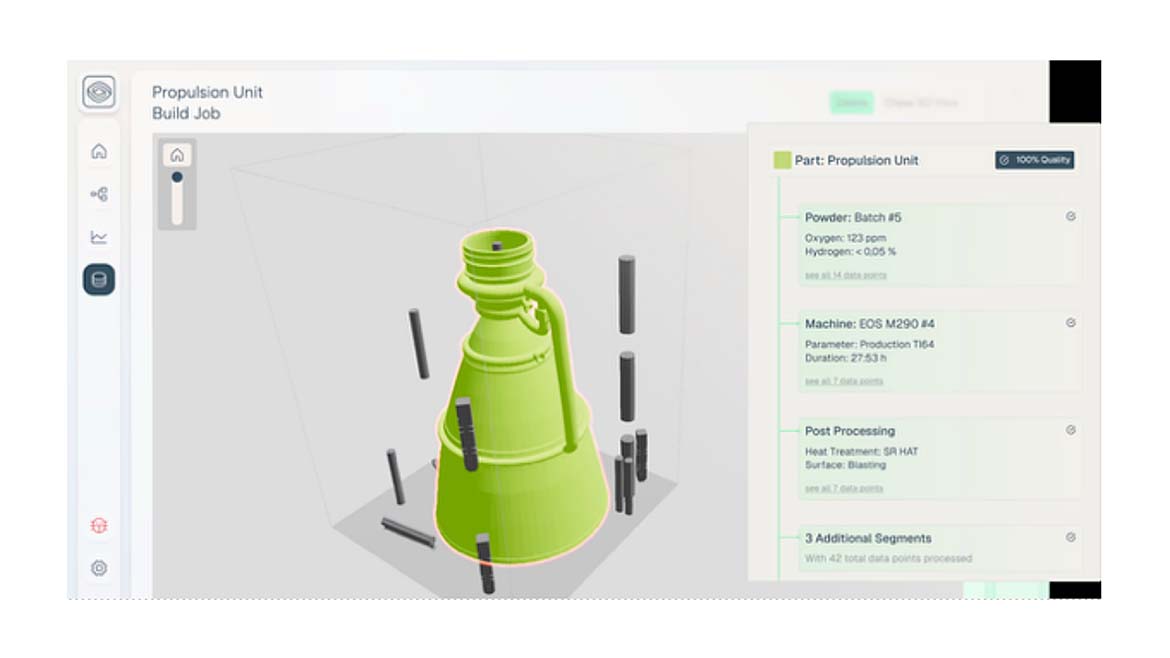
Picture 1. Amsight software for quality management in AM, providing data transparency from material to final part inspection.
As metal additive manufacturing (AM) matures from prototyping tool to bona fide production technology, the conversation around “quality” has to grow up with it. For years, AM has been celebrated for design freedom, light-weighting, and consolidation of assemblies. Increasingly, it is being asked a more demanding question. Can it deliver repeatable, certifiable, economically viable production at scale?
The honest answer is — only if the way we handle quality data changes dramatically.
Walk into almost any AM facility today and you will see impressive hardware, smart engineers, and… a lot of spreadsheets. Build histories, inspection results, powder certificates, CT images, mechanical tests, machine logs, all scattered across Excel files, PDFs, shared folders, and individual inboxes. When something goes wrong, or a customer asks “why did this happen?”, the real challenge is not the analysis itself, but the hunt for the data before analysis can even begin.
This “spreadsheet culture” is how many teams got AM off the ground. It was the fastest way to get moving. But as AM is entrusted with space-grade components, flight-critical parts, and safety-relevant medical devices, it turns from a clever workaround into a structural constraint.
You can’t build an industrial technology on heroic copy-and-paste.
Why Spreadsheets Are Now Holding AM Back
Additive processes generate data at every step:
- powder batches, mixes, and reuse cycles
- parameter sets and build histories
- in-situ monitoring streams and machine events
- heat treatment, machining, surface finishing steps
- dimensional inspection, CT scans, mechanical tests
Excel is brilliant for local calculations and ad hoc analysis. What it isn’t designed for is the long-term management of complex, interrelated process and quality data across multiple machines, materials, sites, and years of production.
The cracks show in familiar ways. It becomes harder and harder to maintain part-level traceability across different shifts, printers, and powder lots. Statistical process control (SPC) and trend analysis over dozens or hundreds of builds become so labor-intensive that they rarely happen. Audit-ready documentation has to be reassembled manually every time. Collaboration across sites is fragile because everyone has a slightly different version of “the truth.”
At that point, AM is no longer limited by the physics of the process, but by the quality of its information infrastructure. The machines might be production-ready, but unfortunately the data handling is not.
From Point Tools to a Digital Quality Backbone
To unlock AM as a mainstream production technology, the industry needs to move beyond “better spreadsheets” toward what many now call a digital quality backbone.
Think of this as a dedicated, AM-specific quality layer sitting between the machines on the shop floor and the higher-level business systems such as ERP, and which connects to other software such as MES or PLM. It isn’t a generic MES extension, and it isn’t just business intelligence on top of exported CSV files. It is software built from the ground up around quality-critical AM data and relationships.
In practical terms, a digital quality backbone does a few essential things. It connects all relevant data sources (powder information, build parameters, machine events, post-processing steps, inspection results) in a coherent data model anchored at part level. Instead of “a folder per build” and “a sheet per test”, you get a structured view of each part’s complete history.
It provides end-to-end traceability as a by-product of doing the work. When all the relevant data is linked by design, answering questions like “which parts were built with powder lot X under parameter set Y?” becomes a filter operation, not an investigative project.
It embeds SPC and analysis tools into everyday workflows. Control charts and trends are produced directly from the backbone, not recreated manually in Excel. That makes it realistic to monitor stability over time, catch drift early, and base corrective actions on evidence rather than gut feel.
And it treats documentation as an output of the system, not the personal project of the most conscientious engineer. Conformity reports, audit packs, and customer dossiers are generated from the data backbone, ensuring consistency and reducing the risk of errors.
Companies like ours have oriented their entire product vision around this idea. That AM production will only truly scale when quality data stops being a by-product and becomes a first-class asset. The software the company builds is less about “nice dashboards” and more about providing that backbone for real-world metal AM fleets.
Why “Tidying Up Excel” Is Not Enough
When confronted with this argument, many organizations respond with admirable determination. “We’ll just impose more discipline on our existing tools”. Better folder structures, stricter naming conventions, more macros, more shared spreadsheets.
There is nothing wrong with discipline. But the underlying limitations remain. Excel has no native concept of a build, a part, a lot, or a machine. Those relationships live only in human convention (and human memory). Version control becomes a constant risk as more people and sites collaborate. Each new machine type, material, or inspection method has to be bolted on manually, adding complexity.
In regulated sectors — space, aerospace, defense, energy, medical — that fragility becomes a strategic concern. At some point, the question is no longer “can we make this work with what we have?” but “is this still an appropriate foundation for the level of trust we are asking customers and regulators to place in AM?”
Keeping Quality Simpler in a World of More Data
An interesting side-effect of the “data backbone” mindset is how it reframes the role of in-situ monitoring. Monitoring tools generate huge volumes of data about what happens during a build. They are invaluable for certain tasks like live process surveillance, anomaly detection, machine development.
But monitoring data on its own is not a quality system. In fact, if not anchored in a broader quality backbone, it can make life more complex, not less. Teams drown in gigabytes of signals without a structured way to link those signals to powder history, process parameters, or downstream inspection results.
A backbone flips this. Instead of “more data everywhere”, it provides the right data, connected and contextualized. Monitoring is just one data point in the larger picture. Statistical process control becomes a way to make sense of variation over time. The goal is not to make AM more complex, but to make good quality management simpler and more robust.
A Pragmatic Roadmap for AM Leaders
The move from spreadsheet chaos to a digital quality backbone does not require a big-bang transformation. In fact, the most successful journeys tend to follow a pragmatic pattern. They start by mapping reality. Where does quality-relevant data live today, in which systems and spreadsheets, under whose stewardship? This exercise alone often surfaces duplicate effort and hidden risk.
They pick a focused pilot. One product family, one machine cluster, one customer program, and centralize its data in a dedicated quality platform. The aim is to test the backbone concept in a contained setting, not to solve everything at once.
They automate the worst pain points first. Repetitive report building, manual copy-paste for audits, re-keying inspection results. This creates immediate, visible value for QA teams and builds internal support.
They then layer in deeper insight. SPC charts, trend dashboards, root-cause tools. Once the plumbing is in place, these capabilities stop being “nice to have” and become the natural next step.
Finally, they scale what works. Concrete wins (fewer hours lost in Excel, smoother audits, reduced scrap) provide the storyline and justification for extending the backbone to more machines, programs, and sites.
Across many organizations, the pattern is the same. As soon as teams see what it feels like to have a real quality backbone, going back to the old way is unthinkable.
AM is ready. Now the data needs to catch up.
There is a growing consensus across industry that AM is no longer an experimental technology on the margins. It is becoming an integral part of how advanced manufacturers think about their product portfolio and their supply chains. The bottleneck is not whether machines can produce good parts; they demonstrably can. The bottleneck is whether we can prove, repeat, and continuously improve that quality at industrial scale.
That is why the conversation about quality data is not a side issue. It is central to AM’s evolution into a mainstream production technology. Companies that treat their quality data as infrastructure (and invest in the kind of digital backbone described here) will find it far easier to win trust, certify processes, and grow their AM business.
Those that stay in spreadsheet survival mode will increasingly struggle to keep up, not because of a lack of expertise, but because their tools are out of step with the demands being placed on them.
The encouraging news is that this is a solvable problem. The vision that we are pursuing (of AM powered by a coherent, connected, and actionable quality backbone) points toward a future in which quality is not an obstacle to AM adoption, but one of its strongest arguments.
Looking for a reprint of this article?
From high-res PDFs to custom plaques, order your copy today!