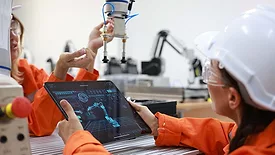
The idea of the ‘dark factory’ has gained new attention as advances in robotics and AI accelerate. Stories range from fully automated automotive plants that operate around the clock and lights-out facilities in China, to experiments with humanoid robots on production lines, often framed as early signs of factories that no longer require people on the shop floor.
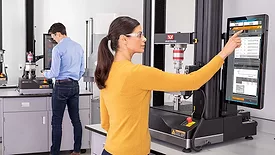
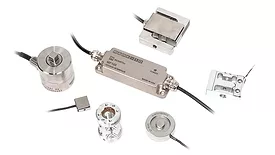
Force testing rarely draws attention until it fails. When components crack, seals leak, or devices do not activate as expected, engineers often trace the problem back to how force was applied, measured, or interpreted.
Quality managers and engineers, like many other professionals, are often judged by what goes wrong. A product failure, a recall, or a customer complaint draws negative press, while processes that run smoothly can be taken for granted.
In many laboratories, confidence in physical testing is based on the assumption that results are consistent and that, if a method works once, it can be repeated. However, shifts in operator technique, environmental conditions, or instrument calibration can undermine that confidence.
Air gaging has moved from the inspection bench to the factory floor, where manufacturers are connecting decades-old measurement physics to modern data systems and inline process control.
Instead of waiting until the end of production to confirm size, quality teams increasingly collect dimensional data during machining and finishing operations.
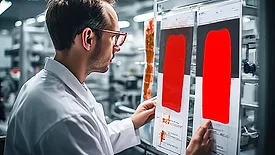
Instead of being caught off guard by quality issues arising from sudden supply chain changes, firms can build control and visibility into their supplier ecosystems.
How do we know when the differences between populations are evidence of real differences, or merely differences to be expected by the nature of random samples?
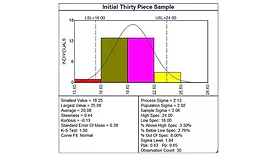
A process was, on an irregular basis, failing to meet the mark, perhaps 5% of the time. The process engineer observed the process in action and took a sample of thirty parts for analysis.
 RSS
RSS