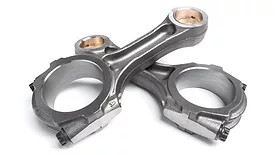
The quality requirements for the aerospace industry are essential to human life, and any component used in the final craft is mission-critical for success.
A homage to the work of David B. Kirk. His 1952 paper on pneumatic gaging is a foundational reference for dimensional inspection and measurement quality.
For more than seventy years, David B. Kirk’s illustrated lecture, Introduction to Principles of Pneumatic Gaging, existed in an unusual place in the history of manufacturing—quietly influential, widely practiced, yet almost entirely absent from the modern technical record.
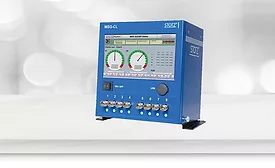
Air gaging has moved from the inspection bench to the factory floor, where manufacturers are connecting decades-old measurement physics to modern data systems and inline process control.
Instead of waiting until the end of production to confirm size, quality teams increasingly collect dimensional data during machining and finishing operations.
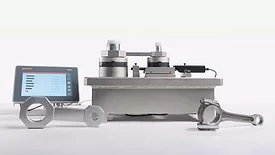
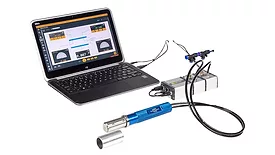
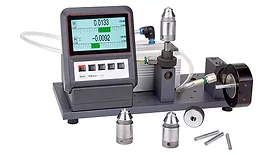
Western’s Micro IIi Air Gage Readout delivers precise measurements of internal and external diameters, tapers, and roundness with 5 micro-inch resolution. It features a microprocessor, digital and analog displays, USB and RS-232 outputs, and auto-calibration. Western also offers custom air gages for various precision inspections.
In manufacturing, precision is crucial for consistency and efficiency. Accurate measurements ensure components meet specifications, improve reliability, and reduce waste. Air gaging is a key technology that supports this.
Air gauges are non-contact devices that utilize air pressure for measurement. They play a crucial role in ensuring precision and quality control in the manufacturing industry, from automotive to aerospace industries. They are particularly valuable for measuring delicate or easily deformable materials.
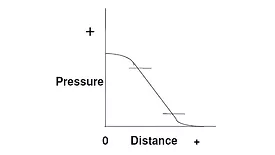
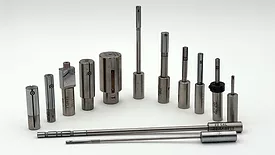
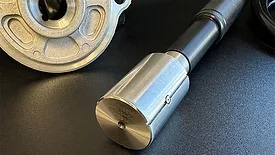
Air gages work well due to three main reasons: they are body-piloting type, use dual-opposing sensor method, and have a noncontact sensing component. These features are present in most air gage designs, including ID/OD air probe, air ring, and air length gages.
When air gaging was introduced, it provided the first high-performance 50u”/1um or better gaging on the shop floor. In fact, air gaging provided two breakthroughs for dimensional measurement.
In this article, I wanted to go beyond the simple go/no go measurements that most air gaging is used for. Air gaging is a highly effective and efficient way for measuring these simple diameter requirements. It is also extremely repeatable on tight tolerances, but for this article, I wanted to focus on using air gaging to measure form requirements such as roundness, flatness, perpendicularity/squareness, taper, straightness, matching, and others.