Handheld XRF, OES, and Portable LIBS Analyzers— Which One Is Best for Your Needs?
Understanding the limitations and differences in each of these techniques is critical when performing material analysis.
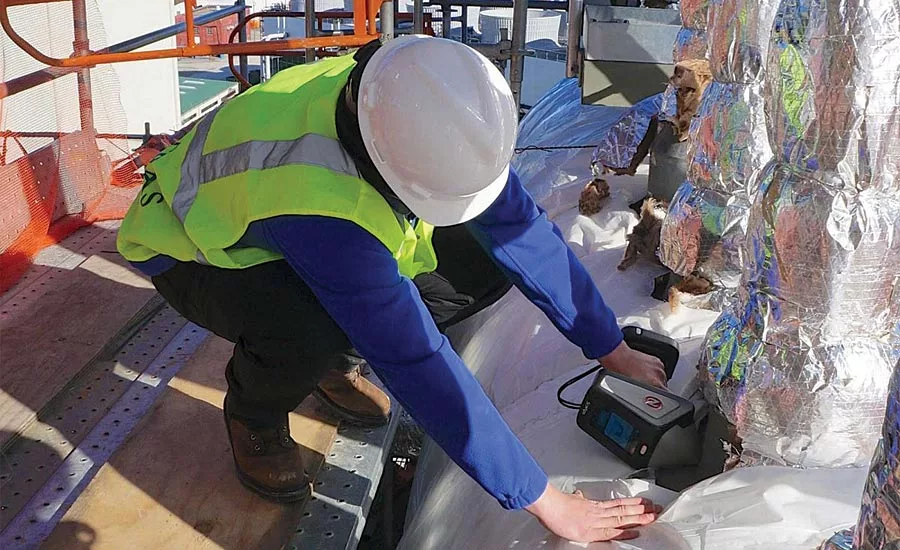
With the increasing regulations in safety, reliability, traceability, and regulatory compliance, material verification has become an essential component in a safety and reliability program.
As material specifications used in industry are becoming more specific, the need for various PMI testing in the field is steadily increasing. Handheld XRF, spark OES, and, now, handheld LIBS analyzers are all common technologies used to determine fast, accurate, and reliable analysis. Each offers its own unique advantages and provides the user with qualitative and quantitative analysis of the material composition. All three technologies are used to ensure compliance with a quality management program. Some examples are:
- Verifying incoming material to ensure the products or components are the correct alloy
- Ensuring the welded component and their filler metals are the correct alloy, meeting the specified material requirements for fabrication
- Sorting and identifying unknown or mismarked materials, ensuring the right material is used for the specified process
- Testing Retro-PMI “in-situ” of material currently in service for compliance with the required specifications
Understanding the limitations and differences in each of these techniques is critical when performing material analysis. They are used in both production and asset integrity management programs and help eliminate costly mix-up of rogue materials, identify unknown materials, improve product quality, and help prevent injuries and loss of life. Understanding each technique will help determine which technology to use to verify the material.
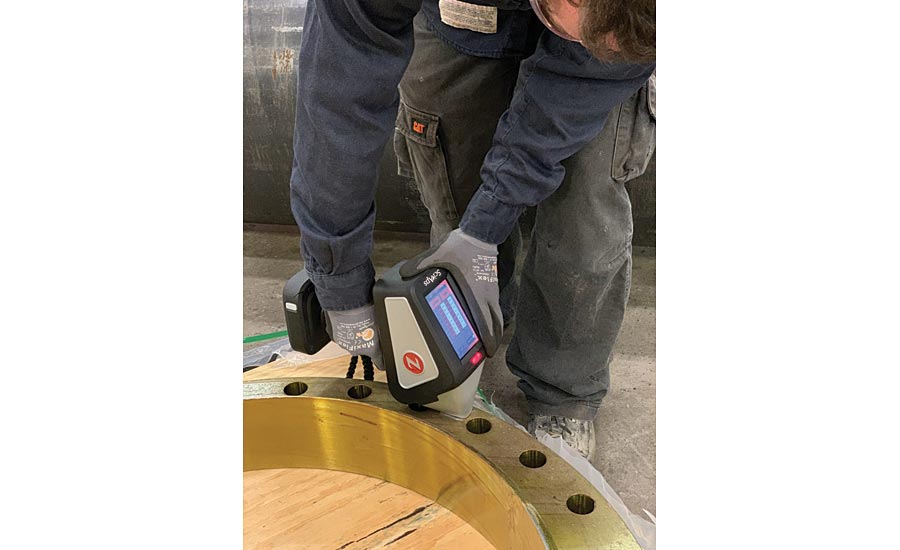
Handheld XRF Technology
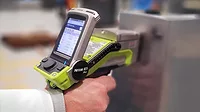
X-ray fluorescence (XRF) is the most used NDT method, offering the user a portable handheld analyzer that delivers fast, accurate results. XRF analyzers use an X-ray tube to emit an X-ray beam into a sample, exciting the electrons and displacing them from the inner shell. The vacancy from the inner shell then gets replaced with an electron from an outer shell. As this electron fills the vacancy of the inner shell it releases energy in the form of a secondary X-ray. This release of secondary energy is known as fluorescence. Each element present will emit unique energy characteristics. By measuring these characteristics, it is possible to determine which elements are present. This is called qualitative analysis. Then, by measuring the intensities of the unique energy and applying correction factors, it is then possible to measure how much of each element is present in the sample. This is called quantitative analysis. However, XRF has limitations on the elements that can be measured.
Spark OES Technology
Optical Emission Spectroscopy (OES) is an optical method that can be used to detect almost all types of elements, including carbon and light elements in a variety of different matrixes including stainless steel, nickel, and carbon steel, etc. In the spark OES technique, atoms are also excited; however, the excitation energy comes from a spark formed between the sample and instrument electrode. Unlike XRF that utilizes an X-ray tube to irradiate the sample, OES uses the energy of a spark that causes the electrons in the sample to emit light, which is converted into a spectral pattern. Each element produces a unique color of optical light. By measuring the intensity of the peaks in this optical light of the spectrum, the spark OES analyzer can produce qualitative and quantitative analysis of the material composition. Even though OES is considered an NDT method, the sample needs to be prepared with a mechanical sanding device, utilizing a grinder that uses a zirconium aluminum oxide sanding disc, and the spark does leave a small burn on the sample surface that would need to be removed after analysis. Sample preparation is a critical step in any spark OES analysis, and a sample that is not properly prepared will yield undesirable and inaccurate results.
Although spark OES is considered a “portable technique,” it would be better classified as a transportable technique. OES instruments vary in weight and size depending on the manufacturer but can weigh upwards of 45-60 lbs. and requires an argon bottle that, depending on the size of bottle utilized, would also weigh about 20 lbs. The instrument and argon bottle are typically transported on a cart to help make the instrument mobile. Because of the weight and size of this field mobile OES, working in elevated work areas or in ditches could require mechanical assistance to lift or lower an OES instrument.
Handheld LIBS Technology
Laser Induced Breakdown Spectroscopy (LIBS) has been around for many years and is a technique used primarily in laboratory equipment. With recent advances in technology, the technique has now been developed into a portable handheld analyzer capable of measuring carbon in the field for material identification and grading of materials. The LIBS technique utilizes a pulsed laser to ablate the surface of the sample creating a plasma. As the plasma cools, the electrons from the cooling plasma are excited, causing the plasma to emit light. Each element of the periodic table produces a LIBS spectral peak unique to itself. By using a detector to measure the unique characteristics of light emitted, it is possible to detect what elements are present within the sample. By measuring the peaks of light and their intensities in the sample, the chemical composition can be rapidly determined and quantified in weighted percent concentrations (%), or parts per million (PPM).
As with OES, argon is still needed to analyze carbon in a LIBS handheld analyzer. Instead of an external argon bottle, regulator, and hose connection to the OES unit, the handheld LIBS analyzer uses a consumable argon cartridge integrated into the instrument, and with the analyzer’s battery, the instrument weighs four to six pounds, depending on the model. Sample preparation is still required for analysis, but the handheld size of the instrument, the grinder, and sanding discs can all be contained in a small case and transported to elevated working platforms, pipeline ditches, and hard to access areas with minimal effort, giving the user true in-field portability. As with OES, poor sample preparation will yield undesirable results. With proper sample preparations, the user can achieve fast, reliable, and accurate results.
Which analyzer is best for NDT-PMI? It depends on your needs.
XRF, spark OES and LIBS technologies are accurate and viable technologies to achieve chemical analysis in the field. Since OES can measure all elements and grades, it is not included in the chart; however, OES is bulky and difficult to transport into ditches, in racks, or on ropes.
Therefore, the chart presents the best handheld technology for the job.
| ALLOY/ELEMENT | BEST TECHNOLOGY | COMMENTS |
| Carbon and carbon equivalents in steels, distinguish L and H grade stainless, distinguish low carbon nickel alloys like 718LC and MarM 248 LC, and measure cast irons and cast steels | LIBS | X-ray cannot measure carbon. *LIBS is the only handheld that measures carbon in these alloys. Not all LIBS analyzers can measure carbon, so check manufacturer’s spec sheets. |
| Common stainless, Cr/Mo steels, nickel or other high temp alloys not requiring carbon | XRF | *XRF models have a range of abilities, i.e. not all XRF models measure Si, P, S, Mg or Al, or low residual metals. |
| Specialty elements Li, Be, B | LIBS | Some handheld *LIBS can analyze down to 10 ppm B and Be in aluminum alloys. XRF cannot measure Li, Be, B. |
| Phosphorus and sulfur | XRF | LIBS cannot measure P or S. |
| Aluminum and magnesium alloys | LIBS or XRF | Both are good options for basic Al and Mg testing. |
| Lower concentrations of Mg (< 0.2%) | LIBS | X-ray cannot measure lower concentrations of Mg. |
| Flow-accelerated corrosion (FAC) | XRF or LIBS | Both analyzers work, but if you need to test in a power plant with onerous X-ray regulations, then LIBS is the better choice. |
| Measure silicon down to 0.02% | XRF or LIBS | *Both analyzers are capable. |
| 0.05% silicon in steels for API 939 requirements | LIBS | LIBS is able to do silicon analysis concerned about sulfidic corrosion. |
| Residual requirements for HF alkylation units in refineries | XRF and LIBS | *LIBS can measure every element and meet all of the residual requirements for HF alkylation units in refineries; however, niobium and vanadium requirement of less than .02% for each element and not to exceed .03% for the combination of the 2 elements is difficult for LIBS. XRF can measure those 2 elements easily. Using LIBS and XRF together will meet all requirements. |
| Basic stainless, high-temp alloys, Cr/Mo steels, brasses and bronzes and Al alloys not requiring Li, Be or B analysis | XRF | XRF is still the best choice for these elements. |
| Low alloy steels, stainless and high-temperature alloys | XRF or LIBS | *Both analyzers are good options. |
An earlier version of this post originally appeared here. For a complete look at choosing an analyzer, visit this Handheld XRF and LIBS Analyzer Selection Guide.
Looking for a reprint of this article?
From high-res PDFs to custom plaques, order your copy today!