Q-Cast
PODCAST | Why Should We Position Manufacturing Quality at the Center of Our Businesses
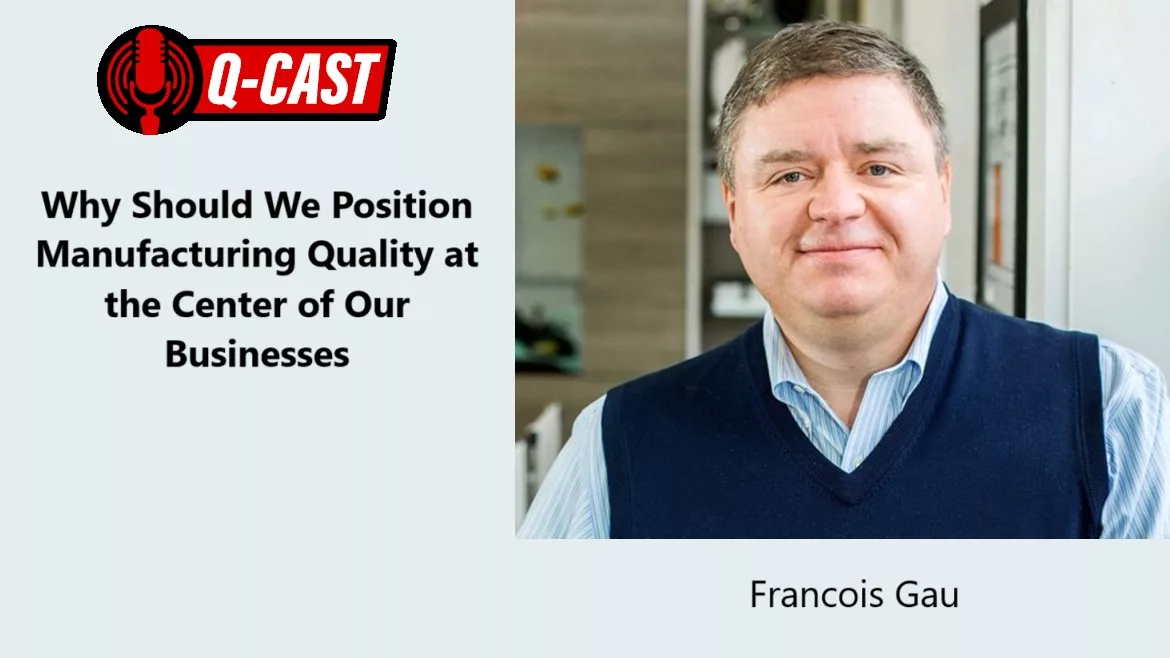
Image courtesy of Francois Gau / graphics by BNP Media
Michelle Bangert, Managing Editor of Quality, sat down with Francois Gau. He's the CEO of Growth Hive and recently wrote an article for Quality called, "Why Should We Position Manufacturing Quality at the Center of Our Businesses?"
Michelle: To start off with, could you tell us a little bit about how you got interested in the topic and why you want to write about this?
Francois: Well, the interest started many moons ago. It's a long story, so I hope to make it short and interesting. Grew up in southern France. This is the country where they make Airbuses. So, I have jet fuels in my veins. I've been a pilot. Worked for a company called Honeywell Aerospace. Cockpit equipment, computers, nav aids, you name it. I moved to the States in ‘95 to join Honeywell headquarters in Phoenix, Arizona. Long story short, ended up working on a lot of aftermarket projects and meeting with a lot of airlines on how to use the products.
And in 2003, I was recruited by a company here in Pennsylvania where I reside now, called Kennametal, which makes cutting tool for the manufacturing of those same components. So, as I joined the manufacturing community in 2003, almost 22 years ago, I came to a realization that part of my job was to obviously sell more cutting tools and work with manufacturers to use more hot tools.
Fantastic, but how do you differentiate yourself in that market? And I came to the very subtle realization at the time that working with some of the OEMs and I'm not going to name anybody today. I'm going to remain all that pretty clean, but I think I visited pretty much all of them over my 10 years and with the factories and suppliers and tier ones and tier twos and tier threes working into the supply chain.
It's about 2,400 of them in total. Not visited by myself, that would be impossible. But I think I had actually looked at it the other day and I had about 100 logos and that I was able to piece me up. So that says that over the 10, 12 years I ran the aerospace and defense business for Kenham and all, had a privilege to sit down with many of the leaders and manufacturers around the world and I'll still continue to do it today as a consultant.
What transpired to me, it's always been very difficult to pick the right machine, the right tool, the right process to make the part. It's always a bit of a have to balance this and I have to compromise that, I have to maximize this.
And then I was reflecting on another topic that hit me when Michelle and I met the first time.
It’s like if you look back 20, 30 years ago, and I'm going to be a little technical here, an aircraft engine, jet aircraft engine, was about 10 to 20,000 hours, what's called a TBO, a time between other holes, that's 10 to 20,000 hours. If you fly three to 4,000 hours a year, that's a lot of years without overhauling your aircraft engine. Today, most of the aircraft engine 20, 30 years later, they're rated at 30,000 hours or more. Hang on a minute. Let's just decouple that for a second. That means I've done 2X TBOs, or time between overhauls, in less than 20 to 30 years. How does that happen?
If you've been following closely, and I was part of some of those packages during the years on some of the newest generation aircraft, such as the 787, 350, 380, and the engine stuff goes with it, the tolerances, the expectations of manufacture, the designers making those parts incredibly tight, made us in the manufacturing supply chain rethink a little bit of how we do things.
So, for those of you that listen from the aerospace world, AS9145 should be something very dear to your heart from the planning, the design of the part all the way to its manufacturing, first article inspection, et cetera, et cetera. There's a chain in there that depends on dozens of CAD software, design software that people use because that's their tool. And then as it comes down into the manufacturing location, either at the OEM, if they have the MRD, or down to the tiers, if they're selected to work on a program, they use a different CAD system.
Listen to the Full Podcast Here:
Looking for a reprint of this article?
From high-res PDFs to custom plaques, order your copy today!