Q-Cast
PODCAST | Versatile Training for an Ever-Changing Industry
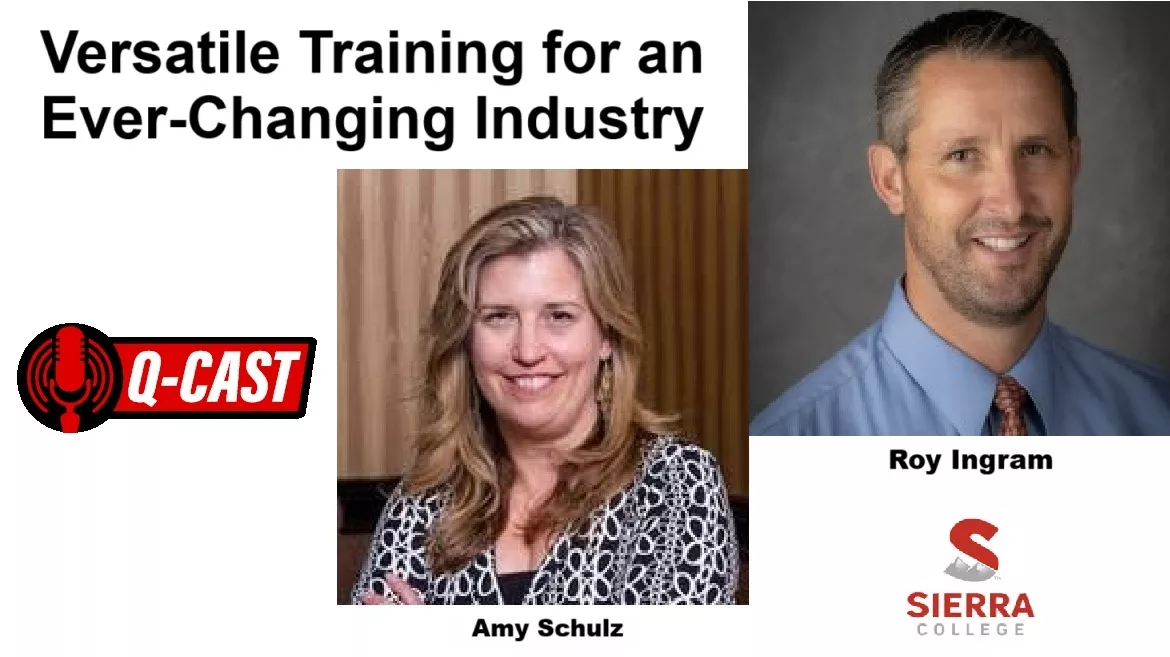
Michelle Bangert, Managing Editor of Quality, talks with the team from Sierra College − Amy Schulz, executive dean for Workforce and Strategic Initiatives, and Roy Ingram, department chair for Electronics, Automation, Robotics, and Industrial Systems, on a topic dear to the heart of the quality industry − the workforce, automation and training.
Michelle: Can you tell us a little bit more about the program you guys are working on now?
Roy: Sure. Well, the program we're working on, it's actually been a continuum of industry input from when we were on electronics program about 20 years ago. And that had to be changed because industry was changing, bench technicians were going away, and they needed to have versatile skills. So being able to work on hydraulics and pneumatics and complex robotics, is a whole different skill set than the electronics that we were initially teaching. So that was a big transition.
And that's just been a continual change over the last 15 years. And now, it seems to be growing. It seems to be being pulled down into even high schools [that] are wanting more of this type of instruction. So yeah, that's sort of a broad picture, but just really applying those types of things where electronics, sensors, automation all come together and work with robotics.
Michelle: Seems like such a good initiative to start younger. Every day I'm reading things that say high school is key. The earlier kids get into robotics, the more likely they are going to use them. So that's great. So what trends do you think are most important that you're preparing students for right now?
Amy: I think regionally, we are seeing a trend for expanding semiconductor manufacturing in region. And in addition to semiconductor manufacturing, these skills are very transferable across industries. So, with our partners with Greater Sacramento Economic Council and our other economic development partners, we really have been nudged to expand our program. Our mechatronics program is very successful and we have a high placement rate. Employers are very engaged. So how can we expand this and make this larger?
As Roy shared, we're expanding through our high school partners. So, we have historically not done a lot of dual enrollment with our mechatronics program because it's very expensive to build a mechatronics lab and have the correct equipment and have trained instructors. But with the regional need, we really, we worked with our partners at the high schools and with employers to be able to expand that into the high schools, apply for some grant funding so that high schools are able to fund it and start those programs and then really meet that regional need. And this is a great opportunity for youth across the region because these are high paying, high demand careers that are right here at home. So, that was really kind of the trend that is driving this right now. Yeah, definitely. It seems like all people talk about is how people are retiring and there's so many more jobs that are available. And so that all makes a lot of sense.
Listen to the Full Podcast Here:
Looking for a reprint of this article?
From high-res PDFs to custom plaques, order your copy today!