Vision & Sensors | Vision
How Vision-Enabled Robotics Are Redefining Factory Quality
From blind robotics automation to intelligent perception. We are witnessing a new era where robots not only act but also see, analyze, and improve.
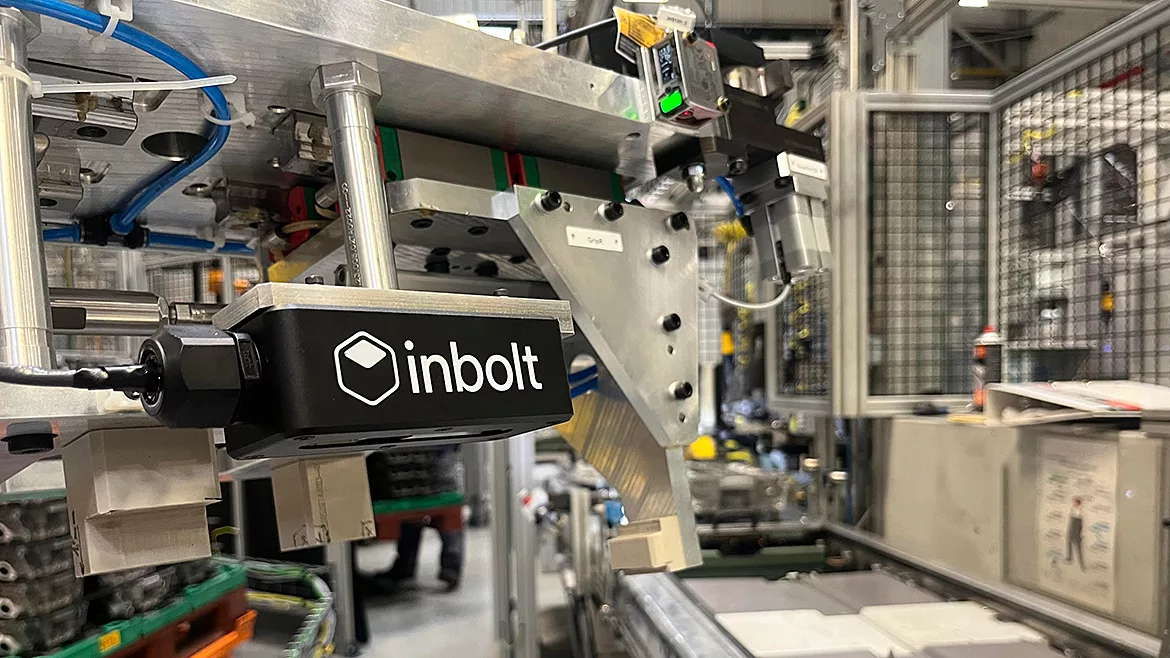
Image Source: Inbolt
Modern manufacturing demands more than speed and scale—it requires intelligence, adaptability, and precision. Traditional robotics brought repeatability but lacked perception. Now, with the integration of computer vision, we are witnessing a new era where robots not only act but also see, analyze, and improve.
This article explores how combining robotics with computer vision is revolutionizing quality control. Far from being a niche innovation, vision-enhanced robotics is becoming foundational to resilient, high-performance factories.
Why Vision Matters in Quality Automation
Industrial robots excel at structured tasks: welding, picking, placing, and assembling. But without perception, they are limited to fixed environments and narrow tolerances. Vision changes that.
Moreover, without perception, robotics automation on moving lines needs complex setups with line encoders, lasers and other sensors. Vision changes that.
By equipping robots with cameras and intelligent visual processing, factories gain systems that can:
- Detect visual anomalies in real time,
- Verify parts and component presence and orientation,
- Adapt to part-to-part variation or lighting changes,
- Handle multi reference parts on the same assembly line
- Log visual records for traceability and audit.
In the food and beverage industry, AI-powered machine vision is more and more deployed to inspect bottles for fill levels, cap installation, label accuracy, and foreign particle detection, ensuring consistent product quality.
These capabilities are particularly powerful in industries where subtle variations can result in costly rework or product recalls. These capabilities are also excellent for industries where multiple references can be processed on the same production line. Vision-enabled robotics ensures that defects are caught early, consistently, and with objective evidence.
Core Technologies Behind Vision-Enhanced Robotics
The integration of vision on robots has always been an ultimate goal, but let’s see what technical bricks are needed to achieve this. This can give a clear explanation why we are at the perfect moment to embrace the era of robots with eyes for quality inspection.
At a high level, making a robot “see” requires combining several components:
- Image acquisition: Using 2D, 3D, or multispectral cameras to capture visual data of parts, assemblies, or surfaces. Amongst cameras, one can differentiate capture cameras that take snapshots and stream cameras that can provide continuous video flux. For example, 3D color cameras are used in logistics for tasks like de-palletizing and order fulfillment. These cameras provide high-resolution depth information, aiding robots in precise handling of items.
- Lighting systems: Proper illumination tailored to the materials being inspected, which is critical for visual consistency in 2D. On the contrary, infrared 3D and laser cameras make ambient lighting conditions’ impacts almost negligible.
- Computer vision software: Algorithms—either rule-based or powered by machine learning and deep learning —that classify, detect, or measure features of interest.
- Inference hardware: Processing units, often on the edge, that evaluate images captures and streams in milliseconds and provide actionable output. Manufacturing floor is a sensitive area where network communications must be controlled. Edge computing is then the key to integration success.
- Integration layer: Communication between the vision system and the robot controller to influence decisions and movements. Real-time decisions need real time detection systems and high speed inference software. On moving assembly lines this is a key success factor for automating quality inspection solutions.
- Vision programming interface: Software for easy and seamless programming of robotics with vision. It can be training, defining and programming models and robotics to run real tasks on the assembly floor.
While traditional systems rely on hardcoded rules and thresholds, modern robotics and vision solutions increasingly leverage deep learning and artificial intelligence. Vision models trained on thousands of annotated examples can identify subtle defects on parts and generalize across new scenarios better than rule-based logic ever could.
The combination of traditional vision models and deep learning provides very interesting performance levels to ensure reliability and quality of the automatic tasks.
How Vision-Enhanced Robotics Improves Quality
Vision-enhanced robotics is offering benefits for quality inspection in assembly lines on multiple aspects. Let’s list them.
➤ Dynamic Adaptability
Vision allows robots to recognize and respond to changes in the environment—such as part reference, orientation, positioning, or lighting—without halting production. This is essential in high-mix or semi-structured manufacturing environments.
➤ Real-Time Inline Inspection
Vision systems embedded directly into robotic workflows allow for continuous inspection during production, rather than separate downstream checks. This reduces defect propagation and shortens feedback loops, enabling near-instant correction.
➤ Fewer False Negatives and Positives
AI-based vision tools can differentiate between natural variation (e.g., surface textures, color tones) and true anomalies, improving accuracy over rigid pixel-based methods. This leads to better yield and fewer unnecessary rejections.
➤ Traceability and Documentation
Each inspection can be accompanied by time-stamped, annotated images. This builds a transparent record for internal audits, supplier validation, or regulatory compliance—particularly valuable in automotive, aerospace, and pharmaceutical sectors.
Key Industry Trends Accelerating Adoption
While in the past vision for robotics may have been considered a costly and complex solution, we are now entering an era where all robots deserve eyes to increase their performance and to open automation in areas it has never been imagined.
In this part, we will review what makes it a good moment to move towards vision augmented robotics.
✔ Easy to program solutions
On the manufacturing floor, the need for fast deployment solutions is a key decision threshold. Then providing solutions that offer simple “non-technical” program interfaces for setting up computer vision on robots is essential. There is also the need for platform solutions that offer pre-trained working use cases to replace niche highly customized standard vision solutions.
✔ Shift from Code-Centric to Data-Centric Development
Instead of focusing solely on writing algorithms, modern vision systems thrive when powered by high-quality data. The performance of machine learning models often depends more on data diversity, labeling accuracy, and feedback cycles than on the model architecture itself.
✔ Use of Synthetic Data
For rare defect types or pre-production phases, manufacturers increasingly use synthetic data—rendered images from CAD models, with simulation tools—to train vision models. This enables earlier deployment without needing months of sample collection. As an example, synthetic data, such as rendered images from CAD models, are frequently used to train vision models for defect detection, enabling earlier deployment without extensive sample collection.
✔ Edge Deployment for Real-Time Response
Thanks to compact and efficient inference hardware, vision models can now run directly on robotic arms or inspection stations on the assembly floor. This reduces latency and dependency on external networks or cloud infrastructure.
✔ Reinforcement via Human-in-the-Loop Feedback
Hybrid systems—where human inspectors review edge cases and feed corrections back into the model—help maintain accuracy in changing environments and reduce long-term performance drift.
Common Challenges and How to Address Them
Adoption of vision-enhanced robotics for quality applications can be a change of paradigm in the way teams integrate quality inspection solutions. Several challenges can be met along the way. Anticipating them is a key for success.
Vision Model Degradation Over Time
As production environments evolve, vision models may underperform unless retrained. Implementing periodic validation routines and maintaining an annotated image archive supports long-term robustness.
Lighting and Environmental Instability
Changes in ambient lighting or reflections can lead to inconsistent inspection outcomes. Engineering for controlled illumination, using polarizers or enclosures, is essential for stable RGB vision. 3D vision is largely immune to these scenarios as point cloud and image depth capture does not rely on ambient lighting conditions.
Integration Complexity
Vision-enhanced systems require coordination between mechanical, electrical, and software layers. Early collaboration between quality, controls, and data teams reduces risk and accelerates commissioning. Moreover, the use of seamless programming tools for vision solutions on robotics empowers all teams on complex solutions deployment.
Skill and Knowledge Gaps
Technicians and engineers must increasingly understand data workflows, labeling tools, and inference logic. Investing in training and building cross-functional teams is critical for sustainable adoption. The use of vision solutions programming with integrated knowledge is also a key factor of success.
Best Practices for Implementation
The maturity of vision enhanced robotics and the experience sharing from different use cases running in production helped identify best practices for implementation of vision on robots. The major ones are listed here:
-
Start with a narrow, high-impact use case
Choose a defect type or part where automation would relieve a known bottleneck or improve consistency. Making the acquisition of key KPIs to measure impact can ease shareholders sponsoring of projects. -
Develop a strong image labeling pipeline
Accurate annotations are the foundation of a performant model. Combine semi-automated labeling tools with human review. -
Use domain-specific validation metrics
Don’t rely solely on test-set accuracy. Evaluate false acceptance and rejection rates under realistic production variation. -
Design for traceability
Automatically store inspected images with metadata, inspection outcomes, and process timestamps. The gathering of data on the assembly line in production is a true source of high-quality data. -
Build feedback loops into operations
Use edge-case capture and occasional human review to fine-tune performance and adapt to drift.
From Automation to Intelligent Assurance
Robots that see aren’t just more capable—they’re more trustworthy. By integrating computer vision into factory robotics, manufacturers are building systems that elevate quality from a reactive checkpoint to a proactive, intelligent process.
One major use case example is the implementation of robotic inspection cells fully equipped with vision systems to enhance quality assurance in automotive manufacturing, ensuring high-quality standards and reducing manual inspection errors.
Whether it’s improving first-pass yield, reducing manual inspection load, or building confidence in traceability, vision-enhanced robotics delivers measurable value. As the barriers to entry fall—thanks to more accessible AI tools, edge computing, and synthetic data—vision will no longer be a premium feature. It will be standard.
In this transformation, one thing is clear: in modern manufacturing, seeing is improving.
Looking for a reprint of this article?
From high-res PDFs to custom plaques, order your copy today!