Quality Magazine logo
search
cart
facebook twitter linkedin youtube
  • Sign In
  • Create Account
  • Sign Out
  • My Account
Quality Magazine logo
  • NEWS
  • PRODUCTS
    • FEATURED PRODUCTS
    • SUBMIT YOUR PRODUCT
  • CHANNELS
    • AUTOMATION
    • MANAGEMENT
    • MEASUREMENT
    • NDT
    • QUALITY 101
    • SOFTWARE
    • TEST & INSPECTION
    • VISION & SENSORS
  • MARKETS
    • AEROSPACE
    • AUTOMOTIVE
    • ENERGY
    • GREEN MANUFACTURING
    • MEDICAL
  • MEDIA
    • A WORD ON QUALITY PUZZLE
    • EBOOK
    • PODCASTS
    • VIDEOS
    • WEBINARS
  • EVENTS
    • EVENT CALENDAR
    • IMTS
  • DIRECTORIES
    • BUYERS GUIDE >
      • Supplier Insights
    • NDT SOURCEBOOK
    • VISION & SENSORS
    • TAKE A TOUR
  • INFOCENTERS
    • Digital Quality Management Systems
    • NEXT GENERATION SPC & QUALITY ANALYTICS
  • AWARDS
    • ROOKIE OF THE YEAR
    • PLANT OF THE YEAR
    • PROFESSIONAL OF THE YEAR
  • MORE
    • Expert Columns
    • NEWSLETTERS
    • QUALITY STORE
    • INDUSTRY LINKS
    • SPONSOR INSIGHTS
  • EMAG
    • eMAGAZINE
    • ARCHIVES
    • CONTACT
    • ADVERTISE
  • SIGN UP!
Vision & Sensors

Vision & Sensors | Lighting

How to Evaluate Machine Vision Lighting for High-Speed Inspections

As inspection speeds continue to get faster, it is important to remember that lighting principles remain unchanged.
By Lindsey Sullivan
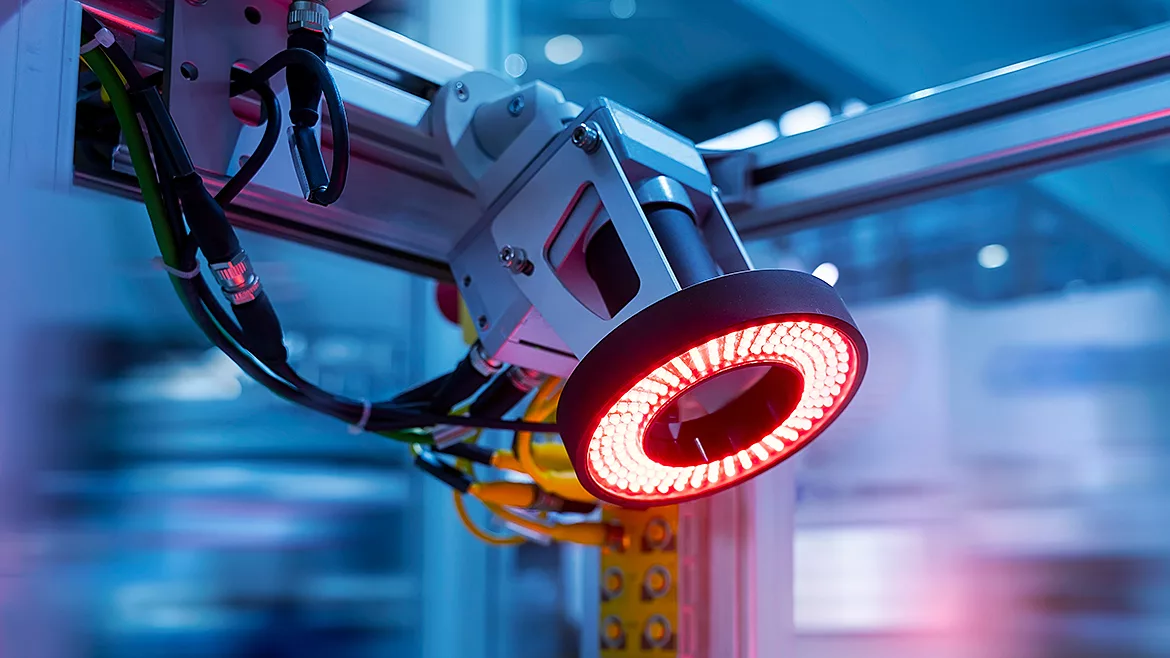
Robotic vision sensor camera system.
Image source: kynny / iStock / Getty Images Plus
August 7, 2025
✕
Image in modal.

Getting enough light for a high-speed application is not as simple as confirming the lux at a given working distance. Because whether a light is bright enough is more about how much light is reflecting off a sample, not how much light hits it. Are we capturing direct or scattered light? Is the sample going to absorb a lot of light?

Even if the light has a high intensity, the inspection target will still be undetectable if the sample does not reflect enough light to the camera. This challenge becomes even harder in high-speed applications, where lights must be significantly brighter to compensate for short exposure and avoid blur.
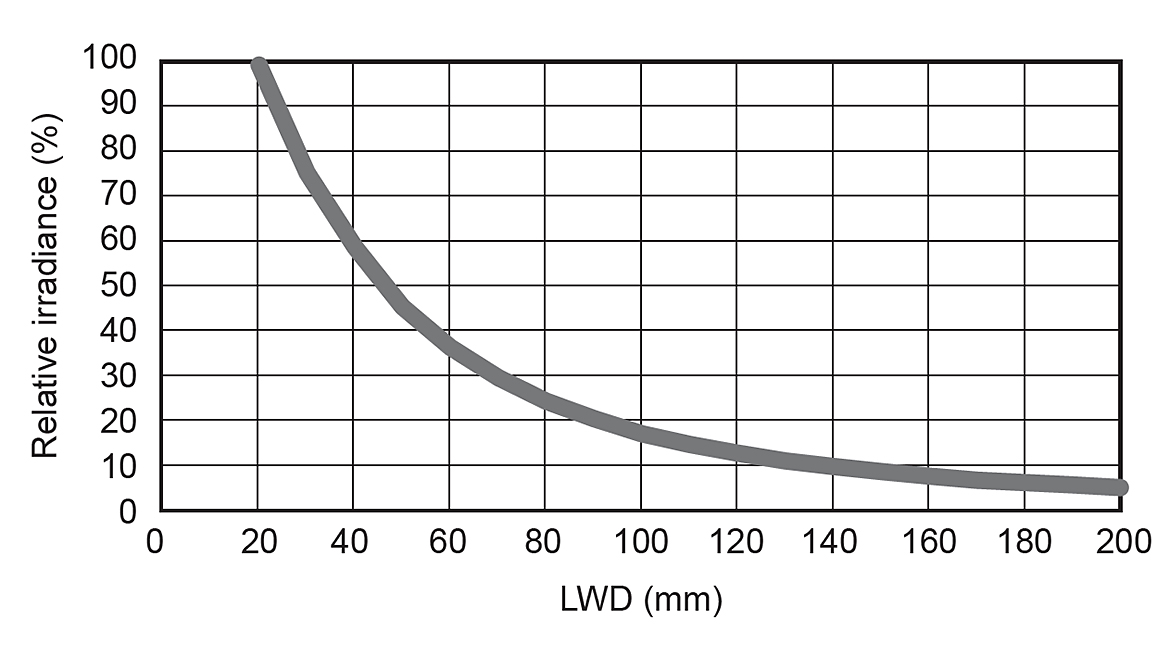
Relative irradiance graph
There is a common misconception that if a light has enough lux at the distance that it will be installed from the sample, the image will be bright enough. In reality, the way light interacts with a given workpiece means there can be a lot less light actually reaching the camera, and the inspection target may be too difficult to detect as a result. Image Source: CCS America

The current demands of high-speed applications go beyond what generic lighting is capable of. In recent years, manufacturers have focused on developing lighting solutions that can strobe at the highest intensity possible, for the shortest shutter speed possible. But regardless of whether exposure time is 20 ms or 20 µs, the machine vision system’s accuracy still depends on following the principles of machine vision lighting.

Challenges of high-speed applications

Speeding up operations to increase throughput risks losing accuracy in a vision system if it is not designed to handle those demands.

One of the most significant consequences of high-speed applications is that overdriving lights for short pulses generates heat. Without proper thermal design, lights can degrade more quickly. High-power strobing can also cause shifts in color or intensity over time or between pulses. This can affect color inspections where consistent wavelength illumination is critical. Lights designed specifically with dedicated strobing for high-speed applications focus on getting the highest intensity possible while sufficiently dissipating heat.

The lighting itself is not the only consideration. With line speeds so fast, it is important to be able to turn the light on and off with the camera exposure, and there is marginal room for error. If the light cannot receive a trigger, turn on, flash, and turn off all within the camera’s exposure time, the image will flicker and have inconsistent intensity. Any jitter in the triggering of light pulses relative to the camera exposure can blur or misalign images. Lighting control needs to be nearly perfect for consistent and precise results.

Lighting control can precisely time light flashes down to the microsecond-level, so that the maximum amount of light reaches the camera within every shutter.
Lighting control can precisely time light flashes down to the microsecond-level, so that the maximum amount of light reaches the camera within every shutter. Image Source: CCS America

With lights getting brighter and lighting control improving, machine vision inspections can be performed much faster compared to 20 years ago.

The difference between high-speed flood lighting vs. precision lighting applications

Regardless of whether the sample is stationary or moving, lighting is about creating contrast for the camera so that software can analyze the image repeatably and reliably. Whether to use flood lighting or precision lighting depends on what is required to create contrast.

In flood lighting applications, the contrast is there even without lighting, such as a dark barcode on a light background. There is no specific direction or LWD required to see the target information, and the main purpose of lighting is to evenly illuminate the entire field of view.


NG-FLEX Autostrobe twenty-twenty
Image Source: Effilux
OK FLEX LG Megastrobe twenty-twenty barcode
Barcodes, such as those in logistics applications, already have high contrast. Dedicated strobe flood lighting ensures the image is bright and uniform for code reading, even at long working distances. Image Source: Effilux

A dedicated strobe flood bar light can provide uniform illumination, so ambient light or other factors do not affect the image day to day. The most common application of high-speed flood lighting is logistics, where thousands of packages need to be scanned every day. Flood lights also provide the intensity needed for high-speed applications that require installing lights at longer working distances.

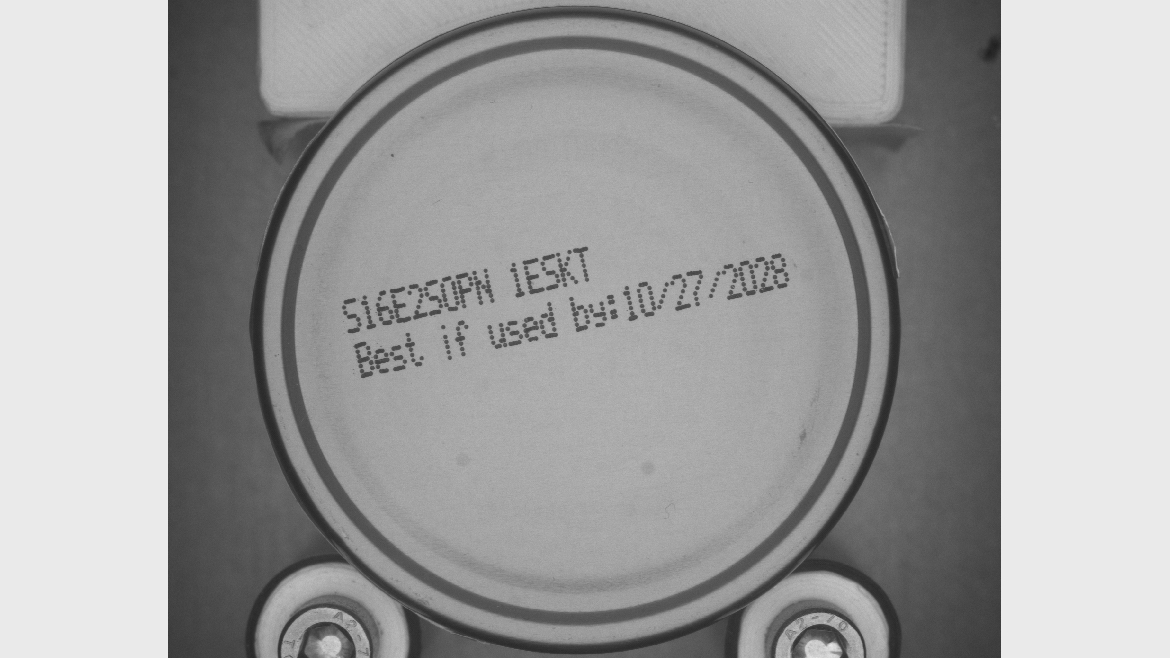
Inspections that use precision lighting have a specific detail that needs to be seen that has little to no contrast on its own. Engineers must factor in what wavelength, direction, angle, size, and optical accessories will do the most to enhance uniformity for the highest possible contrast, or else the system will not be accurate enough to be reliably deployed.
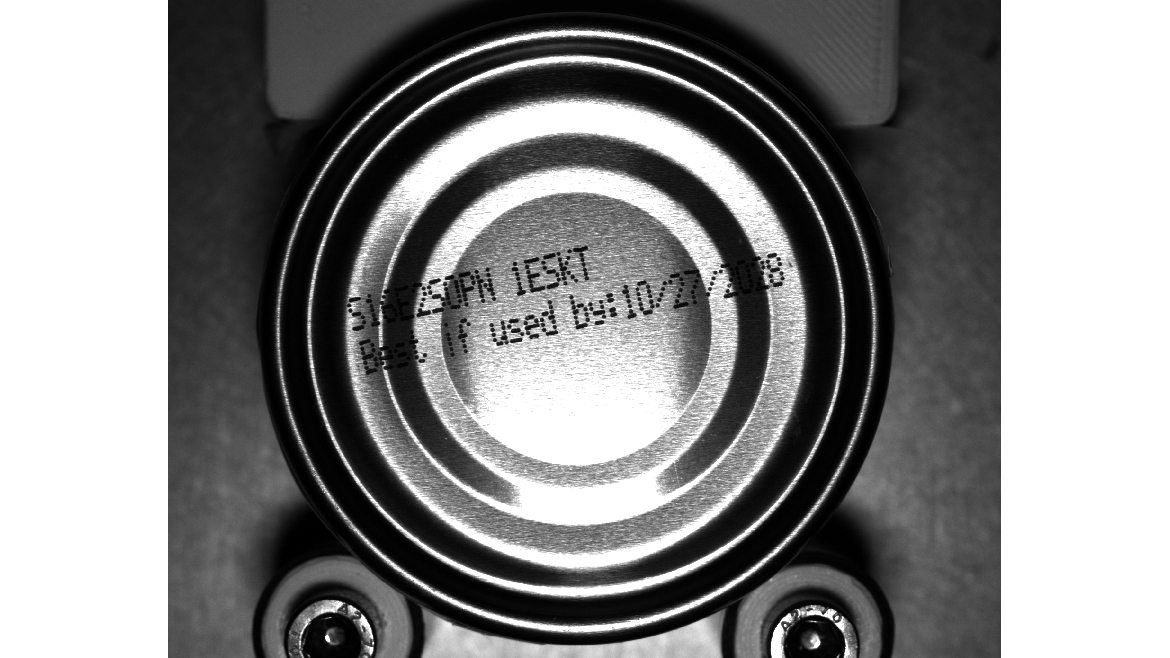
Top view of a food can label that's difficult to see due to light.
Image Source: CCS America
Food can label, clear image with no blur or bright light.
Sometimes, flooding the FOV with a lot of light makes it harder to see the target information. A lighting solution with a specific lighting geometry, working distance, etc. will clearly highlight the defect and emit enough light, so the image is bright with no blur. Image Source: CCS America

Since higher intensity lighting may create more harsh specular reflections, especially on curved or shiny parts, precision lighting solutions become even more crucial in high-speed applications. High-speed precision lighting must provide different types of lighting geometries in addition to strobing capabilities, so that there is as little noise as possible interfering when capturing the defect.

How to determine the lighting intensity needed for a high-speed application

The best indicator of an application’s required intensity is the exposure time. To calculate the exposure time for an application, you need to know blur (B), field of view (FOV), part velocity (VP), and pixels in camera resolution (NP).

Exposure time formula
This formula is used to calculate exposure time for an application and can help engineers determine if a standard light on overdrive or a dedicated strobe light is the likely solution. Part velocity can be calculated using parts-per-hour (pph) if that is the information the customer provides. Image Source: CCS America

Generally, if the exposure time is:

  • >500µs: standard intensity is usually sufficient
  • 100µs - 500µs: application dependent
  • <100µs: dedicated strobe required

Testing high-speed applications is about determining how much brighter the light needs to be compared to standard intensity. It might sound counterintuitive, but the most effective way to test a high-speed application is to initially treat it like it is not. When setting up the testing station, start with standard lights and a slower shutter speed. This is because there are more lighting options if the application can be solved with standard lights on overdrive compared to strobe-only lights. It is also easier to start with standard lights because you can test all lights in continuous mode. Otherwise, it will take extra time to set the current rating and strobe time for each light being tested.

Once you have determined the optimal lighting solution, you can then test what type of intensity control is required to properly illuminate the high-speed image: overdriving the light or using a dedicated strobe overdrive light.

Here is a recommended process for testing intensity:

  1. Set the camera to the required exposure time.
  2. Overdrive the standard light at its maximum intensity (with respect to the duty cycle and maximum intensity rating).
  3. Set the strobe time of the light to 85-90% shorter than the exposure time. This ensures 100% of the flash is captured within the exposure time.
  4. If the image is not bright enough, switch to a dedicated strobe light that is as close to the chosen light form factor and size as possible and set it up in the same way as Step 3.
  5. Confirm the initial solution works with the new light and intensity control method and adjust as needed.

If a dedicated strobe light is unavailable for testing, you can use the difference between ideal and target exposure time to approximate how much brighter the standard intensity would need to be. Set the exposure time on the camera to whatever it needs to be to reliably solve the application. How far away that is from the target exposure time provides a good idea of how much more light is required.

For example, if the target exposure time is 80µs, but the exposure time for a reliable image at standard intensity is 220µs, the light needs to be around 2.75X brighter than the standard intensity. You can then ask a lighting manufacturer if the light will be 3X brighter or if it can be overdriven at 300%.

In most cases, the intensity will be bright enough with a dedicated strobe light. If brightness is still insufficient, consider slowing the inspection speed or consulting a lighting manufacturer about a custom strobe light to meet the application’s intensity requirements. If you do not have the lighting or controllers needed to test high-speed applications, most lighting manufacturers can either test your sample in their lab or loan you their lights to test in your facility.

As inspection speeds continue to get faster, it is important to remember that lighting principles remain unchanged. Instead of relying solely on illuminance measurements, testing that a light not only reflects enough light to the camera but also gets a uniform image of the target information can save engineers from discovering they have the wrong lighting solution after the vision system is already assembled.

READ MORE

  • Why Machine Vision Lighting is So Hard and What You Can Do About It
  • The Critical Role of Wavelength and Filters in Machine Vision Illumination
  • Lighting the Way for Machine Vision and Deep Learning System Success
KEYWORDS: lighting machine vision manufacturing metrology quality

Share This Story

Looking for a reprint of this article?
From high-res PDFs to custom plaques, order your copy today!

Lindsey Sullivan is the technical marketing manager at CCS America. For more information, call (781)272-6900, email [email protected] or visit www.ccsamerica.com/.

LinkedIn: www.linkedin.com/company/ccs-america-inc

Recommended Content

JOIN TODAY
to unlock your recommendations.

Already have an account? Sign In

  • 2024 Quality Rookie of the Year Justin Wise 1440x750px banner with "Quality Rookie of the Year" logo inset

    Meet the 2024 Quality Rookie of the Year: Justin Wise

    Justin Wise is an exceptional individual who has been...
    Aerospace
    By: Michelle Bangert
  • Man with umbrella and coat stands outside while it rains at night looking at a building.

    Nondestructive Testing: Is there an ethics problem?

    I was a whistleblower who exposed fraudulent activities...
    NDT
    By: Dale Norwood
  • Unraveling Deflategate: Football stadium with closeup of football on field

    Unraveling the Tom Brady Deflategate

    The Deflategate scandal erupted following the 2014 AFC...
    Measurement
    By: Greg Cenker and Henry Zumbrun
Manage My Account
  • eMagazine Subscriptions
  • Newsletters
  • Online Registration
  • Subscription Customer Service
  • Manage My Preferences

More Videos

Sponsored Content

Sponsored Content is a special paid section where industry companies provide high quality, objective, non-commercial content around topics of interest to the Quality audience. All Sponsored Content is supplied by the advertising company and any opinions expressed in this article are those of the author and not necessarily reflect the views of Quality or its parent company, BNP Media. Interested in participating in our Sponsored Content section? Contact your local rep!

close
  • Key Takeaways for Quality Leaders
    Sponsored byComplianceQuest

    Key Takeaways for Quality Leaders from the 2026 Gartner Magic Quadrant™ for QMS

  • This image shows a person seated next to a Bobcat T66 compact track loader.
    Sponsored byPolyWorks by InnovMetric

    Supercharging Digital Gauging at Bobcat North America

  • Dorsey Calibration Lab photo by Tom LaBarbera Picture this Studios
    Sponsored byDorsey Metrology International

    Ensuring Product Quality in a Competitive Manufacturing Landscape

Popular Stories

This image shows a person seated next to a Bobcat T66 compact track loader.

Supercharging Digital Gauging at Bobcat North America

a professional in the aviation field performing maintenance, repair, and overhaul (MRO) work

Manufacturing Retention: Strategies for Improving Company Culture, Engagement and Skill Development

Dorsey Calibration Lab photo by Tom LaBarbera Picture this Studios

Ensuring Product Quality in a Competitive Manufacturing Landscape

2026 Quality Professional of the Year!

Events

June 22, 2026

Automate 2026

Automate is North America's largest robotics and automation event — and the best place to take your ideas from insight to impact.
 
Our show floor features the world’s leading automation solutions, from AI and robotics to motion control, vision systems, and more. Plus, our educational conference is second to none, led by the brightest minds in automation today.
 
Ready to transform the way you work? Take the next step at Automate.
July 14, 2026

Quality Leaders Forum: Better Communication, Better Quality Data

The Quality Leaders Forum is a quarterly, editor-moderated fireside chat series hosted by Quality Magazine, featuring candid conversations with senior manufacturing and operations executives shaping enterprise-level quality.

View All Submit An Event

Products

Lean Manufacturing and Service Fundamentals, Applications, and Case Studies

Lean Manufacturing and Service Fundamentals, Applications, and Case Studies

See More Products
Quality Podcast Channel Custom Content

Related Articles

  • This diagram illustrates the scattering of light, specifically diffuse reflection.

    Machine Vision Lighting Solutions for Unwanted Glare

    See More
  • VS 0522 Lighting feature photo

    Three Challenges In Machine Vision Lighting Today And How To Solve Them

    See More
  • QM 0222 NDT LIBS FME Graph on Scree

    How to Evaluate Accuracy and Why You Should Calculate the Error Margin of Spectroscopy Measurements

    See More

Related Products

See More Products
  • 118877.jpg

    How to Audit ISO 9001 2015 A Handbook for Auditors

  • Machine Vision and Error Proofing DVD

  • temp_6351_1_5705_1_8318_1_17674.jpg

    How To Implement Lean Manufacturing, 2E

See More Products

Related Directories

  • Phoenix Imaging Machine Vision

    Porosity Inspection of machined metal components using 3D image acquisition. High resolution laser-based scanning optimizes Porosity detection. Phoenix-Middle-Man™ software package provides image storage and database, SQL query and visual display of defects. High-Speed Surface Inspection Systems from Keyence, Omron and Phoenix Imaging for the tough ICE, BEV & Battery projects.
  • Machine Vision Store

    Machine Vision Store has a laser-sharp focus on machine vision imaging. We deliver a select group of components - cameras, lenses, lights, industrial vision PC's - from leading manufacturers known for quality. Components we understand, support and stand behind. Components and consulting services that will power your success.
×

Stay in the know with Quality’s comprehensive coverage of
the manufacturing and metrology industries.

Newsletters | Website | eMagazine

JOIN TODAY!
  • RESOURCES
    • Advertise
    • Contact Us
    • Directories
    • Manufacturing Division
    • Store
    • Want More
  • SIGN UP TODAY
    • Create Account
    • eMagazine
    • Newsletters
    • Customer Service
    • Manage Preferences
  • SERVICES
    • Marketing Services
    • Market Research
    • Reprints
    • List Rental
    • Survey/Respondent Access
  • STAY CONNECTED
    • LinkedIn
    • Facebook
    • YouTube
    • X (Twitter)
  • PRIVACY
    • PRIVACY POLICY
    • TERMS & CONDITIONS
    • DO NOT SELL MY PERSONAL INFORMATION
    • PRIVACY REQUEST
    • ACCESSIBILITY

Copyright ©2026. All Rights Reserved BNP Media, Inc. and BNP Media II, LLC.

Design, CMS, Hosting & Web Development :: ePublishing