Software Error-Proofs Assembly of Medical Training Equipment
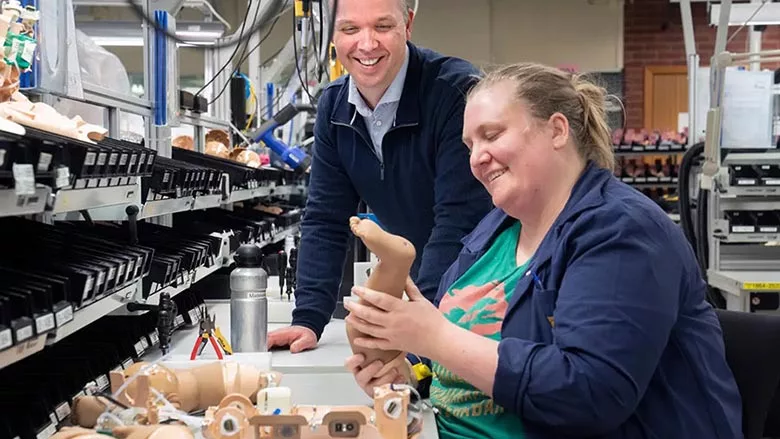
Photo courtesy Laerdal Medical
Medical emergencies are not the best time for training. When administering life-saving treatments, first responders and emergency room personnel can’t necessarily pause to explain what they’re doing to a newbie.
That’s where training dummies come in. Founded in 1940, Laerdal Medical is one of the world’s leading suppliers of models for teaching people how to do CPR, intubate a patient or even deliver a baby. Headquartered in Stavanger, Norway, Laerdal employs some 2,000 people in 26 countries.
As a global manufacturer, Laerdal often shifts value streams across its facilities around the world to meet customer demands. After two decades of manufacturing a facsimile of a human bust at one location, the Laerdal team needed to move production to a new facility. There, Laerdal needed a way to kit the busts with an array of auxiliary equipment and to collect data for optimizing the new assembly line.
At the original facility, this was not a problem. The team reliably sent kits to customers without any omitted parts. However, as with any new process, Laerdal engineers faced a steep learning curve to get workers at the new facility up to speed.
Quality is at the core of Laerdal products. As such, it is critical that when manufacturing and assembly is transferred from one facility to another, quality is not adversely affected.
To ensure that each bust is assembled correctly and shipped with the right auxiliary components, Laerdal engineers implemented Tulip Vision, a vision-based error-proofing system from Tulip Interfaces Inc. in Somerville, MA.
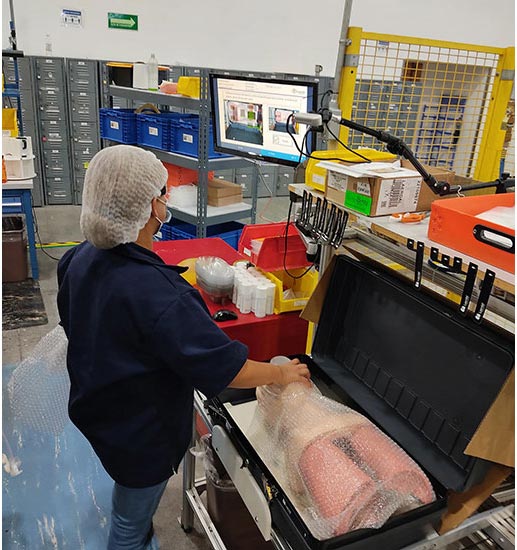
A vision-based error-proofing system guides workers as they assemble medical training dummies. Photo courtesy Laerdal Medical
The system built by the Laerdal team works behind the scenes, continuously monitoring the kits as they are assembled. As workers pick parts and place them in a crate, Tulip Vision automatically recognizes the parts and checks them off the bill of materials. Once all parts have been placed, a photograph of the kit is captured for future reference and remote visual inspection, and the technician is allowed to ship the kit.
This simple system ensures that the kits are complete, provides a digital reference for potential warranty claims, and allows the team to identify and drive improvements within the process.
Tulip Vision is a versatile, powerful tool that lets operations teams build custom vision-enabled apps without writing a single line of code. To build the error-proofing system at their assembly plant, the Laerdal team purchased one of the recommended off-the-shelf cameras available from many retailers and built an app to guide technicians through kit assembly.
The team set up the cameras to face down at each assembly station, and hooked them up to Tulip Vision. This allowed technicians to pick parts without having to adhere to a particular order, or manually check off parts from a long list of bill of materials. It also served as a visual aid during production, and as a future reference for process improvements.
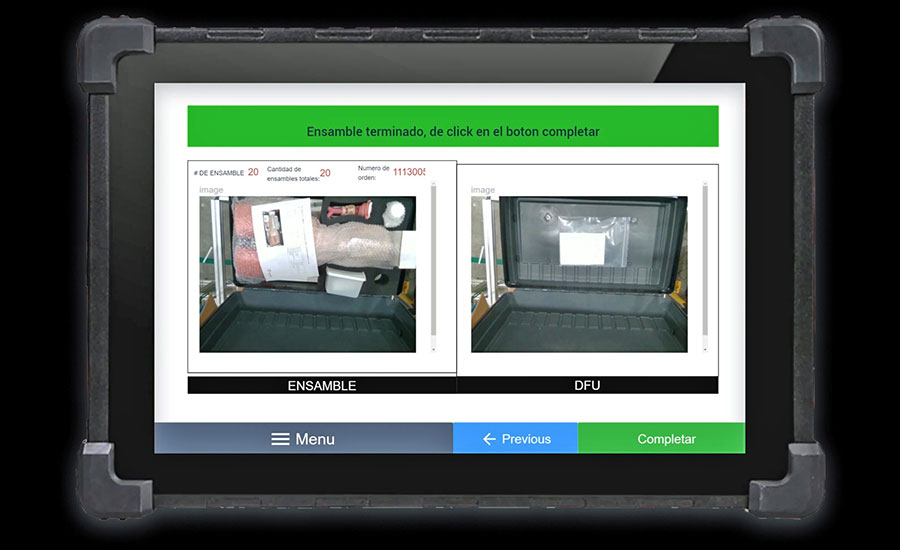
As workers pick parts and place them in a crate, Tulip Vision automatically recognizes the parts and checks them off the bill of materials. Photo courtesy Laerdal Medical
The Laerdal team was also able to expand visibility into the process’ cycle times and quality defects. Using Tulip’s built-in analytics capabilities, the engineering team at Laerdal is now able to analyze and visualize real-time data and make process improvement decisions based on data.
Tulip leverages the scalability and agility of the AWS cloud to support Laerdal. Images ingested by Tulip Vision are used to build machine-learning models using Amazon SageMaker, a fully managed AWS service that helps developers and data scientists build, train and deploy machine learning models at scale.
Since Laerdal incorporated Tulip Vision into their operation, the kitting and assembly line has not produced a single defect or omitted a single component, despite producing thousands of kits. This saved Laerdal from shipping missing parts to customers and processing return claims. It also cut costs and saved time in overall production.
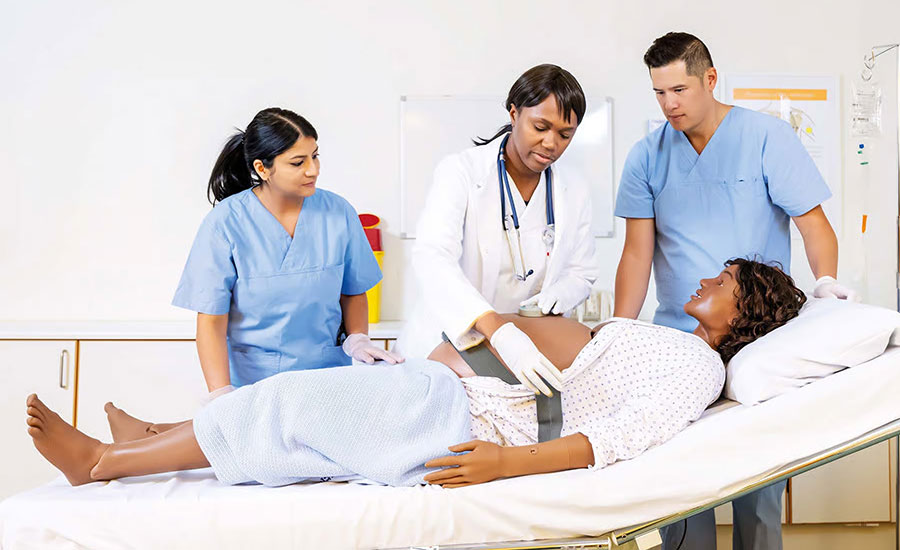
Lifelike models help teach medical personnel how to do CPR, intubate a patient or even deliver a baby. Photo courtesy Laerdal Medical
For more information on error-proofing technology and manufacturing execution software, visit https://tulip.co.
Looking for a reprint of this article?
From high-res PDFs to custom plaques, order your copy today!