Management
Don’t Ignore Gravity: Lean Management Laws for Better Problem-Solving
If we anchor problem-solving in things that are undeniably true, we avoid the doom loop of opinion vs. opinion.

A huge part of any Lean transformation is getting your team fired up about a mission, aligned on problem-solving, and hardest of all, actually working together. Spend five seconds around humans and you already know: easier said than done. Everyone sees problems differently, everyone’s got their own “right” answer, and our egos aren’t exactly known for playing nice.
This article isn’t about fixing people (if you crack that one, call me). It’s about removing the stuff we shouldn’t be arguing about. If we anchor problem-solving in things that are undeniably true, we avoid the doom loop of opinion vs. opinion. Start with: “What do we know to be true?” If it’s an absolute, it’s not up for debate.
Example: Gravity. You might love it, hate it, or have deep philosophical thoughts about it—but drop something and it’s hitting the floor. End of story.
So the real question is: How many undeniable truths can you align the team on before the discussion starts?
Follow these seven laws and get an unfair advantage.
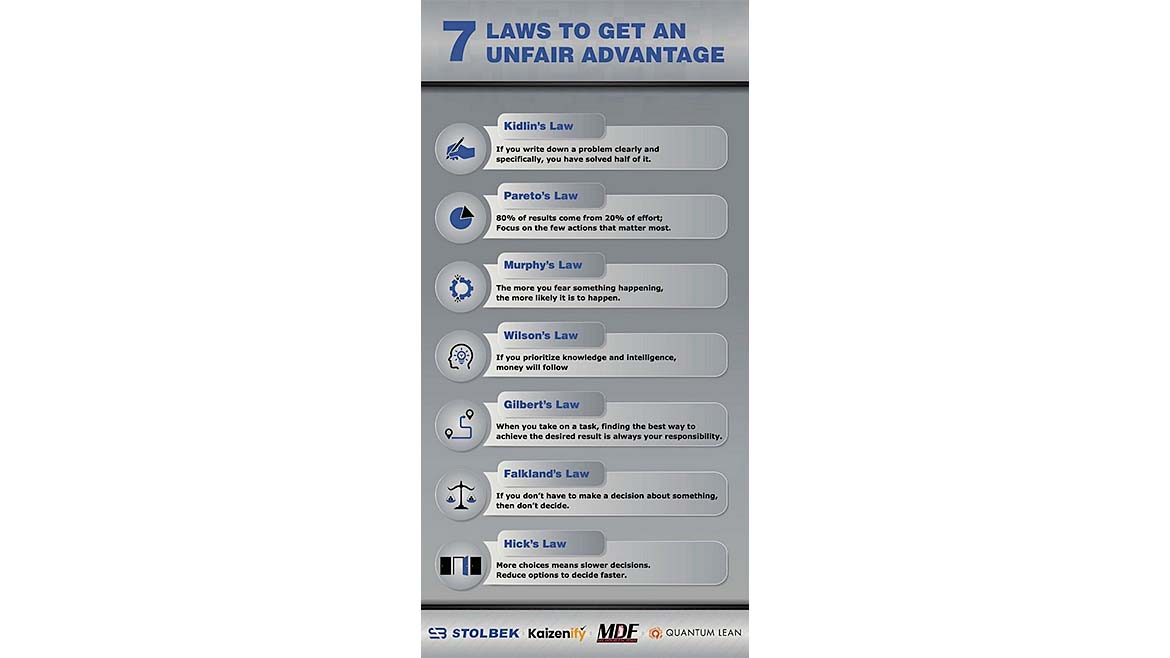
Kidlin’s Law: If you write down a problem clearly and specifically, you have solved half of it.
Practical application: Instead of just sitting in a meeting going back and forth getting nowhere, have your team agree on a problem statement. One or two sentences that succinctly describe the issue with no questions.
Pareto’s Law: 80% of results come from 20% of effort: Focus on the few actions that matter most.
Practical application: I find this one I have to remind people all the time not to trash a good idea because of one scenario they can dream up that won’t work. Particularly in production process designs. If 80% or more of your parts can flow through the system, that’s a green light. Don’t not build the line because a small percent of products will still have to be done the hard way. Reap the benefits of the 80%
Murphy’s Law: The more you fear something happening, the more likely it is to happen.
Practical application: Don’t “what if” all over the place. If it seems reasonable, go for it, the bad thing might not happen. If it does, great you learned. Fail forward.
Wilson’s Law: If you prioritize knowledge and intelligence, money will follow.
Practical application: Trade in your favorite radio station, get hooked on audio books and podcasts. The radio station has never sent you money. Stop giving them your time.
Gilbert’s Law: When you take on a task, finding the best way to achieve the desired result is always your responsibility.
Practical application: Stop going to your boss with problems. Adopt the Gilbert’s Law mindset and start bringing three possible solutions. Show you have done the work and just need direction.
Falkland’s Law: If you don’t have to make a decision about something, then don’t decide.
Practical application: Don’t change a process, buy equipment, or intervene on the floor until the problem is real, verified, and recurring—avoid solving imaginary problems.
Hick’s Law: More choices means slower decisions. Reduce options to decide faster.
Practical application: Standardize tools, labels, and options so operators make fast, mistake-free decisions instead of wasting time choosing.
8 High performance laws that no one teaches
The North Star Principle: Clarity is an advantage. Anchor to a long-term vision with actions and make every decision a step toward it.
Practical application: Make one clear, visible metric, like Pieces per Day or On-Time Delivery, the guiding target so every decision on the floor aligns with it.
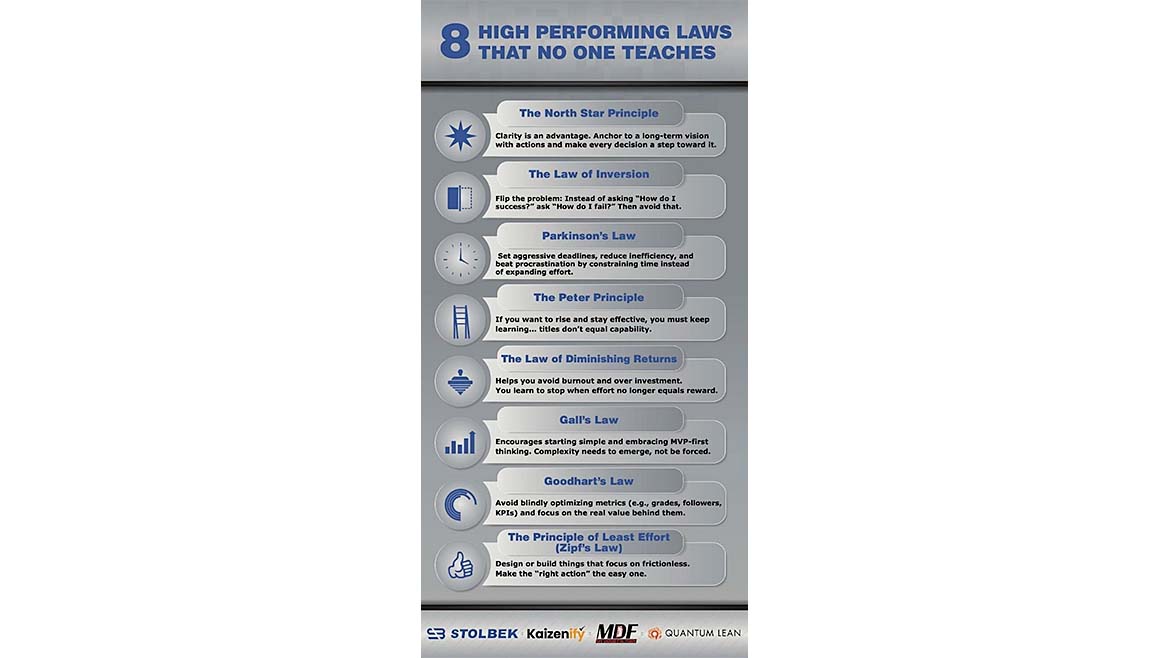
The Law of Inversion: Flip the problem: Instead of asking “How do I succeed? ask “How do I fail?” Then avoid that.
Practical application: Instead of asking how to improve output, ask what’s preventing it, identify and eliminate the constraints, and performance jumps naturally.
Parkinson’s Law: Set aggressive deadlines, reduce inefficiency, and beat procrastination by constraining time instead of expanding effort.
Practical application: Set tight, clear takt times and deadlines. Shorter, focused time windows prevent processes from bloating and force efficiency.
The Peter Principle: If you want to rise and stay effective, you must be learning...titles don’t equal capability.
Practical application: Promote based on proven skills and provide training before giving new responsibilities, so great operators don’t become overwhelmed supervisors. Don’t turn a great worker into an awful leader.
The Law of Diminishing Returns: Helps you avoid burnout and over investment. You learn to stop when effort no longer equals reward
Practical application: Stop over-optimizing a process once improvements flatten, shift resources to the next biggest bottleneck where gains will actually matter.
Gall’s Law: Encourages starting simple and embracing MVP-first thinking. Complexity needs to emerge, not be forced
Practical application: Pilot new processes in a small, simple version, prove it works at one station or cell before scaling it across the entire factory to avoid massive failures.
Goodhart’s Law: Avoid blindly optimizing metrics (e.g., grades, followers, KPIs) and focus on the real value behind them.
Practical application: Balance metrics, if you chase Pieces per Day alone, quality drops; pair every target with a counter-metric (e.g., defects per day) to keep behavior honest
The Principle of Least Effort (Zipf’s Law): Design or build things that focus on frictionless. Make the “right action” the easy one.
Practical application: Design workstations so the easiest way is the right way, short reaches, clear labels, and tools at hand. Because operators will always default to whatever requires the least effort. Shadow boards that are inconvenient will still not get used.
Looking for a reprint of this article?
From high-res PDFs to custom plaques, order your copy today!