Test & Inspection
Elevating Precision in Materials Testing: The Game-Changing Impact of Robust Non-Contact Extensometers Without Sample Marking
By enhancing the natural surface texture of the specimen, blue light eliminates the need for physical markings.
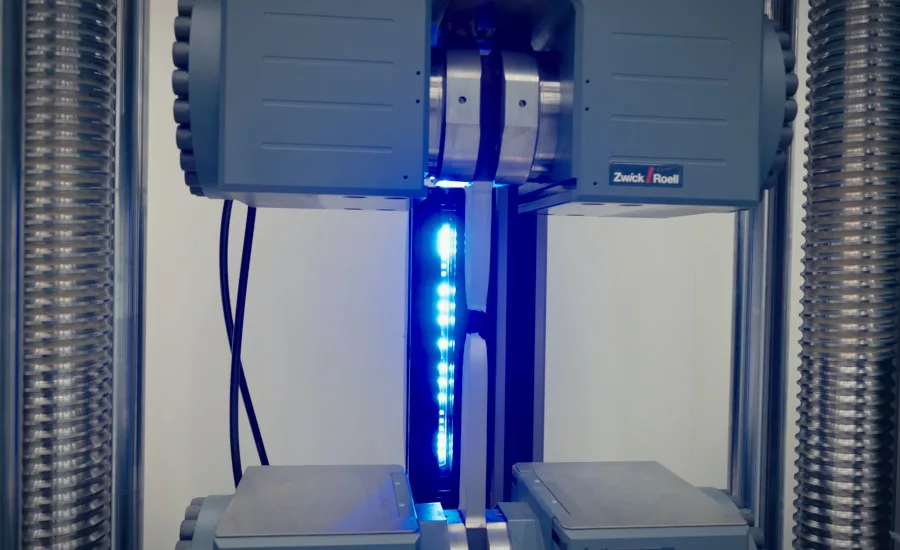
For decades, the metals testing industry has relied on extensometers to measure material deformation and ensure product quality. Traditionally, non-contact extensometers required physical markings on specimens, a method that, while established, presented a definite set of challenges. Today, thanks to advances in optical technology and machine learning, robust non-contact extensometers can deliver precise, repeatable results without the need for sample marking. This breakthrough is reshaping how we approach materials testing, offering new levels of reliability, efficiency, and versatility.
The limitations of marked specimens
Marking specimens for non-contact extensometry has been the norm for about 25 years. Operators gained a visual reference for measurement points, and for some materials, like translucent samples, it may still be the only viable option. However, this method includes a number of drawbacks:
- Concerns about precision and repeatability: markings can be inconsistent, leading to possible issues with measurement accuracy.
- Material suitability: not all materials can be marked effectively.
- Environmental sensitivity: temperature and humidity can affect marking quality.
- Sample size: small specimens are especially challenging to mark.
- Susceptibility to external factors: environmental conditions can compromise results.
Blue contrast lighting: a leap forward
The introduction of blue contrast lighting technology has revolutionized non-contact
extensometry. By enhancing the natural surface texture of the specimen, blue light eliminates the need for physical markings. This innovation offers several key benefits:
- True non-contact measurement: no impact on the specimen, no risk of brittle fracture, and minimal maintenance.
- Automatic multi-point measurement: up to 15 local elongations can be measured and balanced at the breaking point, as per ISO 6892-1 Annex I.
- Consistent, reliable results: every test is dependable, with no manual measurements or retesting required. With blue contrast light, the software can define virtual measurement marks based on the specimen’s surface pattern, making gage marks obsolete and enabling flexible, automated measurement.
Defining gage marks: from two to hundreds
Why limit yourself to just two gage marks? Blue contrast light generates a pattern across the entire sample, allowing for the definition of up to 100 gage marks anywhere within the field of view (FOV) or the evaluation of an entire area.
Automatic centering and strain distribution
Optical extensometers allow us to see and use the entire specimen. Instead of just two
measuring points, we can define up to 16 evenly spaced across the sample. During testing, the extensometer records local strains simultaneously, and the software automatically centers the virtual gage length around the area of maximum strain. If the gage region is centered, and break happens near the center, then most of that uniform and even post-necking deformation is captured in the elongation measured between gage marks (or by the extensometer). This means the measured strain (and elongation) values up to fracture are more representative of the material’s ductility. This ensures the breaking position is accurately identified, minimizing specimen rejection and saving valuable time and resources.
Even when the break occurs near the end of the specimen, the system can automatically evaluate the result using mirrored sections, as described in ISO 6892. This calculation is performed instantly, streamlining the process and preserving specimens.
Advanced applications: 2D DIC and speckle patterns
Non-contact extensometers equipped with 2D DIC can analyze flat specimens, notched tensile specimens, and punched specimens. They determine stress-strain curves, edge tear strength, and failure positions, even for brittle materials. Speckle patterns further expand the range of applications, enabling precise local elongation measurements and virtual strain gages.
A speckle pattern is a random, high-contrast (dark/light) pattern on the surface of a specimen, made visible with blue light technology. This pattern allows optical systems to track local displacements during deformation. Digital image correlation (DIC) compares images of the specimen surface before and during loading. The speckle pattern provides unique “fingerprints” for small surface regions, enabling precise mapping of strain fields.
For tensile testing, traditional extensometers or clip-on gages only measure average strain over a fixed gage length. A speckle-based DIC system instead provides a strain field map, showing heterogeneities, localization, and necking. With speckle patterns + DIC, you no longer rely solely on gage length placement, since strain everywhere is captured. Speckle patterns let you see where strain localizes before fracture, making it clear if a break near the grip is due to boundary effects, geometry, or actual material behavior.
Notched specimens are intentionally stress-concentrated, so deformation is not uniform. DIC with speckle patterns quantifies the localized strain gradient near the notch tip. High-resolution speckle tracking shows how cracks start at the notch root and how strain redistributes around the growing crack.
Edge tear tests (commonly used in automotive sheet metal testing, especially for advanced high-strength steels) involve irregular strain distributions at the cut edge. A speckle pattern enables DIC to capture the true local strain to failure at the edge.
Technology benefits: every test is valid
The strain distribution function automatically computes 15 local elongations, positioning the virtual gage length near the break point. Accurate strain-at-break measurements are possible, and the test re-run feature allows for revaluation without additional reference marks. This means every test is valid, and results can be recalculated as needed—saving time and ensuring reliability.
Performance at extreme temperatures
Robust non-contact extensometers excel in challenging environments, including tests at temperatures up to +2,000 °C. They meet accuracy class B2 to ASTM E83 and are
suitable for standard and micro specimens, ultra-high temperatures in vacuum or inert gas, and a variety of tensile and fatigue tests. No specimen marking is required, even under the most demanding conditions.
Addressing out-of-plane effects
Optical measurement systems can be affected by out-of-plane phenomena, such as grip alignment, specimen compression, and bending. These factors can introduce inaccuracies, especially with short gage lengths. Stereoscopic measurement—using two cameras with continuous overlap—enables the calculation and correction of lateral movement, ensuring precise results without lengthy adjustments.
Proven effectiveness: out-of-plane compensation
Tests confirm that modeling and correcting out-of-plane effects significantly improve
measurement accuracy. By running ten tests with gage lengths from 10 to 100 mm we were able to demonstrate that out-of-plane compensation reduces variability and delivers more consistent results.
Software integration and recalculation
Integrating all data into a single software platform allows for recalculation rather than retesting. The test re-run function lets users virtually repeat and recalculate tests with modified gage lengths, saving time on specimen preparation and enabling multiple evaluations on the same sample.
Machine learning: the next frontier
The most advanced hardness testers facilitate automated assessment of any indent made using Vickers, Knoop, and Brinell methods—even on imperfect surfaces—all of which are analyzed through an optical system. Classic image processing often fails with scratches or oxidation, but ML recognizes indents as reliably as a human operator, reducing manual intervention and increasing efficiency.
Automation and reliability
ML also enhances automation in tests like the hole expansion test, reliably identifying even the smallest cracks and enabling robot-driven processes. This reduces reliance on user involvement and ensures tests are stopped at the right moment, improving both safety and efficiency.
Robust non-contact extensometers without sample marking are transforming materials testing. By leveraging blue contrast lighting, advanced software, and machine learning, these systems deliver unmatched precision, reliability, and versatility. They save time, preserve specimens, and enable new testing possibilities, making them indispensable tools for metals and automotive specialists committed to elevating precision in materials testing.
Looking for a reprint of this article?
From high-res PDFs to custom plaques, order your copy today!