Test & Inspection
The Role of Microtesters in Materials Testing Today
The microtester has emerged as a recent evolution in materials testing technology.

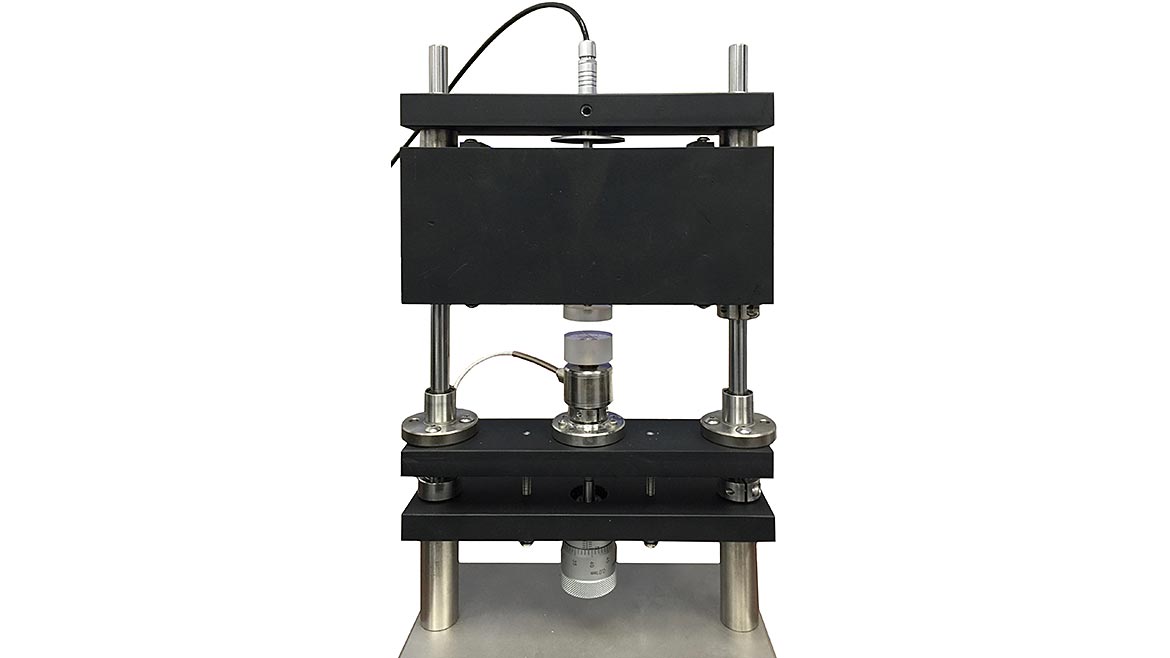
Figure 1. Microtester with Dual-Opposing Crossheads and Heated Fluid Bath.
Image Source: ADMET
Materials testing is fundamental in the development and quality assurance processes of many organizations in aerospace, biotechnology, electronics, and other sectors. Since the late-1800s, high force capacity Universal Testing Machines (UTM) have been employed, offering a reliable solution for evaluating material properties under varied stress and strain fields. In the intervening years, manufacturers have refined the UTM design, incorporating advancements in ergonomics, measurement precision, digitalization, and automation to meet evolving test requirements. Despite its “universal” designation, today’s UTM falls short of being one-size-fits-all, as its generalized design can struggle to accommodate niche testing scenarios or tight technical specifications.
In the last decade, the microtester has emerged as a recent evolution in materials testing technology. Unlike the conventional UTM (for large-sample, high-force testing), the microtester excels in microscale evaluations, offering enhanced sensitivity and adaptability to smaller specimens. It shines with test samples such as biological tissues, biomedical implants, semiconductor wafers, thin films, small fibers and high-temperature aerospace alloys, where traditional UTMs may lack the necessary hardware compatibility or measurement finesse for testing. Its compact tabletop design—small enough to fit in a shoebox and weighing less than 10 pounds—enables easy integration with both advanced imaging, fluid baths and in-situ bioreactor capabilities. This article explores the microtester’s standout features, evaluates its advantages and limitations, and presents a look at how it could further change materials testing in the future.

Key Components of a Microtester
Microtesters are specialized mechanical testing systems engineered to evaluate the properties of miniature specimens with exceptional precision. Each has a few key components that are common to conventional UTMs, such as:
- A load frame, to maintain structural integrity during testing (capacities ≤ 5 kN)
- A controller and servo drive, to convert electrical power into mechanical energy
- A set of grips or fixtures to transfer stress from the frame to the test specimen
- An optical encoder to measure displacement and strain
- A load cell to measure force (or torque, if required)
Unlike conventional UTMs, microtesters are designed to measure low forces and small displacements with high accuracy, addressing the growing need for mechanical characterization at the micro scale.

How are the load frame and drive systems different?
In principle, microtester frames are lighter and handle smaller samples compared to traditional UTMs. The most common loading cases are tension and compression; however, combined linear and torsion actuated machines (called axial-torsion systems) are also available. Microtesters are designed with force capacities ranging from 10N to 5 kN. The overwhelming majority are screw-driven systems, but for some fatigue tests, voice coil actuators are used. Drivetrains feature either dual-opposing crossheads (fixing the center of mass in one place) or single-acting crossheads (mechanically simpler but allowing the center of mass to float).
The scaled-down microtester frame is easily integrated to a multitude of accessory systems. Many microtesters are designed to be installed on stages of optical microscopes, scanning electron microscopes (SEMs), and Raman microscopes; allowing observation of morphological changes in materials under a variety of loading conditions. Environmental accessories, such as temperature chambers and bioreactors, are often included in designs as well.
How are the sensors and fixturing different?
Microtester sensors are also scaled for use with smaller samples. Most employ optical encoders for position measurements, achieving nanometer displacement resolution which is at least one or two orders of magnitude finer than standard UTMs. They can be equipped with load cells as small as 5 grams capacity, enabling force measurement at the microgram level.
There are several unique considerations for design of microtester fixturing. First, ergonomics are crucial for sample loading and alignment, since specimens are often less than 5 mm in size and are handled with tweezers. Unobstructed access to grips and prevention of specimen damage is essential, so protective sample loading jigs are often provided. Grips must be engineered to avoid load cell damage, as even the weight of small steel fixtures can exceed the safe overload limit. To address this, PTFE or Polycarbonate grips are used due to their lighter weight compared to metals. Furthermore, material selection can be dependent on environmental needs. Polycarbonate or 316 stainless steel are well suited for use in sterile environments. Inconel is a good choice for testing at high temperatures because it is able to retain its strength.
Common Applications
Microtesters can apply forces in tension, compression, bending, and torsion making a wide range of loading conditions possible. The need for a small sample, specialized accessories, and fine measurement precision lend it quite well to a few niche applications. The duration of tests varies, with a simple pull to sample break taking less than a minute, fatigue tests up to several days, and bioreactor-based tests lasting for weeks. There is high demand for microtester systems in medical prostheses, tissue engineering, and advanced materials.
Medical Prostheses
In the development of medical prostheses, microtesters have proven instrumental in assessing the mechanical integrity of implantable devices. For example, by integrating a microtester and an optical microscope, researchers have accurately imaged and measured deformation of implantable contact lenses in 3D under compressive loads. Similarly, microtesters have been used to determine the tear force of vascular stents subjected to complex loading. In the world of prosthetics, precise microtester measurements are essential to ensure that safety standards are met and patient outcomes are positive.
Tissue Engineering
Engineers also rely on micro-scale mechanical testing to characterize properties of biological tissues and engineered constructs. Bioreactor-based microtesters have been used to obtain compressive modulus readings that differentiate healthy and cancerous organs. Additionally, these systems have enabled measurement of tensile and fatigue strength in cell-seeded collagen matrices, often within a microscope setup and bioreactor environment, which provide real-time insights into tissue remodeling and durability. Fatigue testing of pre-treated animal tendons is another application where microtesters have helped quantify endurance and mechanical resilience.
Advanced Materials
The broad field of advanced materials benefits greatly from the precision and adaptability of microtesters. Researchers have employed these systems to evaluate the performance of flexible electronic displays across extreme temperature ranges, ensuring reliability in demanding environments. Additionally, microtesters have also facilitated the tensile testing of fiber-embedded epoxy dogbone specimens, providing critical data for the development of new composites. Furthermore, the tensile strength of graphene membranes and other nanomaterials has been characterized, enabling breakthroughs in materials science by revealing mechanical properties at the smallest scales.

Microtester Tradeoffs
When considering a microtester purchase, it is important to weigh the tradeoff versus a traditional UTM. The advantages and disadvantages of the microtester are:

Advantages
Sample Cost Benefits: Some complex test samples are quite difficult to produce, with costs that scale with size. Similarly, extracting biological material can require undesirable surgical procedures. Working with microtester samples reduces the sample cost by keeping the “size per test” down.
Small Laboratory Footprint: All microtesters occupy less than a full bench in a lab. The smaller sizing makes the microtester a great choice for organizations looking to maximize the space efficiency of their laboratory layout.
Data-Rich Imaging Capabilities: Microtesters can be integrated with advanced imaging systems, such as high-resolution cameras, digital image correlation (DIC) systems, or scanning electron microscopes. These capabilities are important in different fields for different reasons. For a tissue engineer, a microtester can unlock visuals of cell-matrix interactions under different strain fields. Similarly, lumber manufacturers have used SEM-Microtesters to investigate the behavior of individual wood fibers in compression parallel to the grain.
Environmental Capabilities: Microtesters are configured with environmental capabilities such as temperature and humidity control. Some systems have also featured salination, aeration, and nutrient systems to make a functional bioreactor. These Bioreactor-based systems enable cells to proliferate and differentiate over time and maintain desired nutrients concentrations through perfusion, while accurately controlling temperature and applying mechanical stresses.
Strong Measurement Performance: For microtesters, microgram force and nano-scale position resolution is common. These systems are engineered for high precision, making them ideal for applications where very fine measurement of mechanical properties is needed.

Disadvantages
Sensitivity to Damage: The precision components and delicate sensors in microtesters can be more susceptible to damage from mishandling or overloading. Users must exercise care during operation to ensure reliable performance.
Lower Force Capacity: Microtesters are limited in the maximum force they can apply. Most have maximum force capacities of 5 kN, while traditional UTMs commonly exceed 300 kN. As such, they are unsuitable for testing large or high-strength materials.
Sample Size Limitations: With a smaller frame, microtesters are restricted to use with small specimens. For larger or longer samples, a UTM may be more effective.

What’s Next For Microtesters?
Looking forward, the comparative value of a microtester is only expected to improve. Artificial intelligence (AI) and machine learning (ML) are transforming the area by automating image analysis, enhancing image quality, and enabling new discoveries. Algorithms now excel at classifying microscope images and identifying cells, subcellular structures, or disease markers with high accuracy. These advancements are relevant for microtesters, which rely on high-resolution imaging to measure material behaviors under stress. Automated image analysis can streamline workflows by quantifying crack propagation, strain localization, and heterogeneity. This increases test throughput and improves the quality of results.
Advancements in additive manufacturing of metals are also expected to drive a step change in value. With powerful printers in-house, manufacturers can harness benefits of a cost and lead time reduction from quicker, cheaper manufacturing, as well as the possibility for complex, customized geometries for both fixturing and structural machine parts. The added flexibility and manufacturing economies will unlock better hardware designs, produced faster and for lower cost. With this compounding effect, value of the microtester will increase further.
Looking for a reprint of this article?
From high-res PDFs to custom plaques, order your copy today!