Machine Vision
Fiber Optics: The Data Transmission Backbone Powering AI-Driven Industrial Inspection
Fiber optic cabling in machine vision is about moving massive, time-critical image data from sensor to processor at distances copper can’t span.
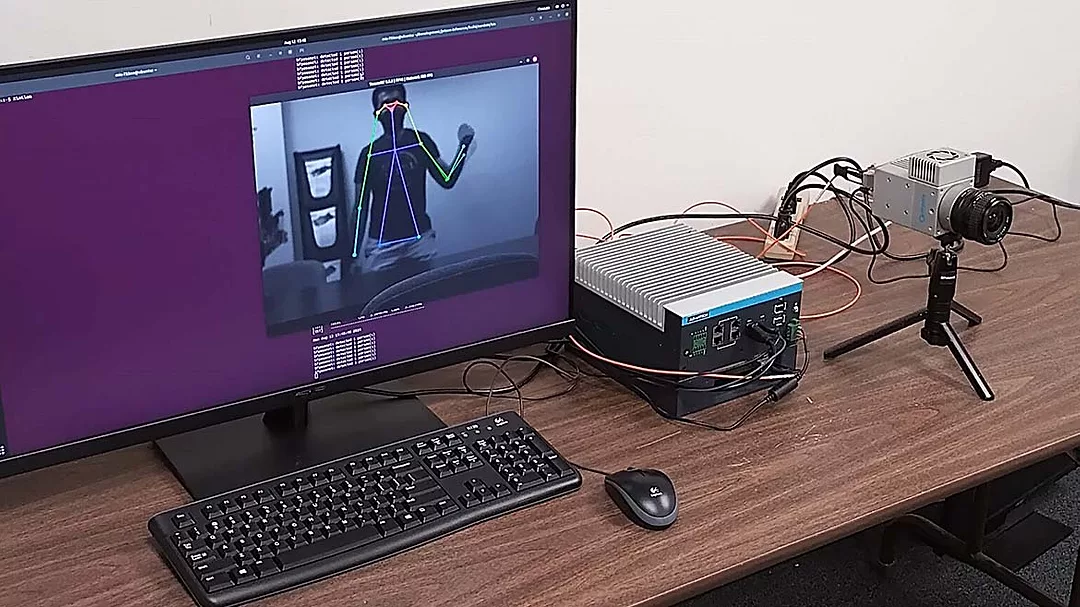
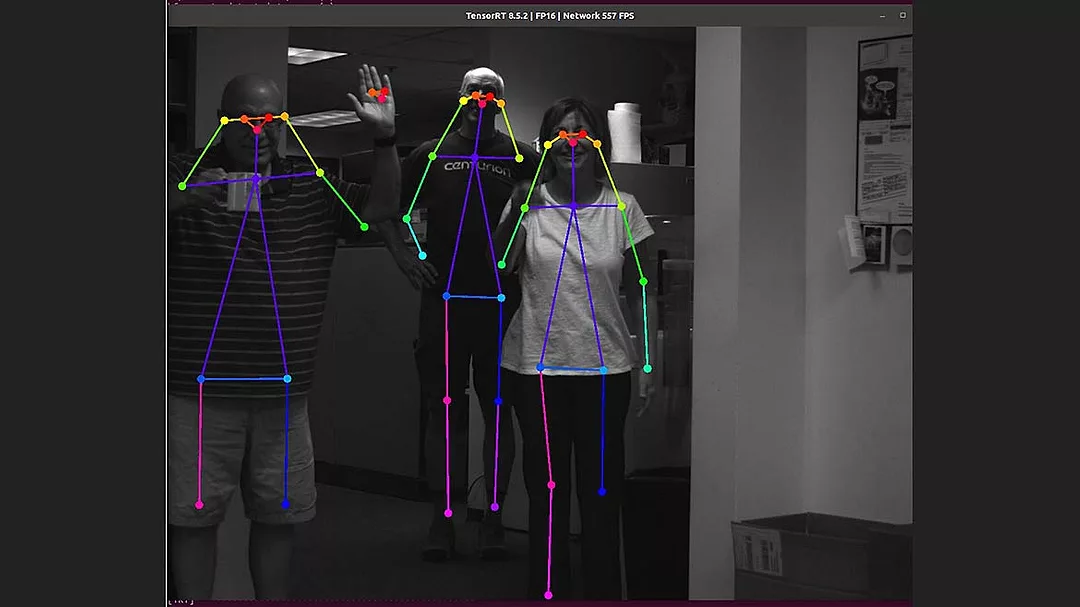
Real-time human pose system incorporating BitFlow CoF frame grabber, Advantech AI edge computer, and Optronis fiber camera, accelerated by NVIDIA TensorRT deep learning.
Machine vision cameras have crossed a threshold. Imaging sensors today measure resolution in the tens of megapixels and frame rates in hundreds or even thousands per second. Concurrently, machine vision system’s AI inference models are scaling up to use camera image data to perform more tasks, going far beyond detecting defects on production lines to segmentation, classification and pose estimation. Yet none of these innovations matter if the cable connecting cameras to computers can’t keep up. Copper, the machine vision industry’s default for decades, is increasingly becoming a bottleneck. Fiber optic cabling is the enabling infrastructure for an entirely new generation of powerful cameras and AI-powered industrial vision systems where even millisecond delays can lead to degraded performance.
Fiber optic cabling in machine vision is about moving massive, time-critical image data from sensor to processor at distances copper can’t span, in electromagnetic environments copper can’t survive, and at bandwidths copper can’t sustain. When AI inference requirements are layered on top of those demands, fiber stops being an optional upgrade and becomes a necessity.
Overcoming Copper’s Limitations
Standard machine vision interfaces over copper have hard physical limits. USB3 Vision tops out at 5 Gbps and is restricted to 3-5 meters of cable before signal integrity degrades. The GigE Vision interface (1000BASE-T) has a maximum cable length of 100 meters and an effective sustained throughput for image data of 125 MB/s. Camera Link, a mainstay of industrial imaging, peaks at 6.8 Gbps in Deca mode. At the highest camera clock speeds (85Mhz), the cable is often limited to 4-5 meters. CoaXPress (CXP) over coaxial cable, the most capable copper-based machine vision interface, maxes out at roughly 40 meters at full CXP-12 throughput of 12.5 Gbps per link.
Those constraints aren’t just inconvenient. In environments such as automotive assembly lines, aerospace component inspection bays, and pharmaceutical web inspection systems, the camera is often nowhere near the processing hardware. Add the electromagnetic interference (EMI) generated by motors, drives, and high-voltage switching equipment in industrial settings, and copper’s susceptibility to EMI becomes a threat to image data integrity. EMI induces unwanted voltages or currents in the cable, causing signal distortion, adding noise, and introducing errors. Longer copper runs pick up more interference, amplifying the problem.
The demand side has also shifted. AI-powered models require higher-resolution inputs, multi-spectral image capture, and higher frame rates to feed inference pipelines for the accurate detection of micron-scale defects reliably. The data volumes these systems generate have outpaced what copper-based interfaces were ever designed to carry.
CoaXPress over Fiber: The Protocol Changing the Equation
The engineering solution that has most directly addressed these constraints is CoaXPress over Fiber (CoF), introduced in 2021 as an official extension/add-on to the CoaXPress 2.1 specification.
CoF permits the unmodified CoaXPress protocol to run over standard fiber optic cabling using Ethernet Layer 1 physical signaling, meaning it inherits the cost economics, supply chain depth, and continuous performance improvements of the broader fiber networking industry. The CoaXPress protocol itself remains unchanged with no modifications to packet formats, control mechanisms, GenICam integration, low-latency behavior, triggering, or other higher-layer features.
The bandwidth performance is decisive. CoF delivers approximately 40 Gbps on a single QSFP+ transceiver module and a single fiber optic cable, the same throughput that would otherwise require four separate CXP-12 coaxial links and four individual connectors. The simplification represents a meaningful reduction in complexity and failure points.
Range is where the specification becomes transformative. CoF supports distances of up to 120 kilometers over single-mode fiber and 550 meters over multimode compared to the 40-meter ceiling of copper CoaXPress. Applications that were previously impossible such as distributed camera arrays across large factory footprints, vision systems installed on moving gantries at the far end of a production hall, or cameras integrated directly into avionics with processing hardware located remotely, become straightforward engineering exercises with CoF.
The CoF specification is also forward compatible. CoF’s physical layer is based on 10GBASE-R Ethernet signaling, and this roadmap includes CXP-25 and CXP-31 transmission rates. Every improvement to Ethernet physical layer infrastructure benefits CoF automatically, without requiring protocol-level changes.
CoF Advantages in the Industrial Environment
- EMI Immunity: Fiber optic cable transmits data as pulses of light through a glass core that does not conduct electricity. It neither radiates electromagnetic signals nor receives them. In settings with large motors, variable-frequency drives, induction heating equipment, or high-voltage switching infrastructure, which is the standard topology of a modern manufacturing facility, this immunity is not a checkbox feature. It is the difference between a vision system that produces reliable inspection data and one that produces intermittent false rejects driven by noise artifacts in the image stream.
- Physical Form Factor: Modern industrial fiber optic cable runs under 4mm in diameter and is significantly lighter than equivalent copper cabling. In robotic arm integration, where cables travel along articulated joints through millions of flex cycles, the reduced mass matters for arm dynamics. Modern glass fiber is manufactured to withstand the same shock, vibration, bending, and pinching that industrial copper must endure. The cable can also be threaded through conduit that would be impractical for heavier copper runs, simplifying installation in dense machine enclosures.
- Longer Distances: According to the CoaXPress 2.1 specification, CoF’s maximum distance over single-mode fiber is 120 kilometers (~75 miles), or 550 meters over multimode fiber compared to roughly 40 meters for standard copper CoaXPress. This opens whole categories of previously impractical deployments: large-format manufacturing floors, aerospace hangars, stadium surveillance, and distributed medical imaging installations.
- Total Cost of Ownership: Fiber cabling costs have converged with copper over the past decade, driven by volume production for telecommunications and data center markets. Over long cable runs, fiber is frequently the lower-cost option when repeater hardware, which is required to amplify copper signals over distance, is factored into the comparison. Each installed repeater adds cost, power consumption, an additional maintenance point, and potential failure mode. Fiber eliminates repeaters.
Bandwidth Requirements of AI Inference Pipelines
Integration of AI inference into machine vision systems changes the bandwidth equation. Deep learning models require higher-resolution, higher-frame-rate image inputs than the rule-based algorithms they replace. Data volumes that flow from camera to inference engine are substantially larger than those of legacy vision systems, and they must arrive with deterministic, bounded latency.
Fiber optic cabling, with its high bandwidth ceiling and consistent signal characteristics over distance, is suited to these demands. A single-cable, 40 Gbps CoF connection between a high-resolution industrial camera and its frame grabber provides headroom that AI-driven systems will continue to consume as model sophistication increases.
Edge Computing and the Fiber Backbone
Edge AI inference refers to running detection models locally rather than offloading to cloud infrastructure. It places the processing hardware closer to the machine but not necessarily adjacent to every camera. A factory deploying twenty cameras across a 200-meter production line with edge inference hardware centralized in a control cabinet requires reliable high-bandwidth connections across that physical span. Fiber makes that possible.
Edge inference also demands low, deterministic latency. When a vision system is coupled to a robotic rejection mechanism or a closed-loop process control system, the time between image capture and inference output must be tightly bounded. Fiber’s signal propagation characteristics and the elimination of the repeater delays that long copper runs require contribute to the latency budget directly.
Converting CXP to Fiber Optics
Machine vision integrators can convert CoaXPress signals from copper coaxial cables to fiber optic cables by using specialized media converters or extenders that support the CoF extension. Converters and extenders convert CXP coaxial signals to fiber at the camera end and transform it back to coaxial at the host end. For a more streamlined setup, an integrator can also pair CoF cameras with frame grabbers that natively support fiber, eliminating the need for a second converter at the host.
Responding to market demands, new copper-to-fiber modules have been developed that solve the long-distance challenge while taking a minimal parts approach. Rather than two cumbersome media converter boxes plus extra cabling and power management, these solutions call for a single module that directly connects to a non-CoF CXP single-link camera via a standard coaxial cable. The modules use low-cost, off-the-shelf single-mode or multi-mode cables with QSFP+ transceivers for aggregation. The module may also supply 13W of PoCXP power to the camera, so they eliminate the need for an external power source, while also offering support for an uplink channel accommodating camera configuration and control, triggering, and firmware updates. On the host end, the fiber cable plugs directly into a CXP fiber frame grabber.
Light at the End of the Cable
Fiber optic cabling in machine vision is no longer a specialist solution for long-run or high-interference edge cases. It is the appropriate default architecture for any AI-driven industrial inspection system where performance, reliability, and forward compatibility matter, which is to say, for most systems being deployed today.
The combination of CoaXPress over Fiber’s 40 Gbps single-cable bandwidth, multi-kilometer range capability, complete EMI immunity, and alignment with Ethernet infrastructure development timelines makes fiber the rational choice for new installations. As AI inference models continue to grow in image requirements, systems built on fiber today will have the headroom to accommodate them. Those built on copper will not.
Finally, the CoF standard is built on Ethernet physical layer infrastructure that the data center industry is actively advancing. As such, machine vision will continue to benefit from its ongoing developments. The broader AI infrastructure build-out is also accelerating fiber deployment economics in ways that directly benefit machine vision. For those reasons and many more, machine vision system integrators can specify fiber cabling with confidence in long-term supply availability, cost stability, and a clear performance roadmap.
Looking for a reprint of this article?
From high-res PDFs to custom plaques, order your copy today!