NDT
The Invisible Shield: How Nondestructive Testing Raises the Bar for Public Safety
The bridges hold. The pipelines carry. The aircraft land. None of these occur by accident.

Every morning, millions of people cross bridges, board aircraft, step into elevators, cook with gas, and drive through tunnels without giving a second thought to the forces that hold those structures together. This collective confidence is not accidental. It is, in large part, the product of a discipline that most people have never heard of: nondestructive testing (NDT).
NDT is the science of examining materials, components, and structures for flaws or degradation without causing damage to the inspected object. It covers a wide range of techniques, including ultrasonic testing, which bounces sound waves through metal to detect internal cracks/defects; radiographic testing, which uses X-rays or gamma rays to image the interior of welds; magnetic particle inspection, which reveals surface/subsurface defects in ferromagnetic parts; and eddy current testing, which probes conductive materials for discontinuities using electromagnetic fields. Together, these methods form an invisible safety net woven into virtually every sector of modern industrial life.
The social impact of this discipline is far deeper than most people appreciate. Understanding this impact requires stepping back and asking a simple question: what happens when things fail?
When Structures Speak — or Stay Silent
Material failure is rarely dramatic in the early stages. A crack in a pressure vessel grows incrementally over thousands of pressure cycles. Corrosion beneath a pipeline coating thins the wall by a fraction of a millimeter per year. Fatigue in aircraft components accumulates invisibly at stress concentrations no wider than a human hair. For years — sometimes decades — these defects develop in complete silence. When the margin is gone, structures speak in the only language they have left: sudden and catastrophic failure.
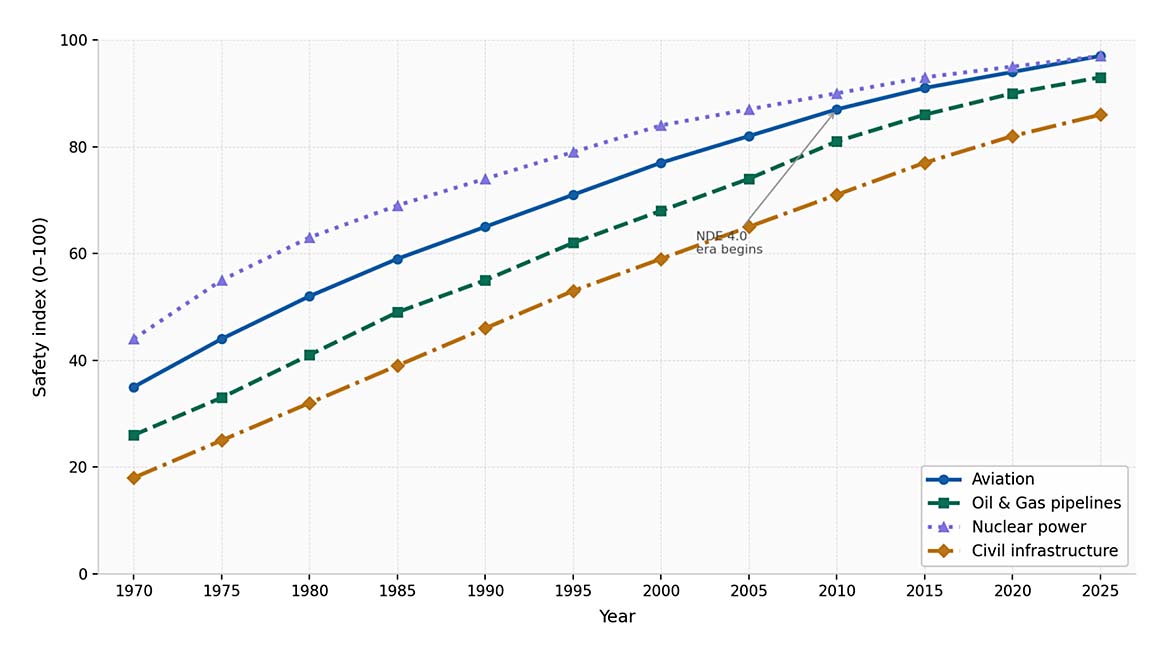
Figure 1 shows the composite NDT-driven safety index for four major sectors from 1970 to 2025. All four lines trend sharply upward, with aviation and nuclear reaching the high 90s, reflecting the compounding effect of stricter inspection codes, advanced equipment, and more rigorous certification standards over five decades. Civil infrastructure, the lowest scorer, showed the steepest relative gain, illustrating how older sectors catch up as NDT adoption deepens.
Source: Kuldeep Sharma and Ashok Kumar
Raising the Floor on What "Safe Enough" Means
For decades, safety standards in high-consequence industries have been driven primarily by design margins and periodic visual inspections. Codes assumed a certain level of defect tolerance, built-in safety factors, and hoped that scheduled shutdowns would catch degradation before it became dangerous. This approach worked reasonably well when the infrastructure was young and the tools available were limited.
The progressive maturation of NDT technology has done something more consequential than merely improving the odds of detecting defects. This has changed the conversation about what constitutes an acceptable risk. Once regulators and engineering bodies understood that phased array ultrasonic testing could characterize a weld flaw to within fractions of a millimeter, the question shifted from “can we detect a defect?” to “how precisely must we characterize it before we decide whether to repair or retire a component?” This is not a technical refinement. This represents a philosophical shift in how society defines the obligation of care owed to the public.
Modern fitness-for-service assessments, which are engineering frameworks used to decide whether a flawed component can remain in service, are built on the premise that NDT can deliver reliable, quantitative data about flaw size, orientation, and location. The more capable the inspection, the tighter the assessments can be drawn, avoiding unnecessary shutdowns while simultaneously refusing to approve structures that have genuinely reached the end of their safe operating life. Better NDT means better decisions, which protect both people and the economic systems they depend on.
From Reactive to Predictive: A Generational Change
Historically, inspections have been reactive. You scheduled an outage, inspected, found defects, and repaired or replaced. The interval between inspections was determined by experience and code requirements, not by real-time knowledge of what was happening inside a structure. However, this paradigm is rapidly changing.
The integration of digital technologies into NDT, often grouped under the banner of NDE 4.0, enables a shift toward continuous, condition-based monitoring. Permanently installed sensor arrays now monitor critical welds on offshore platforms and high-pressure pipelines in real time. Acoustic emission sensors detect the stress waves generated by growing cracks. Guided wave systems scan hundreds of meters of piping from a single transducer position. Drone-mounted inspection systems can examine infrastructure in environments that are too dangerous for human entry. Artificial intelligence algorithms process data streams from all of these sources and identify degradation patterns that would take a human analyst days to find.
The societal implications of this shift are significant and far-reaching. When degradation can be detected and tracked continuously, asset owners can intervene before defects reach critical sizes. Risk-based inspection frameworks, which concentrate inspection resources on the components most likely to fail and most consequential if they do, become far more powerful when they are fed with real-time condition data rather than periodic snapshots. The result is a measurable reduction in the probability of catastrophic failure across entire industrial systems, not just at individually inspected components.
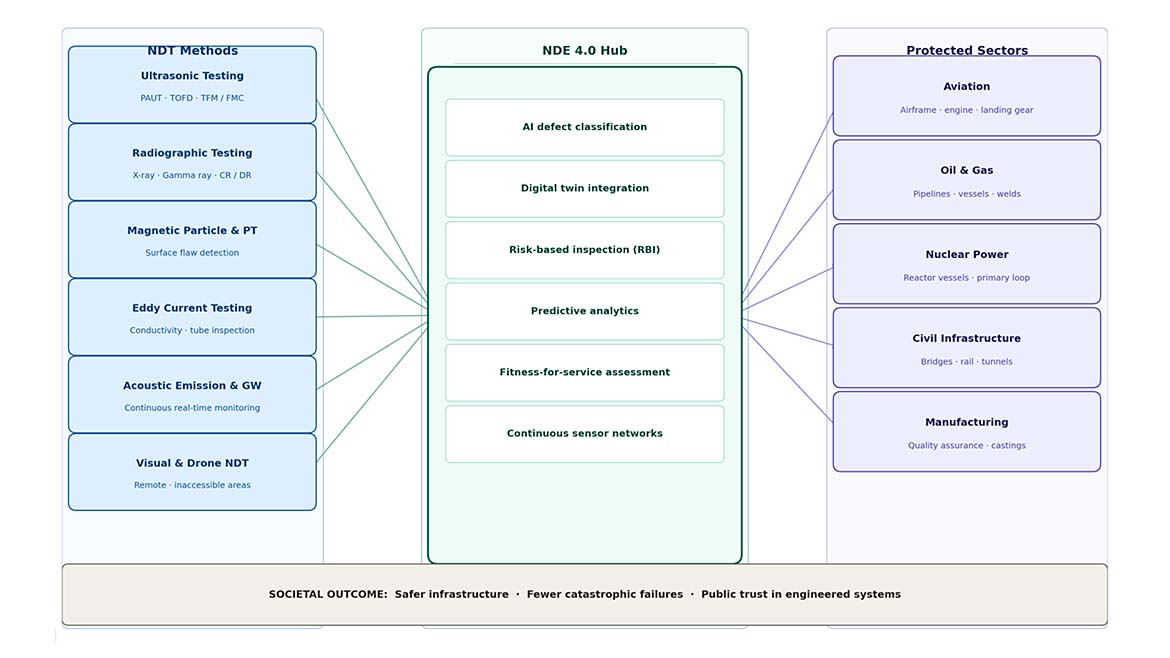
Figure 2 maps the complete inspection chain as a three-stage ecosystem: detection methods on the left, the NDE 4.0 digital intelligence layer in the center, and the protected sectors on the right. The diagram makes the argument of the article visual — NDT is not a series of isolated tests but a connected system where better data processing at the center amplifies the protective value of every method feeding into it
Source: Kuldeep Sharma and Ashok Kumar
The Human Dividend
It is worth being direct about what these technical developments mean in human terms. Pipeline integrity management programs, underpinned by sophisticated inline inspection tools and advanced NDT protocols, have materially reduced the frequency and severity of pipeline failures in the oil and gas industry over the past three decades. The extraordinary safety record of aviation — commercial flight is statistically the safest form of long-distance travel ever invented — depends on inspection intervals and acceptance criteria that are grounded in the demonstrated capability of NDT systems. Nuclear power plants operate under some of the most rigorous inspection regimes on earth, with NDT methods that can detect sub-millimeter flaws in reactor pressure vessels and in primary loop piping.
Beyond major industrial sectors, NDT impacts daily life in ways that are easily overlooked. Steel girders in a highway overpass were inspected during and after fabrication. Pressure cylinders supplying medical oxygen to hospital patients are periodically tested to verify their integrity. The railways that carry commuters and freight are monitored by ultrasonic rail inspection cars that travel the network continuously and map defects before they can cause a derailment.
Each of these inspections represents a decision — a professional judgment backed by technical data — that a structure is safe for continued service. Cumulatively, these decisions constitute something larger: a social compact in which the industry and the engineering profession accept a defined obligation to the public, and in which NDT is one of the primary mechanisms through which that obligation is fulfilled.
The Responsibility That Comes With Capability
Greater capability also brings greater accountability. As NDT methods become more sensitive and quantitative, the argument that a defect cannot be detected becomes more difficult to sustain. Courts, regulators, and the public increasingly understand that modern inspection technology can detect defects that older methods would have missed, and they expect it to be deployed accordingly.
This raises the bar not only for technology but also for the professionals who apply it. NDT practitioners, who are certified to international standards, trained in the physics of their methods, and experienced in the judgments that inspection data demand, carry a genuine public safety responsibility. The quality of an inspection is determined not only by the sophistication of the equipment but also by the knowledge and integrity of the person operating it. In this sense, NDT is ultimately a human discipline, in which professional standards and personal accountability matter as much as sensor sensitivity.
Looking Forward
Society is in the middle of a transition from infrastructure built in the mid-twentieth century, with design lives that are now expiring or have already exceeded, to a world where both the consequences of failure and the tools available to prevent it are more powerful than ever before. In this context, NDT is not a technical backwater. It is one of the central disciplines through which modern civilization negotiates its relationship with aging, stressed, and complex physical systems on which it depends.
The bridges hold. The pipelines carry. The aircraft land. None of these occur by accident. This occurs because someone in the background ran a test, read the data, made a judgment, and signed off that it was safe to carry on. That unglamorous act, repeated millions of times a year by professionals working largely out of public sight, is one of the quiet foundations on which a safe modern society rests.
Looking for a reprint of this article?
From high-res PDFs to custom plaques, order your copy today!