Software
How to Integrate Risk Management Frameworks into Quality Processes to Reduce Operational Failures
Integrating corporate and strategic risks into tactical quality routines goes far beyond a mere software update or a one-time compliance project.

Enterprise Risk Management (ERM) frameworks are sets of models, methodologies, and tools that help incorporate risk management into process design. This way, quality stops being merely corrective and becomes predictive and preventive. ISO 31000, for example, offers principles and guidelines to identify, analyze, evaluate, treat, monitor, and communicate risks in a structured manner across any type of organization.
In today’s complex corporate and industrial environment, quality management often finds itself trapped in a vicious cycle of resolving immediate problems. Responding to operational failures, handling customer complaints, dealing with recalls, and managing non-conformities after the fact are activities that drain valuable resources and limit organizations’ strategic potential.
To break away from this essentially defensive posture, industry leaders and executives are increasingly uniting strategic risk management with daily operations. This is why structuring robust ERM frameworks is so important: it enables the transition from a corrective to a predictive posture, especially when combined with the disciplined and consistent application of various process improvement methodologies.
This article explores how this integration redefines operational excellence standards, shielding organizations against uncertainties, and transforming the quality sector into a true pillar of competitive advantage.
The Quality Management Dilemma: Reactive vs. Proactive
Traditional quality management, in many organizations, still operates predominantly in a reactive manner. This model concentrates its efforts on final inspection, sorting defective products, and damage control only after deviations occur.
Although the ability to contain errors is a necessity, relying exclusively on it generates significant costs. For example, this affects the Cost of Poor Quality (COPQ), which is made up of aspects such as:
- Rework;
- Raw material waste;
- Overtime;
- Eventual damage to brand reputation.
Furthermore, measuring this cost is already proving to be a challenge for many companies, with only 23% of manufacturers actively tracking their Total Cost of Quality (TCOQ), which on average costs about 5% of companies’ annual revenue.
On the other hand, proactive management anticipates problems. Instead of focusing on the final product, the focus is shifted to the process that generates the product. The goal is to design workflows that actively mitigate the likelihood of failures before they even have a chance to manifest.
In practice, this changes the central management question. Instead of “what went wrong?”, the organization begins to ask, “where is the process most vulnerable?”, “which step concentrates the greatest exposure?” and “which controls actually reduce the likelihood of failure?”. This shift in focus brings quality closer to more mature management based on priority, prevention, and operational consistency.
The foundation for this evolution from reactive to proactive quality management lies in “risk-based thinking.” This is a central concept widely encouraged by modern international standards, such as ISO 9001:2015. Basically, the idea is to guide organizations to systematically map their vulnerabilities and establish preventive barriers across the entire value chain.
The Importance of Enterprise Risk Management Frameworks
Historically, enterprise risk management was seen as a hermetic discipline, restricted to the finance, internal audit, and legal departments. The focus was predominantly on market, credit, or litigation risks. However, operational reality has proven that the greatest threats to a company’s stability often originate on the shop floor or in service delivery routines.
It is in this scenario that modern enterprise risk management frameworks come into play. Globally recognized frameworks, such as the guidelines established by COSO (Committee of Sponsoring Organizations of the Treadway Commission) and ISO 31000, propose a holistic and integrated view. From this perspective, risk stops being a topic for annual board meetings and begins to be actively managed at all levels and processes of the company.
When operational risks are treated in isolation, separate from the team that manages quality processes, a dangerous strategic misalignment is created. Integrating ERM frameworks into the quality ecosystem ensures that threats to compliance, product safety, and efficiency are identified at the source and mitigated through rigorously controlled and optimized operational routines.
Source: SoftExpert
What Are the Main Process Improvement Methodologies?
For the risk mindset to move off paper, stop being just a document in a drawer, and transform delivery routines, it is essential to use tactical engineering and management tools. This is exactly where the use of process improvement methodologies becomes the vital link between risk theory and quality practice.
Improving a process essentially means understanding its behavior, eliminating its unnecessary variability, and removing its bottlenecks. A highly variable process is, by definition, a high-risk process.
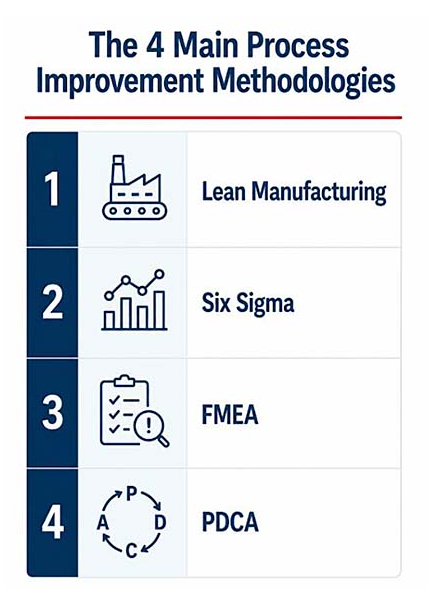
Among the most consolidated methodologies and their intrinsic relationship with risk mitigation, the following stand out:
Lean Manufacturing
The Lean philosophy is premised on the systematic elimination of waste and activities that do not add value to the customer. By leaning out a process, removing excessive inventories, unnecessary movements, or waiting times, for example, the complexity where operational risks usually hide is also eliminated.
Six Sigma (DMAIC)
The Six Sigma methodology uses a strong statistical foundation—through the Define, Measure, Analyze, Improve, and Control (DMAIC) cycle—to reduce the variability of a workflow. Processes with lower variability present a much higher level of predictability, drastically reducing the risk of generating defects.
FMEA (Failure Mode and Effects Analysis)
FMEA functions as the perfect translation mechanism between risk and quality. It is an analytical tool that evaluates, step by step, how a process can fail, what the severity of the impact on the customer would be, and what the current defenses are. Based on this analysis, the quality team can prioritize preventive and corrective actions based on the Risk Priority Number (RPN).
PDCA Cycle (Plan-Do-Check-Act)
PDCA serves as the iterative engine for continuous improvement and the review of mitigation strategies. It ensures that risk assessment is never a one-time event, but rather a cyclical and adaptable process to changes in the internal and external environment.
Diagnostic Methods and Manufacturing Optimization
Moving away from the reactive ERM model requires investigative discipline. When deviations occur (which are, to some extent, inevitable in complex environments), the proactive mindset requires the organization to go beyond immediate repair.
The technical and structured application of root cause analysis methods is indispensable for intelligently feeding back into the risk framework: studies show that implementing efficient preventive maintenance schedules and structured control methodologies reduces ERM expenses by 25% to 30%.
Among the most widely used root cause analysis methods are:
- Ishikawa Diagram (also known as Fishbone Diagram);
- 5 Whys method;
- Techniques like FMEA, which help separate symptoms from structural causes.
In practice, the Ishikawa Diagram is a tool widely used in quality to identify possible causes of an effect or problem, organizing hypotheses into useful categories for analysis and brainstorming. Meanwhile, the 5 Whys serve to deepen the investigation down to the origin of the deviation.
By identifying whether the problem stems from factors such as a systemic training gap, a machinery calibration failure, or a design engineering error, the organization can implement safeguards that definitively prevent the recurrence of that unwanted event.
However, in a quality environment integrated with risk, root cause analysis should not be restricted to serious incidents. It is also valuable for studying non-conformity trends, recurring waste, communication failures, and operational performance problems, for example. When well-applied, this practice strengthens corrective and preventive actions, reduces recurrence, and improves the quality of organizational learning.
This is why, especially in the industrial sector, combining root cause analysis with continuous improvement methodologies directly drives profound manufacturing process optimization initiatives. After all, an optimized manufacturing process is not just one that produces faster, but also one whose processes are so stable and controlled that they consistently operate within engineering specifications.
This allows for:
- Reducing non-conformity costs;
- Elevating Overall Equipment Effectiveness (OEE);
- Ensuring that risk management is a tangible reality on the shop floor.
The Role of Digital Transformation in Quality Management
The convergence between risk frameworks, improvement methodologies, and quality processes reaches its peak scalability when supported by technology. Digital transformation in quality management is revolutionizing how companies monitor their operations.
This shift has become an important force for quality improvement, especially when there are cross-departmental collaboration, greater information transparency, and integration between data and decisions. In practice, clipboards, manual controls, and static spreadsheets make way for integrated cloud data platforms capable of gathering evidence, tracking deviations, and supporting faster responses.
Sustaining this level of integration between risk, quality, and continuous improvement requires data centralization, traceability, and automation of critical workflows. For example, using digital Quality Management Systems (QMS), Internet of Things (IoT) sensors attached to production lines, and analytical intelligence algorithms provides full, real-time visibility into process performance. The great differentiator of technology is precisely the ability to perform process optimization continuously and automatically.
With centralized data, managers can monitor key risk indicators (KRIs) uninterruptedly. This way, when a process begins to show deviation trends, the system triggers predictive alerts before the specification limit is breached. This digital transformation facilitates corporate decision-making based on precise statistical evidence, eliminating intuition-based management.
Thanks to these features, digital transformation can help in all aspects of quality control, with a direct impact on mitigating compliance risks and improving customer experience. At the same time, digitalization of quality routines strengthens traceability and data-driven decision-making.
How to Integrate Risk into Quality Processes?
Building an integrated ERM model begins with mapping critical processes. From there, the organization identifies where the most sensitive steps are, which variations most affect the outcome, and which events could compromise performance, compliance, or safety. This diagnosis allows each step to be associated with a risk level and defines controls proportional to the process’s criticality.
Next, come the indicators. It is necessary to define metrics for rework, failure’s recurrence, cycle time, non-conformity rate, and the effectiveness of corrective actions to move away from subjective perception and build evidence-based governance. The logic is simple: when the process is measured consistently, risk becomes more visible, and improvement becomes more objective.
Finally, the organization needs to close the loop with learning and standardization. What worked in a pilot must become routine; what did not work needs to be reviewed; and what generated a reduction in risk needs to be incorporated into the process. It is this movement that separates isolated initiatives from a real culture of continuous improvement.
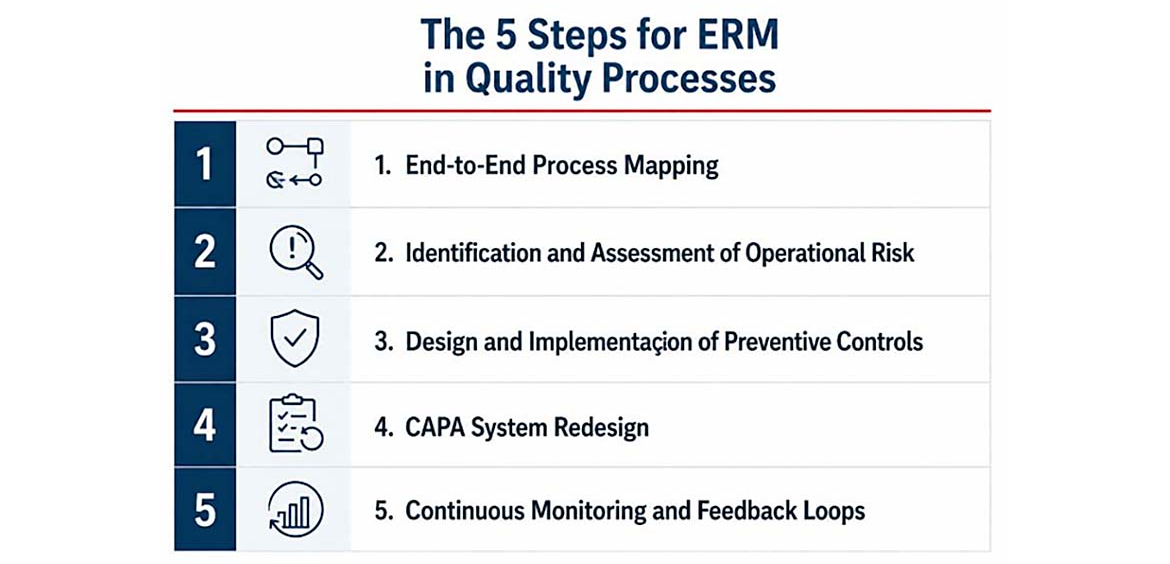
The 5 Steps for ERM in Quality Processes
1. End-to-End Process Mapping
The first step for improvement is visibility. Use process mapping techniques, such as Value Stream Mapping (VSM), to map current workflows. The objective is to visualize exactly how value flows through the organization and to identify complex intersections where operational vulnerabilities are hidden.
2. Operational Risk Identification and Assessment
With the process map in hand, conduct a rigorous assessment at each step using risk matrices or FMEA. The guiding question should be: “What can go wrong at this stage, what is the probability of it occurring, and what is the impact of the occurrence on the quality of the final product?” This step ensures that risk mitigation is specific and actionable.
3. Design and Implementation of Preventive Controls
Once the risk is identified, it is time for it to be isolated. Apply the principles of Lean and Six Sigma, for example, to design modern controls. Prioritize structural and error-proof solutions, known as Poka-yokes. If a human error is likely in an assembly stage, redesign the component so it can only be fitted in the correct way, or use digital sensors to validate the step before the process advances.
4. Overhauling the CAPA System
The Corrective and Preventive Action (CAPA) system is frequently the heart of quality management. To make it proactive, change its focus. Each corrective action generated by a root cause analysis method must not only correct the local error but must be obligatorily linked to the company’s global risk framework. If a new failure mode is discovered in production, the corporate risk register must be updated.
5. Continuous Monitoring and Feedback Loops
Risk management and quality are not projects with an end date; they are continuous disciplines. Therefore, establish rigorous audit cycles, use performance dashboards updated in real time, and keep the PDCA culture alive. This monitoring ensures that implemented preventive controls remain effective over time.
Source: SoftExpert
Conclusion
Integrating corporate and strategic risks into tactical quality routines goes far beyond a mere software update or a one-time compliance project. For this, a profound cultural and operational evolution is necessary. The diligent application of process improvement methodologies allows enterprise risk management frameworks to transform into real protective barriers on production lines and in business processes.
By focusing on optimization, surgical identification of root causes, and digitalization of operations, corporations stop spending energy fighting operational fires daily. Instead, they begin to pave a structured and predictable path for stable growth. In other words, the maturity of an organization in today’s competitive market is reflected in its ability to foresee tomorrow through the excellence of quality executed in the present.
Looking for a reprint of this article?
From high-res PDFs to custom plaques, order your copy today!