Vision Systems Automate Inspection of EV Components
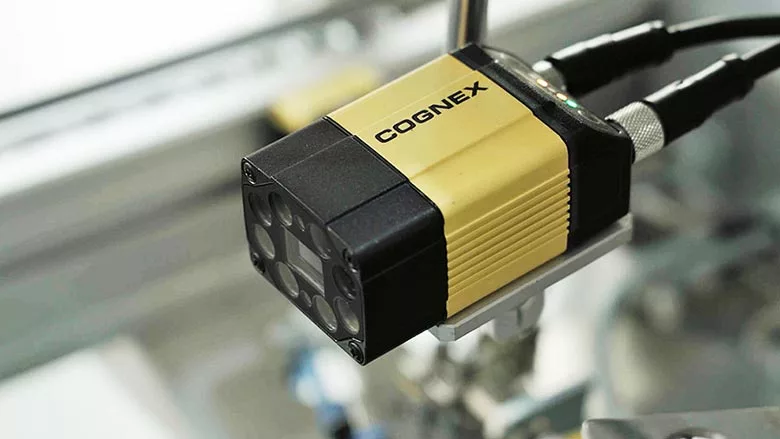
This vision system is used to inspect EV motor components.
Photo courtesy Cognex Corp.
At BorgWarner’s assembly plant in Changnyeong, South Korea, the global shift toward electric vehicles isn’t just a trend—it’s an opportunity for manufacturing innovation.
“I’m excited that we’re doing something new, and I’m still asking questions,” says Young-jun Lee, who heads the production technology team at BorgWarner’s Changnyeong facility. “Manufacturing, assembling and inspecting all the components in an electric car is refreshing. It’s a really attractive job.”
For Lee and his team, the challenge is clear: EV power trains demand unprecedented levels of precision during assembly and inspection. While human expertise remains essential for the intricate assembly process, BorgWarner has discovered that advanced machine vision technology can dramatically enhance the company’s quality control capabilities.
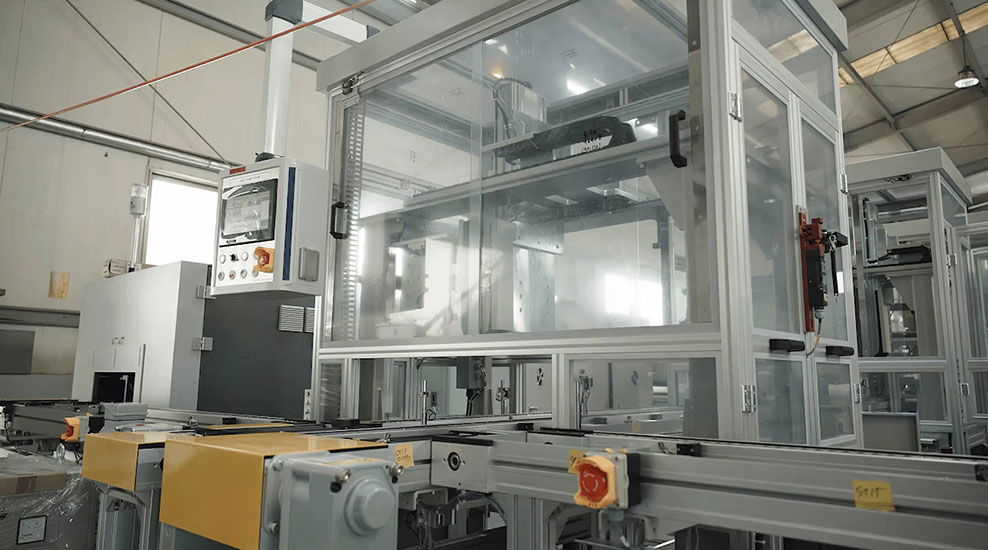
At BorgWarner’s factory in Changnyeong, South Korea, assembling EV components is largely a manual process. However, the inspection process is automated. Photo courtesy Cognex Corp.
Manual Assembly, but Automated Inspection
Delivering and controlling electricity in an EV power train is a complex process involving various components that must work together. The motor converts electrical energy into mechanical energy; the motor controller manages power flowing from the battery to the motor, and the inverter converts direct current into alternating current.
People are essential to the manufacturing process. The number of intricate components that must be assembled and the amount of variables involved doesn’t lend itself to automation.
“Only people can assemble these components with precision, but they make mistakes,” concedes Daebeom Park, senior manager of the production technology team in Changyeong. “To find those mistakes, machine vision systems are really important.”
Finding the right vision system for highly technical applications like EV assembly can be a winding road. Manufacturing EVs requires higher-performing technology than manufacturing gas-powered vehicles.
“If you buy a sensor, you have to buy a good one, and if you buy a part, you have to buy a more advanced part to meet the specifications for the end user,” Lee said. “First, I need to ensure the machine vision system can solve the problem. If it can’t solve the problem, even if it’s 10 percent or 20 percent cheaper, it will be useless.”
For BorgWarner, vision systems from Cognex Corp. are the technology of choice.
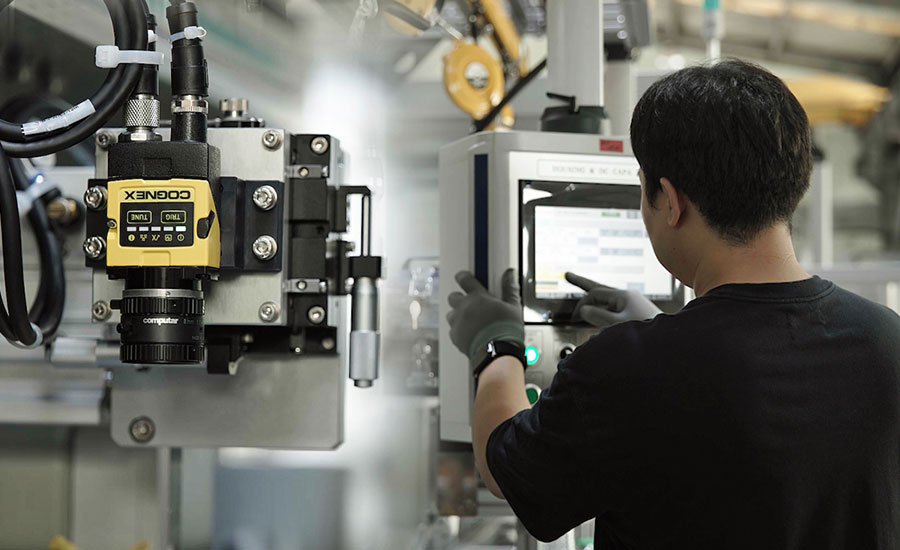
The vision system is easy to use. No programming experience is required. Photo courtesy Cognex Corp.
Putting “Safety First” Into Practice
The risk of missing a defect or part in an EV motor far exceeds the cost of a vision system, Park points out. The safety of the passengers is the main concern. “Ensuring the accuracy and reliability of the final assembly inspection is of utmost importance,” he says. “You can’t just use any vision system because it’s about people’s lives, you have to use the vision that performs the most reliably and the most precisely.”
Vision systems also help improve employees’ lives, Park explains. Some inspection processes required up to five people. Using one Cognex vision system instead allows BorgWarner to redeploy those employees in other areas.
In BorgWarner’s EV power train assembly application, the production technology team had to detect missing parts on a flat surface. Some machine vision systems couldn’t detect defects because of the low contrast of the image, even when the systems were repositioned or looking at a different portion of the power train. A 3D vision system solved this problem.
With 2D machine vision, a two-dimensional map of reflected intensity is captured and processed. Processing consists of comparing variations in intensity or contrast. For this reason, 2D vision systems need highly controlled environments with standard viewpoints and lighting that creates high contrast and eliminates shadows. These systems are typically used for applications like defect detection, optical character recognition, and assembly verification.
3D machine vision captures the depth of a target object to generate a three-dimensional map, or point cloud, for analysis. The point cloud offers precise coordinates where the position of every pixel in space is known. This makes 3D vision useful for tasks where shape information is critical. 3D machine vision works well with objects that can vary in size and shape.
“The Cognex 3D vision system detected everything and found the defective parts,” says Park. “It lets you see all the geometric data, so when the customer comes to visit, we can show them we’re using 3D vision systems for geometry inspections; they’re happy, and we’re happy.”
3D vision systems also assist workers when assembling automotive electronics. Silicone sealants are used throughout the assembly process to protect circuit boards, connectors, sensors and other components from stress and temperature fluctuations.
Confirming the shape of the silicone gel is a challenging application with many possibilities for errors. The gel can be overapplied or underapplied, and the shape of the gel must be uniform without any bubbles or defects. These flaws can expose electronic components to dust and vibrations or cause a short circuit.
BorgWarner engineers tried technology from a few vision suppliers before they landed on a 3D vision system from Cognex.
“We’re quite satisfied…that we’ve built the solution with one camera and one system, and I think that’s probably the biggest advantage Cognex has,” Park says.
AI-Powered Inspection for Safety Components
BorgWarner’s Park-Lock system is a common safety mechanism in electric and hybrid vehicles. The device locks a vehicle’s transmission when parked, stopping it from rolling or moving unintentionally. The system comprises up to 20 parts, including locking mechanisms, electromechanical and hydraulic systems, sensors, and electronics.
The Park-Lock system is largely put together manually. Among other tasks, assemblers tighten bolts and assemble parts. BorgWarner uses the Cognex In-Sight 2800 machine vision system with edge learning—an easy-to-use artificial intelligence technology—to verify that all Park-Lock components are installed correctly.
“There are springs. There are thin nuts. There are many [potential] assembly mistakes,” Park says. “When you put a bolt into a thin, flat part, it’s hard to tell if it’s flush and meets the required tolerance with most vision systems. But since we’ve had the In-Sight 2800, we’ve been able to catch all of these defects, and it’s solved 100 percent of our problems.”
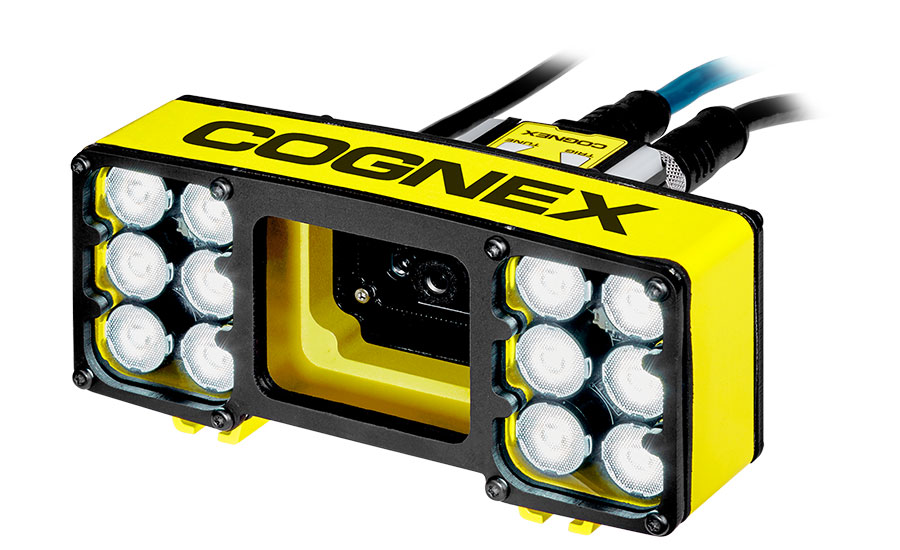
With field-changeable components, the In-Sight 2800 can be modified to address various application settings and custom requirements. Photo courtesy Cognex Corp.
The In-Sight 2800 vision system combines AI with traditional rule-based vision tools to solve a wide range of applications, including presence-absence detection, sortation and character reading.
The edge-learning classifier tool identifies and sorts parts based on multiple features or characteristics. This enables engineers to classify defects into different categories and correctly identify parts with variation. Along with the ability to assign multiple classifications, engineers can set up multiple regions of interest to inspect different sections of an image with a single trigger.
The technology is easy to use. Cognex’s EasyBuilder development environment simplifies setup. No programming experience needed. The intuitive development environment walks engineers step-by-step through application setup, enabling rapid turnaround from proof of concept to deployment. A robust spreadsheet interface is well-suited for building advanced or highly customized applications. It allows engineers to fine-tune application parameters.
High dynamic range technology uses advanced image sensing that is 16 times more detailed than conventional sensors. This drastically increases image quality and contrast, resulting in more accurate inspections and detection of subtle defects.
With field-changeable components, the In-Sight 2800 can be modified to address various application settings and custom requirements. This modularity allows manufacturers to quickly adapt to new parts and keep up with changing demands.
For more information about vision systems, click www.cognex.com.
Looking for a reprint of this article?
From high-res PDFs to custom plaques, order your copy today!