Quality Magazine logo
search
cart
facebook twitter linkedin youtube
  • Sign In
  • Create Account
  • Sign Out
  • My Account
Quality Magazine logo
  • NEWS
  • PRODUCTS
    • FEATURED PRODUCTS
    • SUBMIT YOUR PRODUCT
  • CHANNELS
    • AUTOMATION
    • MANAGEMENT
    • MEASUREMENT
    • NDT
    • QUALITY 101
    • SOFTWARE
    • TEST & INSPECTION
    • VISION & SENSORS
  • MARKETS
    • AEROSPACE
    • AUTOMOTIVE
    • ENERGY
    • GREEN MANUFACTURING
    • MEDICAL
  • MEDIA
    • A WORD ON QUALITY PUZZLE
    • EBOOK
    • PODCASTS
    • VIDEOS
    • WEBINARS
  • EVENTS
    • EVENT CALENDAR
    • IMTS
  • DIRECTORIES
    • BUYERS GUIDE >
      • Supplier Insights
    • NDT SOURCEBOOK
    • VISION & SENSORS
    • TAKE A TOUR
  • INFOCENTERS
    • Digital Quality Management Systems
    • NEXT GENERATION SPC & QUALITY ANALYTICS
  • AWARDS
    • ROOKIE OF THE YEAR
    • PLANT OF THE YEAR
    • PROFESSIONAL OF THE YEAR
  • MORE
    • Expert Columns
    • NEWSLETTERS
    • QUALITY STORE
    • INDUSTRY LINKS
    • SPONSOR INSIGHTS
  • EMAG
    • eMAGAZINE
    • ARCHIVES
    • CONTACT
    • ADVERTISE
  • SIGN UP!
Measurement

Measurement

Making Sense of Gage R&R Analysis

Ultimately, the goal is not just to evaluate the gage but to ensure that capability studies, SPC charts, and process improvement projects are built on reliable data.
By Ray Harkins
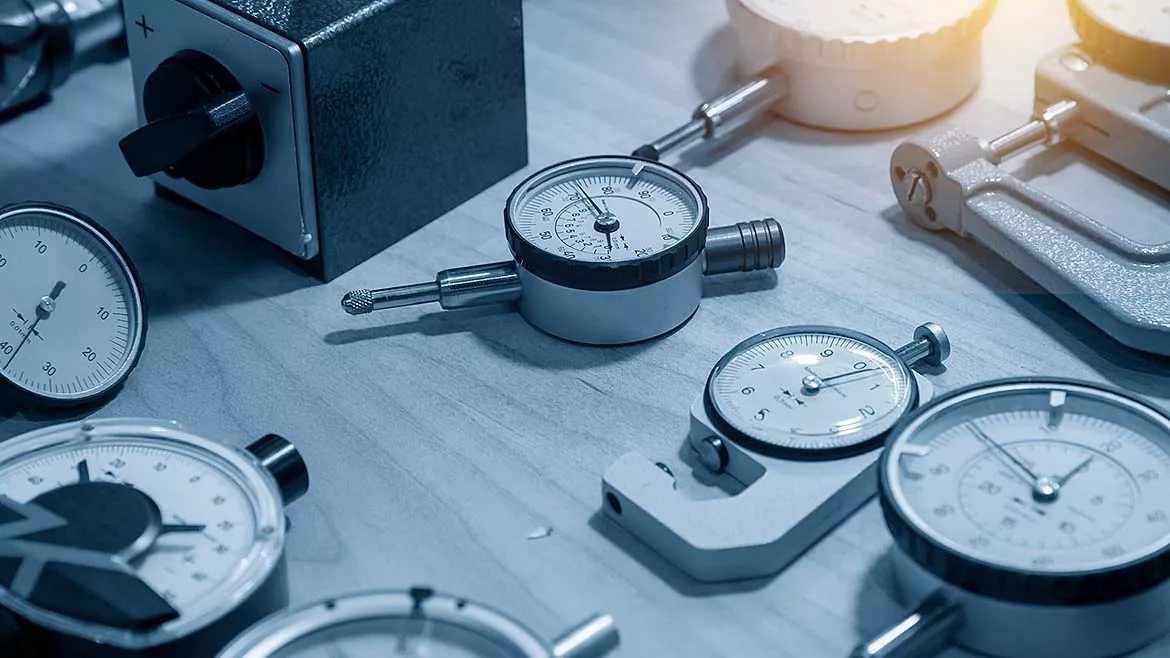
The group of dial indicator gauge on the table with lighting effect.
Image Source: Phuchit / iStock / Getty Images Plus
October 24, 2025

The term Measurement Systems Analysis (MSA) refers to a collection of experimental and statistical methods designed to evaluate the error introduced by a measurement system, and the resulting usefulness of that system for a particular application. In manufacturing, measurement system quality directly affects decisions about processes, products, and a manufacturer’s ability to meet their customers’ requirements.

Measurement systems range from the simplest of gages, like steel rulers, to the most complex, multi-sensor measurement platforms. Yet regardless of their sophistication, all gages are flawed and fail to deliver a perfectly accurate result to their users. This idea is best expressed by an equation fundamental to measurement science:

Y = T + e

where:

  • Y = the resulting value of the measurement process (what the gage reads)
  • T = the true, typically unknown, measurement of the object under evaluation
  • e = the error introduced by the measurement system

Measurement errors take many forms. Some, like instability (a slow drift over time), emerge gradually. Others, like nonlinearity (inconsistency across a gage’s range), create systematic bias. But because of their applicability to a wide range of commonly used gages, two forms of error—repeatability and reproducibility—are the most discussed and analyzed among quality engineers and calibration specialists. These errors are often evaluated together in a specialized study called Gage R&R Analysis.

Repeatability and Reproducibility

Repeatability, also known as Equipment Variation (EV), refers to the variation in measurements when the same operator uses the same gage under the same conditions repeatedly. EV is caused by issues such as friction within the gage mechanisms, dust and debris, minor design flaws, or wear in the gage components. These sources of variation result in the random dispersion of measurement values around the true measurement of the part.

Reproducibility, also known as Appraiser Variation (AV), refers to the variation in measurements when different operators use the same measurement system under similar conditions. In other words, where EV highlights differences within a single operator, AV highlights differences between operators.

As an example, consider the telescoping bore gage. This gage is widely used in metal cutting processes, particularly for deep bore applications such as engine block cylinders. To use this gage, the operator twists open the knurled knob to release the spring-loaded rods at the T-end of the gage, allowing them to move freely. The operator then inserts the T-end into the bore at the desired depth, allowing the rounded rod ends to touch the bore wall. Once correctly positioned, the operator twists the knurled knob to lock the rods into place, removes the gage from the bore, and measures the locked rod distance with micrometers or a similar instrument.

Each step in this process—positioning the gage, locking the rods, removing the tool, measuring with a micrometer—introduces another source of variation between operators. Compounded together, these differences form AV.

Two Methods of Gage R&R Analysis

Gage R&R Analysis is performed using one of two major methods: the Average and Range (A&R) method and the ANOVA method. Most fill-in-the-blank Excel-based Gage R&R templates rely on the simpler A&R method, which is also easier for quality professionals to learn because of its similarities to traditional control charting.

The study design, regardless of the subsequent analysis method, involves selecting the number of parts, number of operators, and number of measurements per part. For instance, a 10×3×3 study requires 10 parts × 3 operators × 3 measurements per part, for a total of 90 measurements.

From these data, the study facilitator calculates averages and ranges that reflect differences between parts, between trials, and between operators. These differences are then converted into estimates of standard deviation using statistical constants called K factors.

For example, the A&R method requires calculating the range of measured values for each appraiser-part combination. In the 10×3×3 study, this produces 30 ranges. The grand average of those range values (called R-bar) equates to the average dispersion of measurement values despite measuring the same parts with the same gage. Using a K factor called K1, R-bar is converted into EV, an estimate of the standard deviation of repeatability error. A similar approach is used to calculate AV, the estimated standard deviation of the reproducibility error. Through vector addition, EV and AV combine to form Total R&R, an estimate of the error portion of the total gage output.

The ANOVA Method

While the Average and Range method offers simplicity, the ANOVA method provides more insight. This more complex approach offers an advantage by separating and quantifying the individual sources of variation with greater precision. Instead of relying on ranges and conversion factors, ANOVA uses the analysis of variance statistical technique to directly partition the total measurement variation into components attributable to parts, operators, and their interactions.

This allows practitioners not only to estimate EV and AV with greater accuracy, but also to identify whether significant part-operator interaction effects exist—an insight the A&R method cannot provide. For example, if one operator consistently measures a particular part larger or smaller than the other operators, the ANOVA method can detect this interaction and flag it as a meaningful contributor to overall variation. On the other hand, if all operators measure parts consistently, ANOVA confirms that no significant interaction exists.

In practice, the ANOVA method involves calculating sums of squares for each source of variation, dividing by the appropriate degrees of freedom to obtain mean squares, and then using F-tests to evaluate statistical significance. While the calculations are more involved, the result is a richer understanding of the measurement system’s behavior. In short, ANOVA not only quantifies variation, it helps pinpoint its source.

Why It Matters

Regardless of the chosen method, recognizing that the output of a gage is only a “partial truth” is the key to understanding the importance of measurement system analysis. By acknowledging and quantifying the inherent variability in any measurement system, quality professionals can make informed decisions, improve processes, and ensure that data-driven insights lead to meaningful actions.

Ultimately, the goal is not just to evaluate the gage but to ensure that capability studies, SPC charts, and process improvement projects are built on reliable data. Only then can organizations have confidence that the numbers driving business and engineering decisions truly reflect reality.

Quick Glossary

ANOVA (Analysis of Variance)

A statistical method that separates total variation into parts (e.g., part-to-part, operator, interaction) to identify where variation originates.

Interaction (Part-Operator Interaction)

Occurs when the way one operator measures is systematically different for certain parts compared to other operators.

Instability

A form of error where a gage drifts over time, producing different readings for the same part at different times.

K Factors

Statistical constants used in the Average and Range (A&R) method to convert observed ranges into estimates of standard deviation.

Measurement Systems Analysis (MSA)

A collection of experimental and statistical methods used to evaluate the accuracy, precision, and overall usefulness of a measurement system.

Nonlinearity

A form of error where a gage gives inconsistent results at different points along its measurement range.

Repeatability (Equipment Variation, EV)

The variation that occurs when the same operator measures the same part multiple times with the same gage.

Reproducibility (Appraiser Variation, AV)

The variation that occurs when different operators measure the same part with the same gage.

Total R&R

The combined effect of repeatability (EV) and reproducibility (AV) errors in a measurement system. It represents the overall measurement system variation attributable to the gage and operators, excluding part-to-part variation.

Y = T + e

A basic equation of measurement science. Y is what the gage reads, T is the true value, and e is the error introduced by the measurement system.


LEARN MORE

  • Measurement Systems Analysis
  • Measurement System Analysis More Than a Line on a PPAP Submission
  • Metrology: The Science of Correct Decision Making
KEYWORDS: Gage R&R manufacturing Measurement System Analysis (MSA) quality

Share This Story

Looking for a reprint of this article?
From high-res PDFs to custom plaques, order your copy today!

Ray Harkins is the General Manager of Lexington Technologies in Lexington, North Carolina. He earned his Master of Science from Rochester Institute of Technology and his Master of Business Administration from Youngstown State University. He also taught over 100,000 student quality-related skills such as Gage R&R Simplified: Essential Tools for Quality Engineers, Quality Engineering Statistics, and Root Cause Analysis and the 8D Corrective Action Process through the online learning platform, Udemy. He can be reached via LinkedIn at linkedin.com/in/ray-harkins or by email at [email protected]. www.TheManufacturingAcademy.com.

Recommended Content

JOIN TODAY
to unlock your recommendations.

Already have an account? Sign In

  • 2024 Quality Rookie of the Year Justin Wise 1440x750px banner with "Quality Rookie of the Year" logo inset

    Meet the 2024 Quality Rookie of the Year: Justin Wise

    Justin Wise is an exceptional individual who has been...
    Aerospace
    By: Michelle Bangert
  • Man with umbrella and coat stands outside while it rains at night looking at a building.

    Nondestructive Testing: Is there an ethics problem?

    I was a whistleblower who exposed fraudulent activities...
    NDT
    By: Dale Norwood
  • Unraveling Deflategate: Football stadium with closeup of football on field

    Unraveling the Tom Brady Deflategate

    The Deflategate scandal erupted following the 2014 AFC...
    Measurement
    By: Greg Cenker and Henry Zumbrun
Manage My Account
  • eMagazine Subscriptions
  • Newsletters
  • Online Registration
  • Subscription Customer Service
  • Manage My Preferences

More Videos

Sponsored Content

Sponsored Content is a special paid section where industry companies provide high quality, objective, non-commercial content around topics of interest to the Quality audience. All Sponsored Content is supplied by the advertising company and any opinions expressed in this article are those of the author and not necessarily reflect the views of Quality or its parent company, BNP Media. Interested in participating in our Sponsored Content section? Contact your local rep!

close
  • Key Takeaways for Quality Leaders
    Sponsored byComplianceQuest

    Key Takeaways for Quality Leaders from the 2026 Gartner Magic Quadrant™ for QMS

  • This image shows a person seated next to a Bobcat T66 compact track loader.
    Sponsored byPolyWorks by InnovMetric

    Supercharging Digital Gauging at Bobcat North America

  • Dorsey Calibration Lab photo by Tom LaBarbera Picture this Studios
    Sponsored byDorsey Metrology International

    Ensuring Product Quality in a Competitive Manufacturing Landscape

Popular Stories

This image shows a person seated next to a Bobcat T66 compact track loader.

Supercharging Digital Gauging at Bobcat North America

a professional in the aviation field performing maintenance, repair, and overhaul (MRO) work

Manufacturing Retention: Strategies for Improving Company Culture, Engagement and Skill Development

Dorsey Calibration Lab photo by Tom LaBarbera Picture this Studios

Ensuring Product Quality in a Competitive Manufacturing Landscape

2026 Quality Professional of the Year!

Events

June 22, 2026

Automate 2026

Automate is North America's largest robotics and automation event — and the best place to take your ideas from insight to impact.
 
Our show floor features the world’s leading automation solutions, from AI and robotics to motion control, vision systems, and more. Plus, our educational conference is second to none, led by the brightest minds in automation today.
 
Ready to transform the way you work? Take the next step at Automate.
July 14, 2026

Quality Leaders Forum: Better Communication, Better Quality Data

The Quality Leaders Forum is a quarterly, editor-moderated fireside chat series hosted by Quality Magazine, featuring candid conversations with senior manufacturing and operations executives shaping enterprise-level quality.

View All Submit An Event

Products

Lean Manufacturing and Service Fundamentals, Applications, and Case Studies

Lean Manufacturing and Service Fundamentals, Applications, and Case Studies

See More Products
Quality Podcast Channel Custom Content

Related Articles

  • database

    Making Sense of Machine Data With Time Series Databases

    See More
  • Multisensor Measurement—Making Sense of It All

    See More
  • QUALITY MEASUREMENT: Making Sense of Quality

    See More

Related Products

See More Products
  • leaner.jpg

    Leaner Six Sigma: Making Lean Six Sigma Easier and Adaptable to Current Workplaces

  • Failure Mode Effects Analysis (FMEA) DVD

See More Products

Events

View AllSubmit An Event
  • December 16, 2025

    Focus On CAPA: Enhancing Failure Investigation & Root Cause Analysis & Benefits of AI Powered QMS

    On Demand Gain valuable insights into how to apply failure investigation techniques to identify true root causes and develop effective corrective actions.
View AllSubmit An Event

Related Directories

  • AV&R

    Experts in industrial automation, at AV&R, we offer robotic systems designed to process robotic surface finishing and visual inspection on parts of different sizes and materials. As a result, our systems are adaptable to the size and shape of your parts, no matter your focus and industrial sector.
×

Stay in the know with Quality’s comprehensive coverage of
the manufacturing and metrology industries.

Newsletters | Website | eMagazine

JOIN TODAY!
  • RESOURCES
    • Advertise
    • Contact Us
    • Directories
    • Manufacturing Division
    • Store
    • Want More
  • SIGN UP TODAY
    • Create Account
    • eMagazine
    • Newsletters
    • Customer Service
    • Manage Preferences
  • SERVICES
    • Marketing Services
    • Market Research
    • Reprints
    • List Rental
    • Survey/Respondent Access
  • STAY CONNECTED
    • LinkedIn
    • Facebook
    • YouTube
    • X (Twitter)
  • PRIVACY
    • PRIVACY POLICY
    • TERMS & CONDITIONS
    • DO NOT SELL MY PERSONAL INFORMATION
    • PRIVACY REQUEST
    • ACCESSIBILITY

Copyright ©2026. All Rights Reserved BNP Media, Inc. and BNP Media II, LLC.

Design, CMS, Hosting & Web Development :: ePublishing