Machine Vision
How AI-driven Vision Systems Are Transforming Automotive Quality Control
Modern inline inspection architectures now span the full manufacturing chain, from press lines to paint shops and final assembly.

Eines All-in-One Tunnel
The landscape of automotive quality control is undergoing a profound transformation. As vehicle architectures grow more complex and consumer expectations for surface perfection and dimensional precision increase, manufacturers are rethinking how quality is monitored, enforced, and optimized across the production lifecycle.
Historically, quality control in automotive plants relied heavily on manual inspections, offline metrology, and reactive rework processes. While these methods provided a baseline of assurance, they often introduced bottlenecks, variability, and delayed feedback loops. Today, however, the convergence of AI-driven vision technologies, high-resolution imaging, and data analytics is redefining how quality is managed, moving from isolated inspections to fully integrated, predictive ecosystems.
This transformation is not incremental. It represents a structural evolution in how automotive quality control is conceived, deployed, and measured across modern manufacturing environments.
What is driving the shift from fragmented inspection to intelligent vision architectures?
In the traditional quality control in the automotive industry, inspections were frequently distributed and disconnected. Press shop surface checks, body-in-white dimensional verification, paint inspection, and final assembly validation often functioned as separate processes, supported by different technologies and data silos.
AI-powered quality control vision systems are changing that paradigm. Modern inline inspection architectures now span the full manufacturing chain, from press lines to paint shops and final assembly, providing continuous, automated, and highly sensitive evaluation of components and finished vehicles.
Multi-camera tunnel systems equipped with structured lighting, 3D reconstruction algorithms, and deep learning models are capable of detecting:
- Minute paint defect anomalies
- Dimensional variations in gap and flush
- Assembly inconsistencies in real-time
Rather than serving as isolated checkpoints, these systems act as a unifying layer of intelligence across production, consolidating inspection into a synchronized, data-driven framework.
How is the entire automotive production process inspected in real time?
Inspecting the entire process, from press shop to paint shop and final assembly, requires a total inspection strategy that integrates multiple pillars of quality within a single digital backbone.
A comprehensive approach to automotive quality control typically includes:
- Surface quality inspection
- Dimensional metrology and gap & flush measurement
- Error proofing systems
- Robot guidance and automated correction
Each pillar contributes to transforming inspection from reactive validation into continuous inline quality assurance.
Surface Quality Inspection
Automated surface analysis begins as early as the press shop, identifying cracks, dents, or material inconsistencies before components progress downstream. Detecting defects at this early stage prevents cost multiplication further along the production chain.
In paint operations, high-resolution optical systems detect subtle texture irregularities, inclusions, and surface distortions that may not be visible to the human eye. At the last stage of production it is also important to detect scratches and dents produced during assembly operations, ensuring these damages do not go unnoticed and ultimately reach the end customer, causing a poor impression of quality and affecting brand reputation.
Surface precision directly influences perceived vehicle quality.
Dimensional Metrology and Gap & Flush Measurement
In body-in-white and vehicle-on-wheels stages, vision systems measure structural geometry and alignment. Automated gap and flush inspection ensures that doors, hoods, and panels meet strict tolerances critical not only for aesthetics, but also for aerodynamic performance, water leaks, closing efforts, and perceived quality.
Gap and flush consistency has become one of the most visible indicators of manufacturing excellence. Even minimal deviations can influence customer perception.
Error Proofing Systems
AI-driven inspection enables advanced error proofing, identifying missing components, incorrect installations, or sequence deviations. Inline verification reduces downstream failures and prevents defective units from reaching final validation stages.
Robot Guidance and Automated Correction
Integration with robotic systems transforms detection into immediate action. Vision data can guide robotic systems in operations like sanding, polishing, or localized repair operations, effectively closing the loop between inspection and correction.
Several automotive manufacturers have implemented AI-driven tunnel inspection architectures to integrate surface inspection, metrology, and error-proofing within a single inline ecosystem.
This integrated model replaces fragmented quality checks with a synchronized inspection strategy aligned with takt time and production flow.
From detection to measurable industrial impact
Beyond technological sophistication, the value of AI-based inspection lies in measurable industrial performance.
In high-volume manufacturing environments, inline tunnel inspection systems have demonstrated:
- Rework reductions of up to 30%
- Scrap reductions approaching 50%
- Return on investment within approximately eight months
Actual results vary depending on production volume, defect typology, and integration depth. However, the underlying principle remains consistent: early detection combined with automated intervention minimizes downstream cost multiplication.
Highly sensitive optical systems now enable millimetric precision in detecting alignment deviations and surface imperfections. This level of granularity is critical in modern production contexts where customer expectations for visual and structural quality are continuously rising.
More importantly, inline inspection eliminates the latency inherent in offline measurement. Immediate feedback allows process parameters to be adjusted before deviations propagate across batches or shifts, reinforcing stability and consistency in automotive manufacturing operations.
How does inspection data enable preventive and predictive manufacturing?
While automated inspection enhances detection accuracy, its strategic impact emerges when inspection data becomes a foundation for process intelligence.
Advanced systems aggregate production data across hundreds of units per shift, generating:
- Defect maps
- Frequency distributions
- Correlation matrices
- Pattern analysis dashboards
This integration of big data analytics into production environments enables manufacturers to transition from reactive quality management to preventive and predictive analysis.
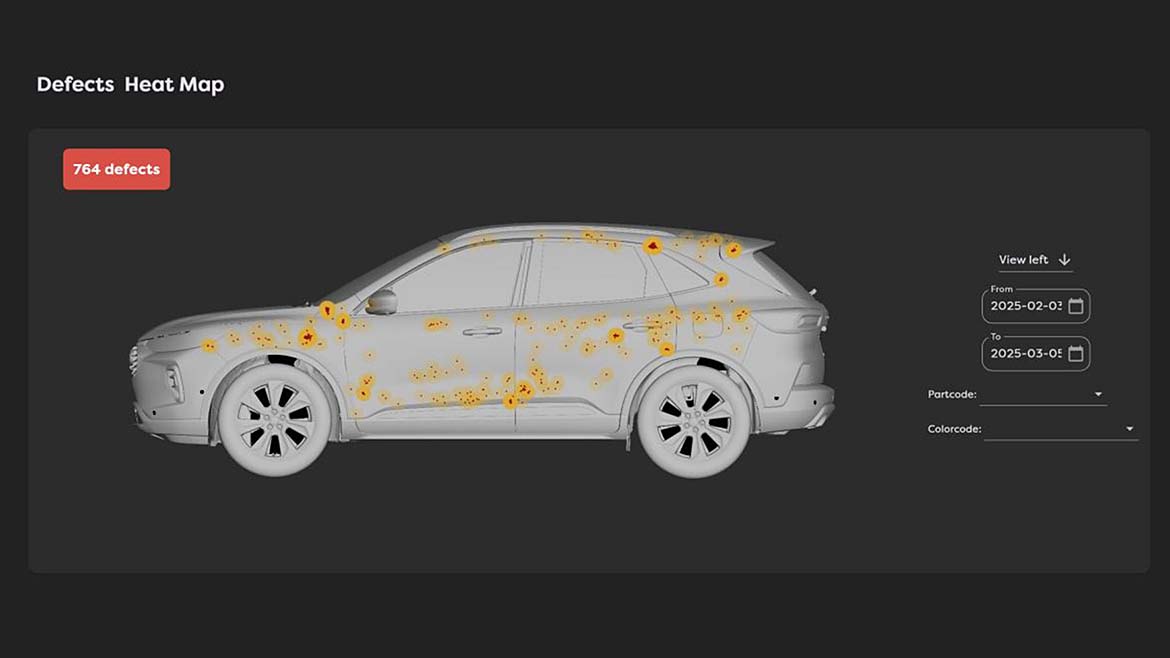
Image Credit: EINES
By linking inspection output with manufacturing execution systems (MES) and process control databases, quality teams can identify root causes and anticipate potential disruptions. Inspection evolves into a continuous sensor for production health, providing real-time insight into process stability.
This evolution signals a broader transformation in production philosophy. Instead of isolating quality control as an end-stage validation step, manufacturers are embedding it as an active driver of operational intelligence.
The strategic role of AI in automotive manufacturing
The integration of AI-driven vision systems into automotive quality control also addresses critical workforce and efficiency challenges.
Manual inspection is inherently variable and dependent on operator experience, environmental conditions, and fatigue. Automated systems offer repeatability, traceability, and scalability, ensuring consistent evaluation criteria across shifts and facilities.
Furthermore, digital traceability ensures that each inspected component is logged, documented, and historically accessible. In regulated markets and warranty-sensitive environments, this level of documentation strengthens compliance and accountability.
Importantly, AI inspection is not about replacing human expertise, it augments it. Quality engineers gain access to structured, high-volume datasets that support faster decision-making and more precise corrective actions.
As system architectures mature, integration across press operations, body-in-white metrology, paint inspection, and final assembly becomes not merely advantageous but essential.
Toward predictive automotive quality
The evolution of quality control in the automotive industry is no longer centered solely on detecting defects. It is about understanding patterns, predicting deviations, and optimizing processes before nonconformities occur.
Vision systems are transitioning from inspection tools to strategic infrastructure.
When inspection, part-to-spec verification, dimensional metrology, and surface evaluation are unified within a data-driven framework, manufacturers gain a real-time pulse of their production ecosystem. This continuous visibility enables a shift from reactive correction to predictive quality orchestration.
In this context, AI-driven inspection does more than identify imperfections, it shapes the future of intelligent manufacturing.
As automotive production continues to evolve, the companies that fully integrate AI-based quality control vision systems into their manufacturing backbone will not only improve defect detection, they will redefine how quality itself is engineered, sustained, and optimized across global production networks.
Looking for a reprint of this article?
From high-res PDFs to custom plaques, order your copy today!