Case Study
Flexible AI Inspection: How Learning Systems Are Changing Visual Quality Control
AI‑based inspection systems approach variability differently.

Quality inspection today must cope with growing demands. Manufacturers are expected to inspect an increasing variety of components with high precision, often under changing conditions and with limited time for complex system adjustments. Variations in materials, assembly processes and component appearance are part of everyday production. Conventional rule‑based inspection reaches its limits in such environments. AI‑driven inspection systems are designed to address these challenges by learning from real examples and remaining stable even when conditions change.
Inspection in an environment that constantly changes
On the factory floor, perfectly repeatable conditions are uncommon. Lighting conditions change throughout the day, workpieces may be positioned slightly off center, and manual production steps introduce small variations. Conventional rule‑based inspection systems often respond to these deviations as errors, which results in frequent retuning.
AI‑based inspection systems approach variability differently. They learn what a component looks like across its natural range of variation and trigger an alert only when a deviation exceeds this learned pattern. Instead of fighting variation, they treat it as information and use it to distinguish between acceptable spread and genuine defects.
A closer look at real‑world inspection: Live results in seconds
Modern AI‑based inspection systems provide immediate visibility during operation. Relevant areas are highlighted in real time, potential defects are marked, and images are recorded automatically during inspection. Results are available as the process runs, without waiting for offline analysis. This enables faster responses and supports confidence in the inspection process.
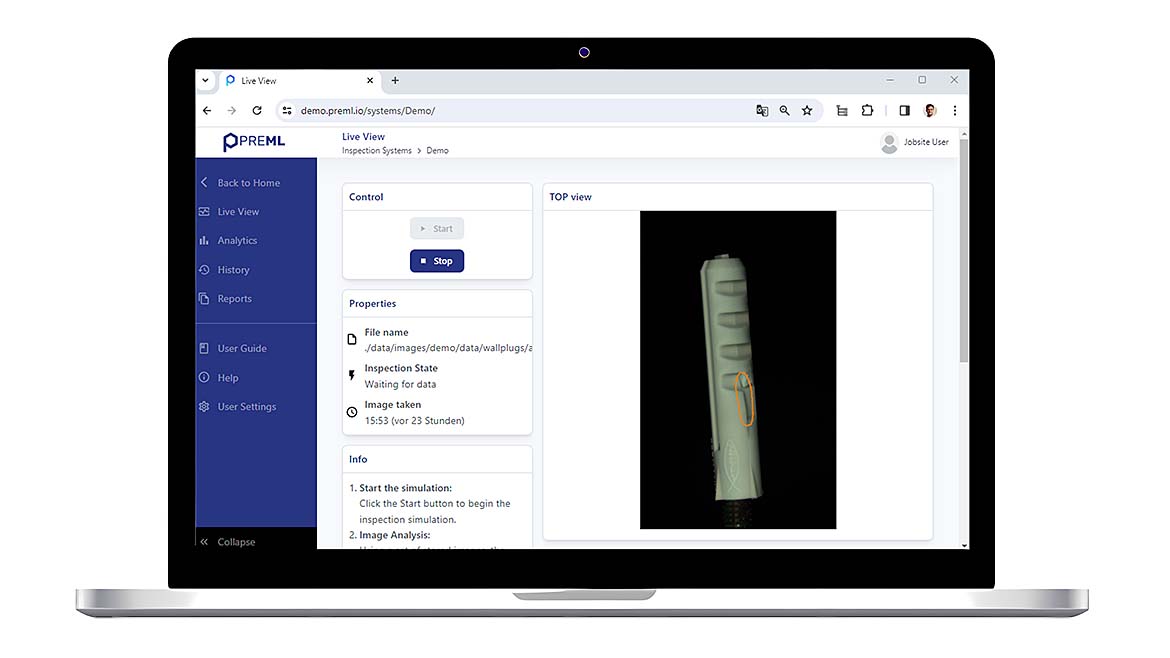
Source: IDS
This type of live feedback is particularly useful during changeovers or ramp‑up phases. Operators see right away whether the inspection model reacts as intended when a new product is introduced or when process parameters shift slightly. That shortens the path from trial to stable series production.
Plastic components: subtle differences that matter
Plastic parts are notoriously inconsistent. Flow lines shift with temperature, surfaces show unpredictable gloss, and tiny deformations can appear even when the tool is in good condition. For a rule‑based system, such variation is a constant source of false alarms.
AI inspection handles these changes with ease. With just a small set of example images, the system learns which variations are acceptable and which indicate a defect. That reduces unnecessary rejections and eliminates the cycle of retuning parameters. As one production manager put it, “Our parts never look exactly the same. A flexible inspection model helps us detect real defects without stopping to adjust settings for every batch.”
In practice, this means that minor differences in texture or gloss no longer cause recurring interruptions. Instead, the model learns the typical appearance range of a good part and reliably flags only those deviations that truly matter.
Electronics manufacturing: reliable presence verification despite manual assembly
Electronics production brings its own challenges. Hand placement of components means angles, reflections and positions vary slightly from one board to another. A rigid setup interprets these shifts as errors or needs constant adjustment.
In many electronics facilities, circuit boards are assembled in small and medium volumes, often under lean‑production principles. Assemblies can range from early prototypes to full series. Manual processes are followed by soldering steps and final inspection. Across all these stages, manufacturers aim to maintain a consistent high quality level and often insist on 100‑percent inspection for every board.
AI‑based inspection systems support this goal by focusing less on exact pixel‑perfect alignment and more on the characteristic features of each component. They can tolerate slight differences in orientation or reflection while still identifying missing, misplaced or incorrect parts. A production lead explained the impact clearly: “Every board we produce goes through a full 100 percent inspection. What matters is that the system recognizes components even when their position or surface appearance changes slightly.”
This adaptability is especially valuable in environments that span prototypes, pilot runs and full series production. Instead of building separate inspection logic for each product variant, the same platform can be extended and refined over time as new designs are introduced.
Quality control without in‑house vision experts
A recurring challenge in many plants is the availability of specialists. Classical machine vision projects often require expert knowledge to set up algorithms, choose features and tune thresholds. That expertise is costly and not always present on site.
AI‑driven systems combined with no‑code workflows change this dynamic. Quality engineers and production staff can create and adapt inspection models themselves. They upload sample images, define relevant regions and start the training process directly in a browser interface on the device. Models evaluate new samples in real time, and adjustments can be made quickly and iteratively.
A quality manager summed it up: “We used to call in a specialist each time we changed something. Now we adjust the models ourselves in just a few minutes.”
Reproducible conditions: the importance of a stable optical setup
AI models perform best when imaging conditions are consistent. Well‑designed inspection stations contribute to this stability. Uniform, diffuse lighting helps ensure consistent surface appearance, while a fixed overhead camera reduces variation caused by alignment or height differences. A rigid mechanical structure maintains stable geometry across shifts and operators.
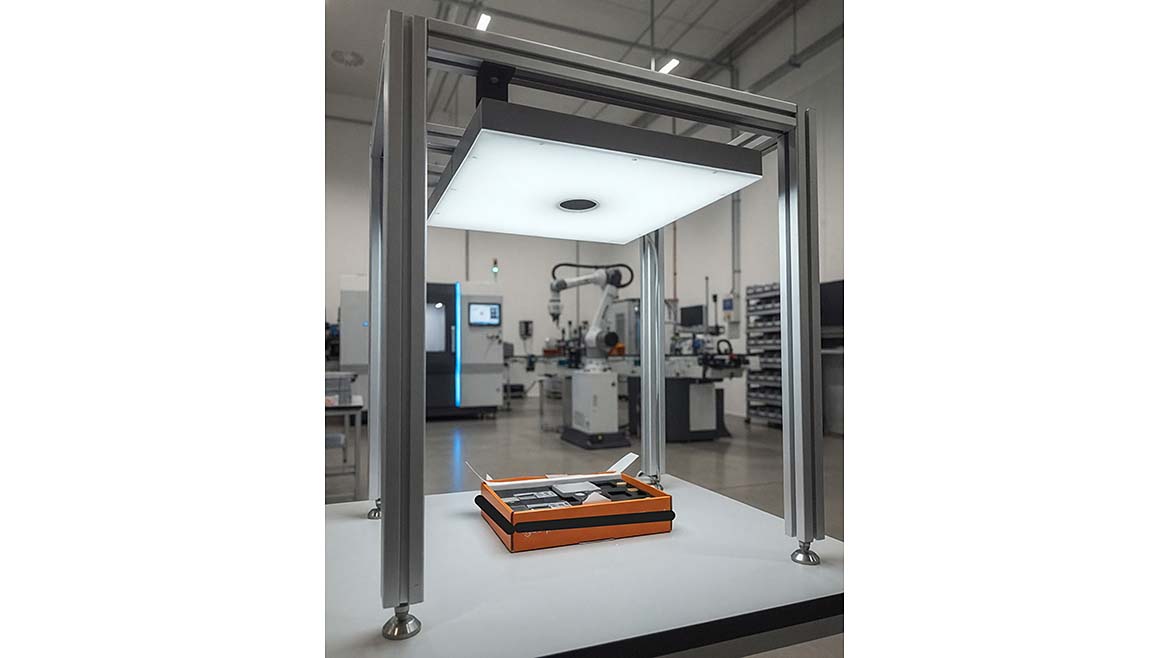
Source: IDS
Such setups provide the predictability required for reliable machine‑learning‑based evaluation and reduce dependence on precise mechanical positioning of each part. Even when surrounding conditions change, the inspection volume remains controlled and repeatable.
Industrial cameras as a critical component
At the heart of every AI inspection system is the camera. High‑resolution sensors capture fine structures that would otherwise go unnoticed: small scratches, minimal deviations in contour, subtle texture changes. A wide dynamic range preserves detail under challenging contrast, and autofocus ensures consistent sharpness even when object heights vary.
As one engineer explained, “The camera has to deliver stable images in every situation. Only then can the AI make reliable decisions.”
The flexibility to switch between macro lenses for detail and multiple cameras for multi‑side views makes these systems suitable for both simple and complex assemblies. Depending on the inspection task, users can combine overview images with close‑up views to capture both global context and fine details.
No‑code training: faster adaptation with less effort
Perhaps the most transformative change is usability. Operators can create and adapt inspection models without programming skills by uploading sample images, defining relevant regions and initiating training directly via a browser interface. Models evaluate new samples in real time, and adjustments can be made quickly.
In everyday use, this means that new product variants or changed process conditions do not automatically trigger a long project. Instead, teams extend existing models with new examples and verify the updated behavior within a short time frame. The system operates on a local edge device, so inspection runs without cloud access, provides low latency and integrates into existing factory networks.
Why flexible inspection is becoming the new standard
Manufacturers increasingly face more variants, shorter product cycles and more demanding quality requirements. AI‑based inspection systems meet these needs by:
- reducing setup effort
- stabilizing inspection processes
- giving quality teams more ownership and autonomy
Instead of enforcing ideal conditions, they work within the realities of industrial production.
Looking ahead: learning systems as part of the production flow
Visual inspection is evolving from a static checkpoint into an integrated element of the manufacturing process. Future systems are expected to interact more closely with robotics, evaluate data across production lines and continuously adapt to new defect patterns. In this context, inspection systems will not only identify quality issues but also contribute to preventing them.
Looking for a reprint of this article?
From high-res PDFs to custom plaques, order your copy today!