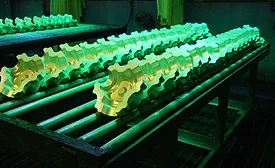
Nondestructive testing of large components can be time consuming and requires several people to work quickly to minimize the impact of testing on the large component manufacturing process.
The aerospace industry uses nondestructive testing (NDT) methods quite extensively. The structural integrity and safety of nearly all components, especially the most critical ones, needs to be validated and NDT plays a major role. NDT is required in virtually all areas of newly manufactured, serviced, repaired, or overhauled inspections.
Friction stir weld (FSW) inspections in aerospace manufacturing are challenging for ultrasound technicians not necessarily because they require specialized computations or complex techniques but because scanning with conventional probe setups can be so time consuming.
As nondestructive examination (NDE) continues to evolve as an inspection discipline, so the technologies of NDE evolve to meet new challenges in terms of materials and material geometries to be inspected.
Additive manufacturing (AM) is everywhere and anywhere nowadays. Every day technical websites, and even most social media sites, are posting cool videos and new applications.
Nondestructive Testing (NDT) is the name given to the processes designed to verify the integrity of a structure in such a way that the performance of that component is not impaired by the test.
According to ASTM E1316-17a and NET.net, a flaw is defined as ‘‘an imperfection or discontinuity that may be detectable by nondestructive testing and is not necessarily rejectable.”
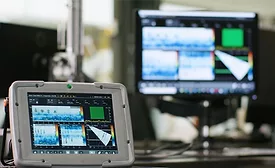
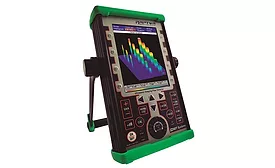
Portable phased array ultrasonic testing systems hit the market nearly 20 years ago, and today the latest generation of these tools delivers better amplitude resolution, faster data acquisition rates, and advanced data analysis in a single easy-to-handle package.
It’s an exciting time to work in ultrasonics. Phased array and other innovations in ultrasound have expanded its applications and uses, and with the advent of carbon fiber reinforced plastics (CFRPs) in aerospace, the need to nondestructively test critical parts for thickness and flaws continues to grow.