The global contribution of the automotive industry to the world economy is approximately $3.4 trillion (2021 – Mc Kinsey). Yet very little is communicated about the nondestructive testing (NDT) techniques used for industrial inspection to meet those often mutually opposed pressures of productivity and quality.
In the past, simple X-ray radiography was sufficient in providing an image needed for this inspection. However, because it views structures in 2D, simple radiography is limited in engineering applications as the objects become more complex. This is where computed tomography (CT) becomes valuable.
Air cooling is the most readily available means for keeping turbine blades from breaking or melting while the engine is running, and in order to get the most from the air streaming through the engine, turbine blades are cast with delicate cooling channels running through them. In the manufacturing process, though, these channels can become clogged. It's important that these defective blades be screened out as thoroughly as possible in quality assurance, and neutron radiography is the most effective nondestructive testing method for this purpose.
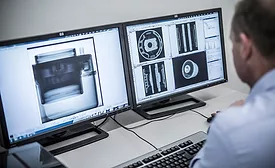
Digital radiography is the future. Read about the most common modalities, computed radiography (CR) and digital detector array (DDA) radiography, that are replacing traditional film-based inspections.
When Wilhelm Rontgen discovered X-rays in the 1890s, he almost immediately discovered the imaging applications of this hitherto-unknown type of radiation, and experts in the medical community and the industrial nondestructive testing community rapidly seized on the potential this new science of radiography offered.
Radiographic inspection is a critical practice across multiple industries, and the development of non-film radiography provides enormous, yet currently untapped, potential to share these images widely and maximize resources.
Radiographs have been interpreted since Wilhelm Conrad Roentgen first observed the X-ray of his wife’s hand back in 1896. The process of radiographic interpretation consists of many variables with the major objective being achieving the highest possible quality level or sensitivity.
As nondestructive examination (NDE) continues to evolve as an inspection discipline, so the technologies of NDE evolve to meet new challenges in terms of materials and material geometries to be inspected.