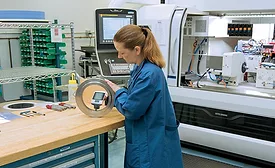
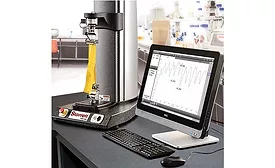
As part tolerances tighten, both form and surface finish have a bigger influence on the size and function of the product. And with pressures on manufacturing to be more productive, it is no longer viable for checks of surface or form to be performed on a measuring system in a quality room.
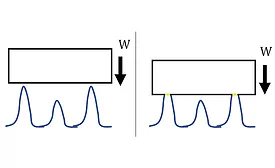
How does the surface texture affect the friction between two dry parallel sliding surfaces? It turns out that this problem has challenged some of the greatest minds in science and engineering.
Sir Isaac Newton’s three laws of motion, published in his thesis Philosophiæ Naturalis Principia Mathematica (Latin for Mathematical Principles of Natural Philosophy) in 1687, are what modern-day physicists and metrologists refer to when they describe force as any interaction that, if unopposed, will change the motion of an object.
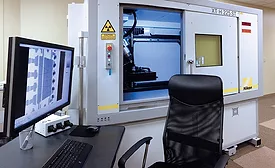
Walking the floor of the International Manufacturing Technology Show in Chicago—between the 100,000-plus attendees and the thousands of booths—it was impossible not to notice the ongoing trend towards speed and automation in every aspect of manufacturing. It’s no different in metrology, as more manufacturers look to automate their inspection processes.
Paul W. Critchley saw the power of lean as a plant manager at a growing medical device company. As the orders increased, every day the two-person shipping department struggled to make deadlines, getting in at 6:30 a.m. and rushing all day in order to make the UPS truck deadline at 5 p.m.
Interest in 3D printing is remaking the manufacturing landscape. Consulting firm IDC says global spending on 3D printers, both desktop and industrial, hit about $11 billion in 2015 and is forecast to reach $27 billion by 2019.
In the realm of coordinate measuring machines (CMMs), system accuracy is no longer the bottom line. Today’s manufacturers require faster measurement speeds in addition to highly accurate machines.
For more than 50 years, coordinate measuring machines (CMMs) have been improving measurement productivity and quality. The power of CMMs has made many complex inspection tasks seem almost trivial. With this much measurement capability, is it possible operators are taking their CMMs for granted?
 RSS
RSS