Check out the April 2026 edition of Quality! Read our cover story on The 2026 Quality Magazine Professional of the Year. Also in this issue: features on Air Gaging, Force and Torque Sensor Integration, Force Testing, and much more!
The idea of the ‘dark factory’ has gained new attention as advances in robotics and AI accelerate. Stories range from fully automated automotive plants that operate around the clock and lights-out facilities in China, to experiments with humanoid robots on production lines, often framed as early signs of factories that no longer require people on the shop floor.
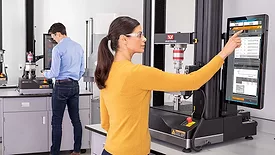
Force testing rarely draws attention until it fails. When components crack, seals leak, or devices do not activate as expected, engineers often trace the problem back to how force was applied, measured, or interpreted.
In many laboratories, confidence in physical testing is based on the assumption that results are consistent and that, if a method works once, it can be repeated. However, shifts in operator technique, environmental conditions, or instrument calibration can undermine that confidence.
Quality managers and engineers, like many other professionals, are often judged by what goes wrong. A product failure, a recall, or a customer complaint draws negative press, while processes that run smoothly can be taken for granted.
Air gaging has moved from the inspection bench to the factory floor, where manufacturers are connecting decades-old measurement physics to modern data systems and inline process control.
Instead of waiting until the end of production to confirm size, quality teams increasingly collect dimensional data during machining and finishing operations.
My career started with the early days of the semiconductor industry, and a few years later techies started dreaming of large-scale semiconductor memory.
In laboratories, manufacturing plants, hospitals, testing facilities, and certification bodies around the world, quality systems are quietly losing their soul.
I felt it might be of interest to continue the discussion from my previous column on organizational culture. It is not easy for some organizations to convert to a culture that is truly focused on establishing a robust culture of quality.
We all have likes and dislikes. When I was young, I liked to wear sneakers and play; what kid didn’t? Sunday mornings were the worst; not only did attending church cut into playtime, but I had to dress up and wear shoes.
You see it a lot with e-commerce. Online shopping is said to offer an advantage. An array of “reviews” posted by other shoppers of the product you are considering. Amazon and others have converted these comments on the worthiness of a product into tools that help browsers decide if they want to become purchasers.