Measurement
Understanding the Functions of Measurement Traceability for Coordinating Metrological Confirmation
Establishing that a reference standard accuracy is traceable to a higher standard gives credibility to the calibration performed.

Measurement which forms the essence of metrology is fundamental to science and technology, vital to safety and health and essential to trade. It underwrites all endeavors in realization of quality, competitiveness and optimization of resources. For this reason, measurement traceability has the capability and application to trace and verify by means of documented calibration. Metrological traceability is a declaration with respect to which national standards certain instruments have been compared with through an unbroken chain of comparisons or calibration, all having stated uncertainties. However, the accuracy, specification and regulations of reference standards must be traced to a higher standard. Accuracy is of prime importance to measurement therefore metrological traceability ensures that different measurement methods and instruments used in different countries at different times produce reliable, repeatable, reproducible, compatible and comparable measurement results.
This paper highlights that measurement traceability plays an important role in metrology and industry and presents concrete foundation of measurement traceability for coordinating metrological confirmation. The focus of the paper is on the improved effectiveness of metrological traceability when used as the foundation for establishing National Metrology Institute (NMI) as well as on the improved accuracy and efficiency of measurement systems. Establishing and understanding the functions of metrological traceability is essential to maintain the reliability of calibration in which a reference standard is calibrated by a higher reference standard. Establishing that a reference standard accuracy is traceable to a higher standard gives credibility to the calibration performed. The economic impact of measurement traceability is it can increase the productivity of organization by reducing waste, ensures open and fair markets and supports precision in measurements. There is also a full national benefit for commodity exports and support of global trade in measuring systems.
Literature Review
“Quality,” as defined by the American Society of Quality, represents the “totality of features and characteristics of a product or service that bears on its ability to satisfy stated or implied needs.” This definition emphasizes the need for goods and services to holistically address societal needs, which in effect illuminates both research and practice on the relevance of this knowledge area and the need for further study in order to come up with more theories and frameworks to address societal demands and human needs.
The calibration requirements and the traceability define the quality of the measurements. The metrological function is responsible for the management of the quality of the measurements. This has to be taken into consideration from the beginning of the process that leads to the selection of the method of measurement, and then the means of measurement.
Objectives
The objectives of this paper are:
- To ensure the validity and accuracy of all measurement devices which are used for calibration and are traceable to international system of unit (SI)
- Identify where metrological traceability is relevant in laboratories, and
- Describe the assessment of metrological traceability in calibration processes
- Describe the role played by national metrology institute (NMI) in establishing metrological traceability.
Discussion/Analysis
Metrological traceability ensures that the measurements are accurate representations of the specific quantity subject to measurement, within the uncertainty of the measurement. The ability to produce equivalent measurement results for the same measurand from a variety of measurement procedures is dependent on traceability to a reference that expresses results to a measurement unit of the International System of Units (SI). Ensuring metrological traceability allows laboratories to confirm the comparability of results, which enables the establishment of common reference intervals. In addition, it is important to recognize that many National Metrology Institutes (NMIs) or other laboratories at a national level designated for a particular field of measurement expertise participate regularly in comparisons, usually between each other. This is necessary in order to demonstrate the international comparability and accuracy of the national standards they maintain.
Equipment and reference standards must be calibrated by a National Metrology Institute (NMI) or an accredited calibration laboratory whose service is covered by the CIPM Mutual Recognition Arrangement (CIPM MRA). Although metrological traceability plays a critical role in achieving harmonized laboratory results, it is not sufficient in producing reliable results. There are other factors such as quality assurance and quality control measures that need to be in place to ensure the measurement process is stable and in control. Qualified staff, proper maintenance of equipment and reagents, use of document-controlled measurement procedures, and monitoring quality control results all play an important role in creating a stable measurement process.
What Must A Laboratory Do to Ensure Metrological Traceability?
Use higher order reference standards available for calibrators. All reference standards must be calibrated by an NMI or an accredited calibration laboratory and covered by the CIPM MRA that includes the range and uncertainty.

Calibration/Metrological Traceability Chain in Practice:
In calibration, the metrological traceability is a fundamental consideration. The metrological traceability in calibration can be presented as a pyramid. The pyramid illustrates how the different levels in the traceability are located. As all your industry and testing laboratories are located in the lowest level, their traceability is dependent on all the levels above the industry and testing laboratories.
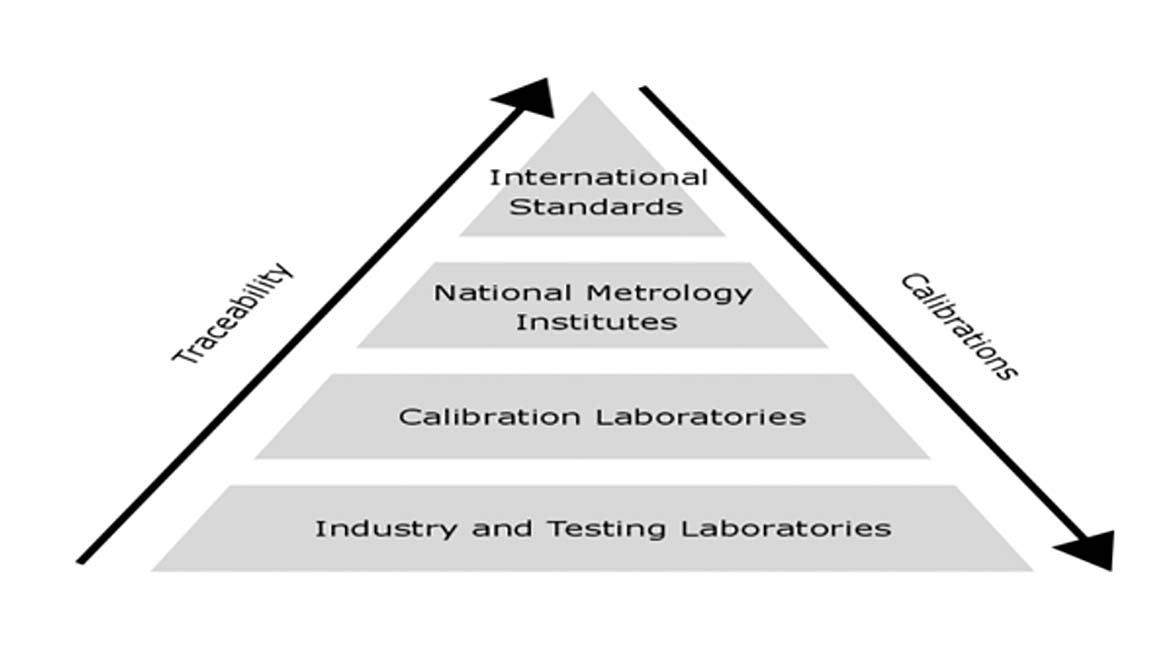
If the calibrations you perform in your laboratory are not traceable, you do not know if they are correct or not and therefore, there is really no point in doing them. All the calibrations in the traceability chain have to be done at regular intervals. It is not enough that you once have had your reference standard calibrated and then you continue using it for years without re-calibrations. The calibration of any measurement device only remains valid for a stated period of time. Therefore, the traceability expires when the calibration expires.
Traceability to SI-units can be achieved in different ways:
- Use of a calibration laboratory, which itself is accredited or bound into an international mutual recognition system, which establishes recognition by performance checks, and therefore guarantees traceability of its services to SI-units.
- Using calibration standards, which are calibrated either through an accredited calibration laboratory or through a documented and unbroken chain of comparisons linking the standard to relevant primary standards of the SI units of measurements.
- Directly comparing the calibration standard with a primary standard of the SI units of measurement realized either nationally or internationally.
The purpose of the metrological traceability to the SI is to make sure that a measurement result obtained at one point on the globe is unquestionably comparable to another measurement result obtained in the same conditions at another geographic location. The organization of metrology at national and international levels is intended to guarantee consistency between the standards of the different nations and to ensure that the deviations which occur are not significant at the level of the measurements made in the firm.
Economic Benefits
The economic impact of measurement traceability is that it can increase the productivity of organization by reducing waste, ensure open and fair markets and support precision in measurements. There is also a full national benefit for commodity exports and support of global trade in measuring systems.
Metrology standards and the traceability of measurement to those standards provide the basis for fair and accurate trade, optimization of production, consumer and business confidence in products. Accurate measurement and regulation of water, fuel, food and electricity are critical for consumer protection and promote the flow of goods and services between trading partners.
Conclusion & Recommendation
An error made on a standard can have more serious consequences, which can translate onto a measuring instrument. To select a standard, you have to take metrological, technical and economic aspects into account. Consequently, the metrological function will be responsible for the metrological confirmation of the measuring equipment. Metrological confirmation generally includes calibration and verification, any necessary adjustment or repair, subsequent recalibration, comparison with the metrological requirement for the intended use of the equipment. Therefore, there is a need for Governments to have a national metrology institute (NMI) to develop and maintain national measurement standards.
Governments should also set a clear policy direction and demonstrate support and commitment to metrological infrastructure. The policy document should be published and communicated as appropriate to all sectors of the economy and the general public. It should state the government commitment and set out an approach to managing metrological infrastructure. To participate in global trade, governments must develop the capacity to meet international standards.
In order to be metrologically traceable, every calibration has to include:
- Calibration certificate
- Indication of the reference used and its traceability
- Whether calibration is performed according to documented procedures.
- An unbroken chain of calibrations
- Known measurement uncertainty
References:
Bell, S. (2001), Measurement Good Practice Guide No. 11 (Issue 2): A Beginners Guide to Uncertainty of Measurement
BIPM (2006), The International System of Units (SI), Eighth Edition
BIPM (2008), International vocabulary of metrology – Basic and general concepts and associated terms
EURAMET (2008), Metrology – in short
ISO/IEC Guide 99:2007, International Vocabulary of Metrology
ILAC P10:01/2013-ILAC Policy on the Traceability of measurement Results
ISO/IEC 17025:2017 “General Requirement for the Competence of Testing and Calibration laboratories”
ISO 10012 (2003) Measurement management systems – Requirements for measurement processes and measuring equipment
JCGM 200:2012, International Vocabulary of Metrology – Basic and general concepts and associated terms (VIM) 3rd edition
Metrology, F. C. (2006). Metrology in Industry. Newport Beach: ISTE Ltd.
Placko, D. (2006). Metrology in Industry. London: ISTE Ltd.
Swanepoel, K. R. (2015). The economics of metrology. Canberra: Economic and Analytical Services Division.
Looking for a reprint of this article?
From high-res PDFs to custom plaques, order your copy today!