Machine Vision
Line Confocal Imaging is the New MedTech Standard
The adoption of coaxial line confocal technology is more than just a technical upgrade; it’s a commitment to patient safety.

If you’ve ever had a vaccine or a routine blood draw and didn’t even feel the “pinch,” congratulations, you’ve been a silent witness to a manufacturing miracle.
We rarely give much thought to the engineering of a medical needle, and that’s exactly how it should be. In the world of medical devices, lack of consideration is the ultimate hallmark of success. When a needle is produced to exact specifications, the patient experience is seamless. But that “seamlessness” is surprisingly fragile. It depends entirely on a piece of polished stainless steel with a microscopic, consistent edge.
In the high-stakes world of MedTech, a needle isn’t just a commodity; it’s a high-precision instrument. A single microscopic metal burr or a bevel angle that’s just a few degrees off can transform a standard procedure into a painful or even dangerous experience. For quality engineers, the mandate is clear: ensure every single unit is perfect. However, measuring these things has historically been a nightmare. Between highly reflective surfaces and steep, recessed angles, these parts are the optical equivalent of a hall of mirrors.
To keep up, the industry is undergoing a fundamental shift. We’re moving away from the “test and hope” methods of the past and toward Coaxial Line Confocal Imaging (LCI), a technology that is turning “impossible” geometries into actionable, 100% inline data.
When Lasers Have a Bad Hair Day: The Triangulation Problem
To understand why LCI is such a gamechanger, we first must look at why traditional 3D sensors often struggle at the “business end” of a needle. For a long time, the gold standard was laser triangulation.
In a standard triangulation setup, a laser emits a line to a part, and a camera views that line from an angle. By measuring the “offset” of the line, the system calculates height. It’s a workhorse for inspecting car bumpers or wooden 2x4s, but when you throw a shiny, steep medical needle in front of it, things get messy.
There are three primary reasons why triangulation often meets its match in the cleanroom:
1. The Mirror Effect (Specularity)
MedTech components are often made of highly polished metal or glass. These surfaces act like mirrors. When a standard laser hits them at an angle, the light doesn’t scatter back to the sensor nicely; it bounces away like a billiard ball hitting a rail. This creates blinding reflections or “washouts” that leave the sensor seeing nothing but white noise. In a 3D point cloud, these manifest as “holes”; essentially, the sensor is blind to the very surface it’s supposed to be measuring.
2. The Shadow Problem
Because triangulation sensors have to “look” at an angle, they inherently create shadows. If you’re trying to inspect the bottom of a deep, narrow needle bevel, the “view” is often blocked by the needle’s own wall. If the light can’t reach the bottom of the bevel, you can’t see defects like “core-outs” (tiny fragments of metal) or dull tips. You’re essentially trying to check the bottom of a well by standing ten feet back and using a flashlight.
3. The Detail Gap
We are now living in a sub-micron world. Detecting a microscopic fragment requires a lateral resolution of 1.9 μm. Most standard sensors can’t reach that level of detail without slowing down the production line to a crawl. In MedTech, you shouldn’t have to choose between “fast” and “perfect.”
The “Headlamp” Solution: Enter Coaxial LCI
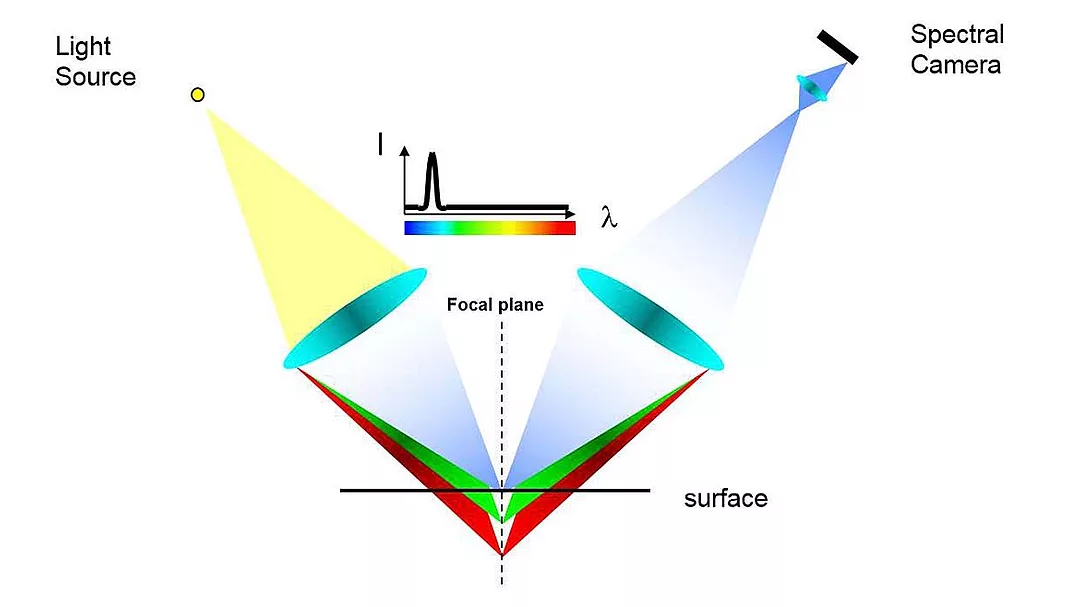
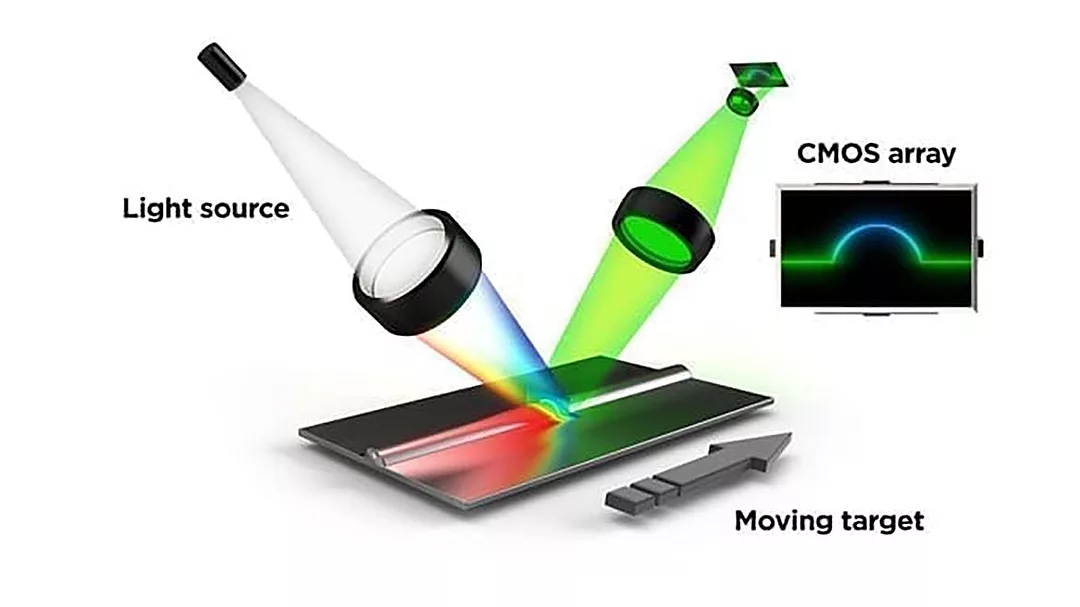
The fix for these “impossible” geometries comes down to a fundamental shift in how we play with light. Line Confocal Imaging (LCI) ditches the “angled” triangulation approach and uses a coaxial optical path.
Think of it this way: If you’re trying to see into a deep crevice with a flashlight held at your side, you get shadows. But if you wear a headlamp that’s perfectly aligned with your eyes, the shadows disappear because your light source and your line of sight are the same.
Because an LCI sensor “looks” straight down into those steep geometries, it can handle slope angles of up to ±85°. This means the sharpest needle points and deepest bevels are captured in full 3D detail, without the data dropouts that usually plague the process.
Exploiting the Rainbow: Chromatic Aberration
LCI technology also uses a clever bit of physics called chromatic aberration. In a cheap pair of binoculars, chromatic aberration is a “bug”; it’s that annoying rainbow fringe you see around objects. But in LCI, we’ve turned it into a “feature.”
The sensor splits white light into a spectrum of colors, where each color (wavelength) focuses at a different distance from the lens.
- Wavelength Mapping: The sensor’s internal optics map specific colors to specific distances.
- Filtering the Noise: Using a physical pinhole (the “confocal” part of the name), the sensor only “sees” the light that is perfectly in focus. This filters out all those annoying reflections from polished metal.
- The X-Ray Vision Factor: Because different colors focus at different depths, the sensor can actually “see through” transparent materials. It can simultaneously measure the top and bottom surfaces and the wall thickness of a glass syringe.
Beyond the Needle: A MedTech Tour
While needles are the most dramatic example of geometric complexity, LCI is solving “unsolvable” problems across the entire medical landscape.
The Glass Syringe Evolution
As we move toward biologics, glass syringes are becoming more common. But glass brings its own set of headaches, like “flaking” or delamination. Because LCI can measure through transparent layers, it can assess silicone oil distribution within a syringe or detect thinning in the glass wall that could lead to breakage.
Cardiovascular Stents
A stent is essentially a tiny, microscopic metal cage. Any burr or irregularity on that cage can cause a life-threatening clot once it’s implanted. By using LCI sensors that scan up to 34 kHz, manufacturers can inspect every strut in that mesh for defects without slowing down the assembly line.
The “Smart” Wearable Explosion
From insulin pumps to heart monitors, medical devices are getting smaller and “smarter.” This means they’re packed with microelectronics that require hermetic sealing. LCI provides the sub-micron precision needed to inspect solder paste and wire bonds, ensuring these devices don’t fail when a patient needs them most.
The Death of the “Statistical Shrug”
Historically, the medical device industry has relied on sampling. Because traditional metrology was so slow, you’d pull a few parts off the line, take them to a cleanroom, and if they passed, you’d assume the other million units were fine.
In a high-litigation, high-stakes environment, that “statistical shrug” isn’t good enough anymore. LCI is enabling 100% inline inspection. This enables the creation of a digital twin for every part.
- Traceability: Every serial number is now linked to a 3D scan.
- Root-Cause Analysis: If a recall happens, you don’t have to guess what went wrong. You can go back and look at the exact 3D data for that specific unit.
- Regulatory Peace of Mind: Bodies like the FDA are increasingly looking for “Quality by Design.” Having a 3D record of every part isn’t just a “nice-to-have” anymore; it’s becoming the expected standard.
The Economics of Perfection
I know what you’re thinking: “This sounds expensive.” And sure, high-end metrology has an upfront cost. But the ROI is found in the “hidden” costs of manufacturing.
Think about the cost of scrap. If a grinding machine drifts out of tolerance at 8 a.m. and you don’t catch it until a manual check at noon, you’ve just made four hours of expensive trash. With 100% inline inspection, you catch that drift in real-time and stop the line immediately. Add to that the mitigation of liability, and the cost of a single recall can reach hundreds of millions of dollars, and suddenly, “perfect” starts to look like the most cost-effective option on the table.
Conclusion: Fulfilling the Promise
At the end of the day, those of us in the medical sector aren’t just making parts; we’re fulfilling a promise. When a doctor reaches for a tool or a patient uses a wearable, they are trusting that the device will perform exactly as intended.
The adoption of coaxial line confocal technology is more than just a technical upgrade; it’s a commitment to patient safety. By using the physics of light to overcome the “nightmare” of complex geometry, we can finally move past “acceptable failure rates.” We can finally ensure that the perfection patients expect is the perfection engineers can guarantee.
Looking for a reprint of this article?
From high-res PDFs to custom plaques, order your copy today!