Test & Inspection
Handheld Gaging Adapts to a More Connected, Hybrid Inspection Process
Handheld inspection remains part of daily work as teams connect more processes and shift responsibilities.
.webp?t=1770832317)
The KSCAN-E is an intelligent, wireless, and all-in-one 3D scanner.
Manufacturing teams continue to use handheld gages during daily quality work, even as they expand their automated inspection systems and adopt more software-driven processes. Engineers rely on these tools for flexibility during early builds, troubleshooting and dimensional checks that do not justify a fixed station. As factories add more digital infrastructure, suppliers are adjusting handheld gage design to support clearer data transfer, easier operation and inspection routines that combine manual and automated steps.
Handheld tools as part of connected data flow
Many manufacturers are looking for ways to move measurement data into their quality software without manual entry. Suppliers are responding with interfaces that allow handheld tools to communicate directly with programs such as Microsoft Excel or statistical process control (SPC) platforms.
Michal Grosenbach, product manager at Mitutoyo America Corp., said the company offers output formats that can send measurements from a hand tool into software systems. He described a bidirectional serial interface, which allows direct communication between a gage and data programs, including Excel or SPC tools.
Paul Zhang, senior director of overseas business at ScanTech, said wireless connectivity also plays a growing role in moving inspection data. He said wireless communication and standard application programming interfaces allow measurement values to flow into manufacturing execution software, product lifecycle management platforms and SPC systems. According to Zhang, this helps teams avoid storing information in local spreadsheets and gives them access to real-time results rather than historical summaries.
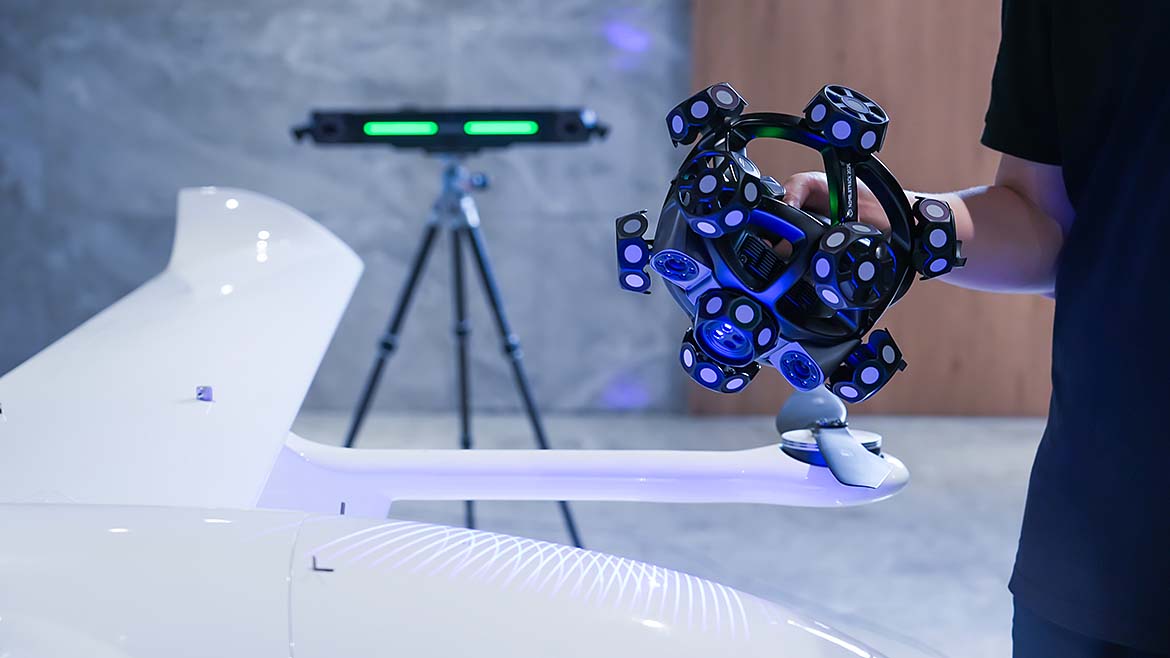
Image Source: ScanTech
Support for inspection work that changes throughout the day
Even as manufacturers automate more of their inspection processes, engineers still turn to handheld tools whenever inspection needs shift quickly. These situations often involve engineering changes, prototypes, or unexpected questions during production.
Zhang said modern handheld scanners help teams respond to these situations because operators can use them anywhere on the shop floor. He said many systems now include onboard computing, wireless operation and guidance features such as augmented reality and artificial intelligence. These can display scan paths or tolerance information directly on the part, which helps operators complete inspections more consistently.
For threaded components, many companies continue to use contact gages. Jack Wickham, founder of New Vista Corp., said hand-applied Go and No Go gages remain the accepted tools for checking pitch diameter and thread depth. Wickham said customers began requesting numerical thread-depth values in addition to minimum-depth confirmation, so the company designed machines that can capture this information while still using standard hand gages.
Features that reduce operator error and training time
As manufacturers hire workers with varying levels of inspection experience, many want handheld tools that are easier to read and operate.
Many supervisors are looking for handheld tools that help newer operators work consistently, and suppliers are responding by focusing on clarity and ease of use. Experts say that many companies want displays that show tolerance status in a direct, unambiguous way, moving toward handheld indicators that provide simple visual cues or step-guided prompts. These features reduce the amount of interpretation required during inspection.

Image Source: ScanTech
Zhang said scanning tools follow a similar pattern. He described systems that guide operators through each action, automatically select some parameters and check whether any steps were missed. These approaches help teams shorten training time and improve consistency across shifts.
Wickham said ease of use has also influenced the design of New Vista machines. Many customers report difficulty finding experienced operators and maintenance staff, so his team builds systems that run for long periods without downtime and can be maintained by mechanics who are unfamiliar with the equipment. He said the company redesigned its machines so “ordinary people with little prior training” can operate them reliably.
Materials and sensing improvements that support stability
Suppliers continue to refine the materials and sensors used in handheld gages. Some organizations use lightweight carbon fiber on large calipers to reduce operator fatigue, or ceramic components for wear resistance and high-grade steel for dimensional and thermal stability.
Some tools include calibration-due reminders. Certain indicators, height gages and micrometers now display calibration information, so operators know when an instrument needs service.
Zhang said many improvements in scanning systems come from software rather than hardware. Artificial intelligence algorithms can compensate for vibration, temperature drift or operator movement, which helps maintain accuracy in variable conditions.
Touchscreen interfaces that mirror everyday consumer technology
Some metrology suppliers are also applying newer interface technology to portable inspection tools, drawing on the same touch controls manufacturers use in other shop-floor equipment. Touchscreen interfaces first appeared on surface and form systems decades ago, but they are now common on portable roughness gages, digital indicators and height gages used on the shop floor. These displays replace dedicated buttons and allow operators to navigate measurements the way they would navigate a smartphone or tablet. An earlier article in Quality shows that this approach reduces mechanical wear, offers better protection against coolants and oils and allows measuring routines, cutoffs or filter settings to be selected with simple on-screen prompts. Touch interfaces also support customization, such as displaying only the parameters an operator needs or rotating the screen for better viewing angles during machining. These changes mirror broader usability trends across gaging tools as manufacturers look for ways to help operators complete measurements with less training and fewer chances for error.
Calibration safeguards in handheld tools
Some suppliers are also adding safeguards meant to help manufacturers avoid using out-of-tolerance handheld instruments. Ken Myers, solutions manager at Mitutoyo America, said some newer handheld digital indicators allow users to program a calibration expiration date into the device. When that date arrives, the indicator disables itself until it is recalibrated, which prevents operators from collecting measurements with an expired tool.
How handheld tools fit into hybrid inspection systems
Many manufacturers now use a mix of automated and manual inspection. Engineers rely on automated stations for consistent measurements on stable parts, but they turn to handheld tools for verification, troubleshooting and checks that require flexibility.
Experts say that some manufacturers mount handheld tools into automated fixtures so software can poll or operate the instrument. This allows engineers to use contact gaging while still capturing digital data within their automated workflows.
Zhang said handheld tools also support closed-loop quality processes. Because many systems now share data across platforms, measurements from handheld scanners can contribute to machine adjustments or help engineering teams evaluate design questions.
Manufacturing teams continue to rely on handheld gages because they need flexible tools that can support early builds, respond to unexpected issues and provide quick verification. At the same time, suppliers are updating these instruments so they can support digital workflows, real-time data needs and operators with varied experience levels.
As manufacturers adopt more automation, handheld gages remain part of daily inspection work.
Fact Box: Handheld Gaging & Measurement Trends
- Wireless data transmission for handheld measuring tools is gaining traction. One expert notes that “wireless precision gages” let any gage, including calipers, micrometers and height gages, transfer data straight to statistical process control (SPC) systems.
- The broader market for handheld gauges used in material-testing applications is projected to expand from about USD 150 million to USD 200 million between 2024–2031, a compound annual growth rate around 3 %, according to HTF Market Insights.
- The shift toward hybrid inspection workflows — which includes both manual and automated approaches — means handheld tools are being repurposed. For example, measurement devices now often feed data directly into quality-monitoring software, reducing transcription and data-entry steps.
Looking for a reprint of this article?
From high-res PDFs to custom plaques, order your copy today!